The craps house edge ranges from 0% on free odds to more than 16% on certain one-roll proposition bets. Pass Line, Don’t Pass, Come, Don’t Come, and Place 6 or 8 offer the strongest standard returns, while Any 7, horn bets, hardways, and most center-table bets cost substantially more over time.
The most important facts are:
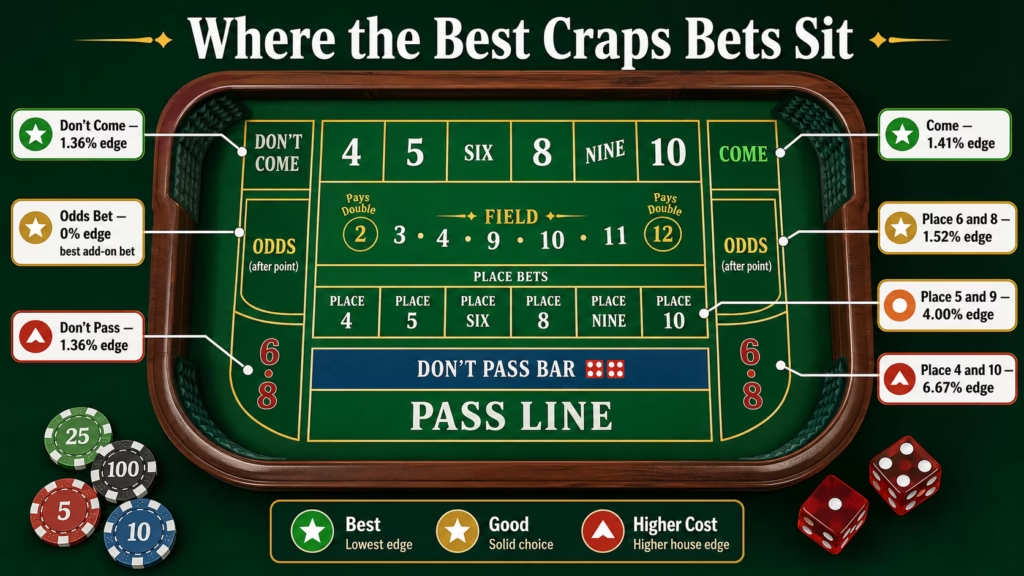
- Pass Line has a house edge of about 1.41% and a theoretical RTP of 98.59%.
- Don’t Pass has a slightly lower house edge of about 1.36%.
- Free odds have no built-in house edge, but they can only be added to an established line bet.
- Place 6 and Place 8 have a competitive 1.52% house edge.
- Any 7 has a 16.67% house edge, making it one of the most expensive common craps bets.
These percentages describe long-term mathematical expectations. Craps RTP does not predict what will happen during a particular roll, session, or visit to a casino.
Craps House Edge and RTP Table
The following table covers the standard payouts used at many craps tables. Individual casinos may use different Field payouts, commission rules, side-bet paytables, or minimum bet increments.
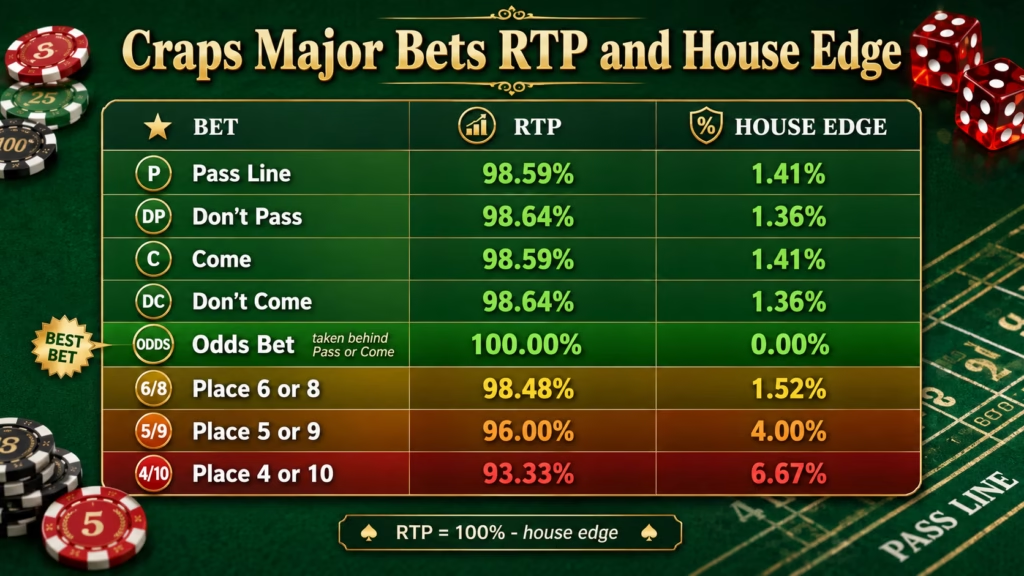
| Craps bet | Common payout | House edge | Theoretical RTP |
| Pass Line | 1:1 | 1.41% | 98.59% |
| Don’t Pass | 1:1 | 1.36% | 98.64% |
| Come | 1:1 | 1.41% | 98.59% |
| Don’t Come | 1:1 | 1.36% | 98.64% |
| Free Odds | True odds | 0.00% | 100.00% |
| Place 4 or 10 | 9:5 | 6.67% | 93.33% |
| Place 5 or 9 | 7:5 | 4.00% | 96.00% |
| Place 6 or 8 | 7:6 | 1.52% | 98.48% |
| Buy 4 or 10, vig on win | 2:1 minus commission | About 1.67% | About 98.33% |
| Buy 5 or 9, vig on win | 3:2 minus commission | About 2.00% | About 98.00% |
| Buy 6 or 8, vig on win | 6:5 minus commission | About 2.27% | About 97.73% |
| Big 6 or Big 8 | 1:1 | 9.09% | 90.91% |
| Field, 2 and 12 pay 2:1 | Varies | 5.56% | 94.44% |
| Field, 2 pays 2:1 and 12 pays 3:1 | Varies | 2.78% | 97.22% |
| Hard 4 or Hard 10 | 7:1 | 11.11% | 88.89% |
| Hard 6 or Hard 8 | 9:1 | 9.09% | 90.91% |
| Any 7 | 4:1 | 16.67% | 83.33% |
| Any Craps | 7:1 | 11.11% | 88.89% |
| Craps 2 or Craps 12 | 30:1 | 13.89% | 86.11% |
| Craps 3 or Yo 11 | 15:1 | 11.11% | 88.89% |
| Horn bet | Combined proposition bet | About 12.50% | About 87.50% |
RTP is calculated as 100% minus the house edge. For example, a 1.41% house edge corresponds to a theoretical RTP of approximately 98.59%.
What Is the House Edge in Craps?
The craps house edge is the average percentage of each wager that the casino expects to retain over a very large number of resolved bets. A 1.41% edge does not mean the casino takes 1.41% from every individual wager. It means that the average expected loss is approximately $1.41 for every $100 wagered under the same rules over the long term.
Short-term results can differ sharply from the mathematical expectation. A player can win several Pass Line decisions in a row or lose immediately on repeated come-out rolls. The house edge becomes meaningful across a large number of wagers, not as a prediction for one session.
What Does Craps RTP Mean?
Craps RTP is the theoretical percentage of wagered money returned to players over the long term. A bet with 98.59% RTP has an expected long-term loss of 1.41% before considering comps, promotions, tipping, or other costs.
Craps RTP by bet should not be treated like a guaranteed refund. A 98.59% RTP does not mean that a player who wagers $100 will finish with $98.59. The entire $100 can be lost, doubled, or changed by any number of short-term outcomes.
Pass Line and Come Bet House Edge
The Pass Line has a house edge of approximately 1.41%. The bet wins immediately when the come-out roll is 7 or 11 and loses immediately on 2, 3, or 12. Any other total establishes a point, after which the bet wins if the point repeats before a 7.
The Come bet uses the same mathematical structure as the Pass Line after it is placed. Come bets are commonly used to establish additional numbers while a shooter continues rolling.
Pass Line and Come bets suit players who want simple rules, a low house edge, and the ability to add odds after a point is established. The main practical risk is that several Come bets can remain active simultaneously, increasing the total amount exposed on the table.
Don’t Pass and Don’t Come House Edge
The Don’t Pass bet has a house edge of approximately 1.36%, which is slightly lower than the Pass Line edge. On the come-out roll, Don’t Pass normally wins on 2 or 3, loses on 7 or 11, and pushes on 12. Some tables use a different barred number, so the layout should be checked before betting.
Don’t Come follows the same general rules after the bet is placed. Once a point is established, these bets win when a 7 appears before the selected number repeats.
The mathematical difference between Pass and Don’t Pass is small. Choosing Don’t Pass does not create a reliable winning strategy, and short-term variance can easily overwhelm the difference between 1.36% and 1.41%.
Free Odds and Combined House Edge
Free odds have a 0% house edge because they are paid at the true mathematical odds of rolling the point before a 7. The payout is normally:
- 2:1 on points 4 and 10
- 3:2 on points 5 and 9
- 6:5 on points 6 and 8
An odds bet cannot normally be made by itself. It must be attached to a Pass Line, Don’t Pass, Come, or Don’t Come bet after a point has been established.
Adding odds reduces the average house edge relative to the total amount wagered. For example, a Pass Line bet with standard 3x, 4x, and 5x odds has an effective combined edge of roughly 0.37% when the calculation includes both the base bet and the average odds exposure. The corresponding Don’t Pass structure is approximately 0.27%.
Free odds improve the mathematical value of the total wager, but they also place more money at risk. A lower percentage disadvantage does not automatically make a larger total bet appropriate for a limited bankroll.
Place Bet House Edge
Place 6 and Place 8 have a house edge of approximately 1.52%, making them the strongest standard Place bets. They pay 7:6 and remain active until the selected number or a 7 is rolled, unless the player takes them down.
Place 5 and Place 9 have a 4.00% house edge and pay 7:5. Place 4 and Place 10 have a 6.67% house edge and pay 9:5.
The difference matters because the casino does not pay Place 4 and Place 10 at their true 2:1 odds. Players interested in 4 or 10 should compare the Place payout with the table’s Buy bet commission rules.
Bet sizing also matters. Place 6 and Place 8 are normally made in multiples of $6, while Place 5, Place 9, Place 4, and Place 10 are commonly made in multiples of $5. Incorrect increments can lead to rounded payouts.
Buy Bet House Edge
Buy bets pay true odds but charge a commission known as the vig. A Buy 4 or Buy 10 can be substantially better than placing the same number when the commission is collected only after a win.
With a standard 5% commission charged only on winning bets, the approximate house edges are:
| Buy number | House edge | RTP |
| Buy 4 or 10 | 1.67% | 98.33% |
| Buy 5 or 9 | 2.00% | 98.00% |
| Buy 6 or 8 | 2.27% | 97.73% |
When the commission is collected upfront, the house edge can be approximately 4.76%. Commission rounding can make small Buy bets more expensive than the headline percentage suggests. Players should check when the vig is charged, how it is rounded, and whether it is returned when the bet is removed.
Lay Bet House Edge
Lay bets are the opposite of Buy bets. The player bets that a 7 will appear before a selected number and must risk more than the potential win.
When a 5% commission is collected only after a winning Lay bet, the approximate house edges are:
| Lay number | House edge | RTP |
| Lay 4 or 10 | 1.67% | 98.33% |
| Lay 5 or 9 | 2.00% | 98.00% |
| Lay 6 or 8 | 2.27% | 97.73% |
When the commission is collected upfront, the approximate edge may rise to 2.44% on 4 or 10, 3.23% on 5 or 9, and 4.00% on 6 or 8. Exact costs depend on the table’s commission and rounding procedures.
Field Bet House Edge
The Field is a one-roll bet that normally wins on 2, 3, 4, 9, 10, 11, or 12 and loses on 5, 6, 7, or 8. Its value depends heavily on the special payouts for 2 and 12.
When both 2 and 12 pay 2:1, the Field has a 5.56% house edge. When one pays 2:1 and the other pays 3:1, the edge falls to 2.78%.
The Field can produce frequent decisions because every roll settles the bet. Even with a reasonable paytable, repeated one-roll wagering can create more expected loss per hour than a slower multi-roll bet with a similar nominal edge.
Hardways, Big 6 and Big 8
Hardways win when a number is rolled as a matching pair before either a 7 or the same number appears the easy way. Hard 6, for example, wins on 3-3 but loses on 1-5, 2-4, 4-2, 5-1, or any 7.
Hard 6 and Hard 8 have a 9.09% house edge. Hard 4 and Hard 10 have an 11.11% edge. These bets offer larger displayed payouts, but their RTP is considerably lower than Pass Line, Don’t Pass, or Place 6 and 8.
Big 6 and Big 8 also have a 9.09% house edge because they pay only even money. A standard Place 6 or Place 8 pays 7:6 for essentially the same winning condition, making the Place version mathematically stronger.
Proposition and Center-Table Bets
Most center-table proposition bets have high house edges because they depend on a specific result appearing on the next roll.
Any 7 has a 16.67% house edge and an RTP of 83.33%. The bet wins relatively often compared with other single-number propositions, but the 4:1 payout is below the true odds of 5:1.
Any Craps wins on 2, 3, or 12 and has an 11.11% house edge. Single bets on 2 or 12 usually have a 13.89% edge, while bets on 3 or 11 normally have an 11.11% edge.
A standard horn bet divides the wager among 2, 3, 11, and 12. Its house edge is approximately 12.50%, although payout handling and minimum units can affect the practical result.
These bets can be entertaining as occasional small wagers, but their high cost makes them unsuitable as the foundation of a low-edge craps approach.
How to Compare Craps Bets Correctly
The house edge is the first comparison point, but it is not the only factor affecting expected losses.
- House edge: Lower percentages generally preserve more of the bankroll over repeated wagering.
- Decision frequency: One-roll bets can generate expected losses quickly because they resolve on every throw.
- Total money at risk: Adding odds lowers the effective edge but increases the amount exposed.
- Commission rules: Buy and Lay bets can change significantly depending on when the vig is collected.
- Payout increments: Incorrect bet sizes can produce rounded-down payouts.
- Table variation: Field payouts, odds limits, side bets, and minimums may differ between casinos.
- Number of active bets: Several Come or Place bets can create much more total action than a single line bet.
A low house edge reduces expected cost. It does not reduce the possibility of losing the entire amount allocated to a session.
Common Craps RTP Mistakes
Assuming 100% RTP on odds guarantees no loss
Free odds have zero mathematical edge, but the attached line bet still has a house advantage. The odds wager can also lose in full when a 7 appears before the point.
Choosing bets by payout size
A 30:1 payout can look attractive, but the probability of winning may be low enough to create a double-digit house edge. Payout size should always be considered together with probability.
Ignoring the speed of play
A 5% edge on a bet made five times can cost less in expectation than a 2% edge repeatedly wagered dozens of times. Expected loss depends on the percentage, wager size, and number of decisions.
Treating recent rolls as predictive
Previous rolls do not make a particular number due. Standard dice outcomes remain independent when the equipment and game are operating normally.
Ignoring table-specific rules
Buy commissions, Lay commissions, Field payouts, odds limits, side-bet paytables, and barred Don’t Pass numbers should be checked directly on the layout or with the dealer.
Practical Low-Edge Craps Approach
A player focused on lower mathematical cost would generally begin with Pass Line, Don’t Pass, Come, or Don’t Come and add only an affordable amount of odds. Place 6 and Place 8 are reasonable alternatives for directly selecting numbers without waiting for a line point.
Place 4, Place 10, Big 6, Big 8, hardways, horn bets, and most one-roll propositions carry higher edges. These bets should not be mistaken for better value simply because they offer different betting action or larger displayed payouts.
A bankroll limit should be set before play begins. Chasing losses by increasing bets does not change the house edge and can turn normal variance into a much larger financial loss.
How This Information Was Reviewed
The comparisons in this guide are based on standard dice probabilities, common craps payouts, and the expected return of each resolved wager. Calculations assume standard rules unless a different Field payout or commission method is stated.
Players should verify the table layout, posted payouts, maximum odds, commission timing, rounding rules, and side-bet paytable before wagering. Craps RTP and house edge describe long-term averages and cannot guarantee the result of an individual roll or session.
Craps should be treated as paid entertainment rather than a way to generate income. Stop playing when the planned bankroll or time limit is reached, and do not use money required for bills, debt payments, or essential expenses.
FAQ
Which craps bet has the lowest house edge?
Free odds have a 0% house edge because they pay at true mathematical odds. However, an odds wager must normally be attached to a Pass Line, Don’t Pass, Come, or Don’t Come bet, which still carries a house edge.
What is the Pass Line RTP in craps?
The Pass Line has a theoretical RTP of approximately 98.59%, corresponding to a house edge of about 1.41%. This percentage is a long-term expectation and does not predict the result of a specific session.
Is Don’t Pass better than Pass Line?
Don’t Pass is mathematically slightly better, with an edge of approximately 1.36% compared with 1.41% on Pass Line. The difference is only about 0.05 percentage points, so bankroll size and total betting volume usually matter more in practical play.
What are the best numbers to place in craps?
Place 6 and Place 8 offer the strongest standard Place bet value, with a house edge of approximately 1.52%. Place 5 and 9 carry a 4.00% edge, while Place 4 and 10 carry a 6.67% edge.
Is it better to place or buy 4 and 10?
Buying 4 or 10 is usually better when the 5% commission is charged only after a win. Under that rule, the edge is approximately 1.67%, compared with 6.67% for placing 4 or 10. Upfront commissions and rounding can reduce or remove this advantage.
Why does the Field bet have different RTP values?
Field RTP depends on the special payouts for 2 and 12. When both pay 2:1, the RTP is approximately 94.44%. When one pays 2:1 and the other pays 3:1, the RTP rises to approximately 97.22%.
Is Any 7 a good craps bet?
Any 7 is one of the most expensive common craps bets, with a 16.67% house edge. A 7 appears on six of the 36 possible dice combinations, but the standard 4:1 payout is lower than the true probability requires.
Do hardways stay active for multiple rolls?
Hardways normally remain active until the hard number appears, a 7 is rolled, or the number appears in an easy combination. Players can usually ask for a hardway to be turned off or removed before the next roll.
Can a craps strategy eliminate the house edge?
No betting system can eliminate the house edge on standard casino bets. Using lower-edge wagers may reduce expected losses, but it cannot control random dice outcomes or guarantee a profit.
Does higher craps RTP mean I will lose less in every session?
Higher RTP means a lower average expected loss over a large number of wagers. It does not guarantee smaller losses in one session because short-term results can vary significantly.
Brief Conclusion
The lowest common craps house edges are found on free odds, Don’t Pass, Pass Line, Come, Don’t Come, and Place 6 or 8. Buy and Lay bets can also be competitive when the commission is charged only after a win. Most hardways and one-roll proposition bets have much lower RTP and should be approached cautiously. Table rules should always be checked before betting, and craps should be treated as entertainment rather than a source of income.