
Crash game RTP is the theoretical percentage of all wagered money that a crash game is designed to return to players over a very large number of rounds. A crash game with 97% RTP theoretically returns $97 for every $100 wagered across long-term play, while the remaining $3 represents a 3% house edge.
RTP does not show how much one player will receive during a session. A player may finish far above or below the theoretical return because crash games can produce highly uneven results over short periods. RTP is a long-term average that may differ substantially from actual results during a typical session because of game volatility.
Key points
- Crash game RTP measures long-term theoretical return, not the chance of winning the next round.
- The house edge normally equals 100% minus the stated RTP.
- Lower cash-out multipliers are reached more often but produce smaller payouts.
- Higher multipliers offer larger possible payouts but are reached less frequently.
- Changing the cash-out target usually changes variance rather than eliminating the house edge.
Crash games may appeal to players who prefer fast rounds, simple rules and direct risk decisions. Players who are likely to chase losses, increase bets emotionally or treat gambling as income should approach this format with particular caution.
What Is Crash Game RTP?
Crash game RTP, or Return to Player, represents the theoretical share of wagers returned as payouts over extended gameplay. The percentage applies to the game’s entire mathematical model rather than to an individual account, bet or session.
For example, a crash game with 96% RTP has a theoretical house edge of 4%:
House edge = 100% − RTP
100% − 96% = 4%
This does not mean the game removes exactly $4 from every $100 deposit. RTP is calculated from total turnover, which means all money wagered, including money that has already been won and wagered again.
A player could deposit $100 but generate $500 in turnover by repeatedly betting returned funds. At a 4% theoretical house edge, the expected long-term loss would be based on the $500 wagered, not only the original $100 deposit.
Official game information should always be checked because crash game RTP is not identical across every title. Some crash games advertise a 97% RTP, while their individual features, limits and mathematical settings may differ.
How a Crash Game Works
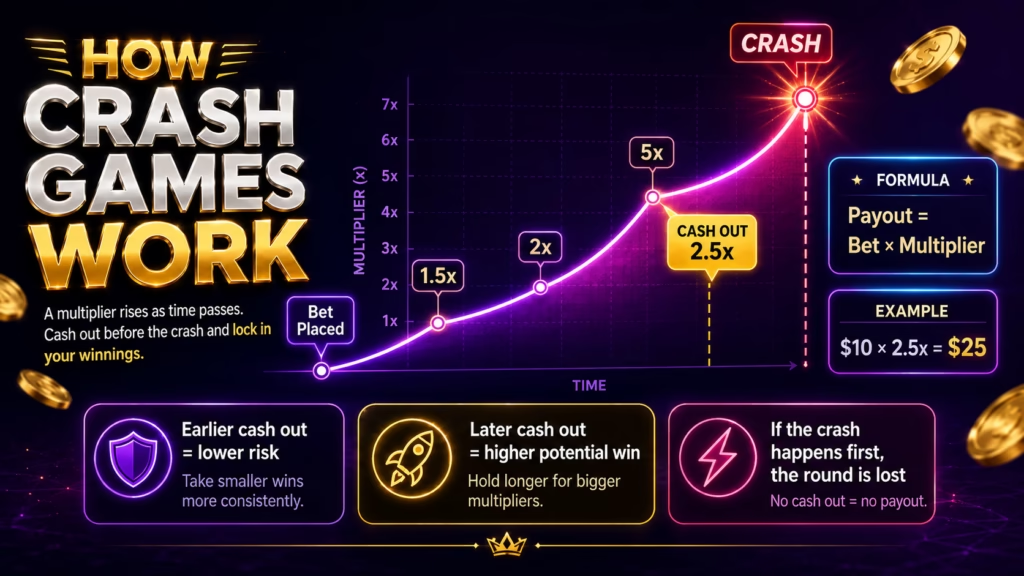
A crash game begins after players place their bets. The displayed multiplier usually starts at or near 1.00x and rises until the round suddenly ends.
A player wins by cashing out before the crash. The total payout is normally calculated as:
Total payout = Stake × Cash-out multiplier
A $10 bet cashed out at 2.00x returns $20 in total:
- Original stake: $10
- Net profit: $10
- Total payout: $20
If the game crashes before the cash-out request is accepted, the wager normally loses. Exact server timing, button rules, maximum multipliers and interrupted-connection procedures should be checked in the game rules.
Many crash games also allow a target multiplier that triggers an automatic cash-out when reached. This feature controls the exit timing but does not alter the underlying RTP.
How Multipliers Affect Crash Game Odds
A higher multiplier generally has a lower probability of being reached. A 1.50x cash-out target may succeed frequently, while a 10.00x target must fail much more often for the game to maintain its stated RTP.
In a simplified crash model with a 97% RTP, the approximate probability of reaching a target multiplier can be illustrated with:
Probability of reaching target ≈ RTP ÷ Target multiplier
The formula is useful for explaining the relationship between risk and payout, but it is not guaranteed to match every crash game. Instant crashes, rounding, maximum multipliers, special features and provider-specific mathematics may change the exact probabilities.
| Cash-out target | Approximate chance at 97% RTP | Total return on a $10 winning bet | Net profit if successful |
| 1.20x | 80.8% | $12 | $2 |
| 1.50x | 64.7% | $15 | $5 |
| 2.00x | 48.5% | $20 | $10 |
| 3.00x | 32.3% | $30 | $20 |
| 5.00x | 19.4% | $50 | $40 |
| 10.00x | 9.7% | $100 | $90 |
These figures do not predict the next round. They only demonstrate why large multipliers must appear less often than small multipliers.
Does the Cash-Out Multiplier Change RTP?
In a standard crash game model, selecting a different cash-out multiplier usually changes the frequency and size of wins rather than the theoretical RTP.
A low target produces more frequent successful cash-outs, but each successful bet earns a smaller amount. A high target produces fewer successful cash-outs, but each win pays more. The mathematical balance is designed so that neither choice automatically removes the crash game house edge.
Using the simplified 97% model:
- A $10 bet at 1.50x has an estimated success probability of about 64.7%.
- A $10 bet at 2.00x has an estimated success probability of about 48.5%.
- A $10 bet at 5.00x has an estimated success probability of about 19.4%.
Each option still has an expected gross return of approximately $9.70 per $10 wagered in the simplified model. The theoretical expected loss remains about $0.30, but the way results are distributed becomes significantly more volatile at higher targets.
Game-specific rules may create exceptions. Players should check whether the title includes instant crashes, special multipliers, side bets, commissions, capped payouts or alternative RTP settings.
Low Versus High Cash-Out Targets
A lower cash-out target is generally more suitable for players who prefer a higher hit frequency and smaller swings. It does not create a profitable system, but it reduces reliance on rare high multipliers.
A higher cash-out target is generally more suitable for players who accept long losing sequences in exchange for occasional larger payouts. The bankroll can decline quickly because several consecutive rounds may crash before the selected target.
| Approach | Typical result pattern | Main advantage | Main risk |
| Low target, such as 1.20x to 1.50x | More frequent small wins | Lower short-term variance | One loss can erase several small profits |
| Medium target, such as 1.75x to 3.00x | Balanced frequency and payout size | Clear risk-to-reward structure | Losing streaks remain common |
| High target, such as 5.00x or above | Rare larger wins | Higher payout when reached | Long dry periods and rapid bankroll decline |
The best target is therefore not the multiplier that guarantees profit. It is the target whose possible losing pattern fits the player’s risk limit.
Manual Cash Out Versus Auto Cash Out
Manual cash out allows the player to choose an exit point during the round. The main disadvantage is that hesitation, distraction or connection delay may cause the cash-out request to arrive after the game has already crashed.
Auto cash out automatically submits the exit when a selected multiplier is reached. It may help players follow a predetermined limit and avoid changing decisions while the multiplier rises.
Auto cash out does not improve RTP or predict the crash point. It only automates the timing of the exit. If the round crashes below the selected multiplier, the bet still loses.
Players should also check how the game handles connection interruptions. In many systems, the server result remains authoritative even when the animation freezes or the player’s screen loses connection.
Why Previous Crash Results Cannot Predict the Next Round
A history panel may show recent crash multipliers, but previous results do not reliably reveal when a high or low multiplier will occur next in an independently generated game.
A sequence such as 1.02x, 1.14x and 1.31x does not mean a large multiplier is due. Likewise, a recent 100x result does not prove that another high multiplier cannot appear soon.
The belief that the game must compensate for a previous sequence is the gambler’s fallacy. Random or independently generated rounds do not need to create a balanced pattern within a short visible history.
Result charts can still be useful for understanding how volatile a crash game feels. They should not be treated as a forecasting tool.
Crash Game House Edge Explained
The crash game house edge is the mathematical advantage built into the game. It represents the share of total wagers the game is designed to retain over long-term play.
Examples include:
- 99% RTP equals a 1% house edge.
- 97% RTP equals a 3% house edge.
- 96% RTP equals a 4% house edge.
- 94% RTP equals a 6% house edge.
A lower house edge generally provides better theoretical value, but it does not guarantee a better result in one session. A 99% RTP game can still produce an immediate loss, while a lower-RTP game can produce a short-term win.
The effect of house edge becomes more important as total turnover increases. Fast crash rounds can encourage players to place many wagers within a short period, causing the same bankroll to be exposed to the house edge repeatedly.
Does Provably Fair Mean There Is No House Edge?
Provably fair technology may allow a player to verify that a result was generated from committed data and was not changed after the bet. It does not mean that the game has 100% RTP or no mathematical advantage.
A typical provably fair system may combine a server result, secret value, cryptographic hash and client seed. After the round, the disclosed values can be compared with the earlier hash to verify the result.
Provable fairness and player value are separate questions:
- Provably fair concerns whether a result can be independently checked.
- RTP concerns the theoretical percentage returned through payouts.
- House edge concerns the operator’s long-term mathematical advantage.
- Licensing concerns the legal and regulatory status of the operator.
A game may be provably fair while still having a significant house edge. Players should check all four areas rather than relying on a single fairness label.
Common Crash Game RTP Myths
“A 97% RTP means I will get back $97 from a $100 session”
A 97% RTP does not promise a $97 personal return. It describes theoretical performance across a very large volume of wagers. A short session can end with a complete loss or a substantial win.
“Cashing out early beats the house edge”
An early cash out normally increases the frequency of wins while reducing the size of each win. It does not automatically change the underlying expected return.
“A high multiplier is due after several low rounds”
Past multipliers do not force the next result in an independent game. A long sequence of low crashes may continue without producing a compensating high multiplier.
“Martingale guarantees recovery”
Doubling the stake after every loss can produce temporary recoveries, but one extended losing sequence can require extremely large bets. Bankroll limits and maximum-bet limits eventually prevent continued doubling.
“Auto cash out increases RTP”
Auto cash out controls the selected exit point. It does not modify the game’s mathematical return.
How to Compare Crash Games
A crash game should be evaluated by more than its largest advertised multiplier. A theoretical 10,000x maximum has limited practical meaning when the probability of reaching it is extremely small.
Before playing, check:
- Displayed RTP: Confirm the exact RTP inside the game rules or information screen.
- House edge: Subtract the RTP from 100%.
- Maximum multiplier: Check whether the maximum is a mathematical limit or only a promotional figure.
- Maximum payout: A casino or provider may cap the amount paid even when the multiplier continues rising.
- Auto cash-out rules: Confirm the minimum target and how automatic exits are processed.
- Multiple-bet options: Two simultaneous bets increase total exposure even when different targets are used.
- RTP variants: The same title may be supplied with different mathematical configurations.
- Fairness information: Check whether results use a tested RNG, provably fair verification or another disclosed system.
- Operator status: Use a casino legally permitted to operate in the player’s jurisdiction.
- Responsible gambling tools: Deposit limits, loss limits, timeouts and self-exclusion should be easy to access.
Practical Risk Management
Risk management cannot turn a negative-expectation crash game into guaranteed income. Its purpose is to limit the amount of money and time exposed to the game.
Set a fixed spending limit before starting and treat the entire amount as entertainment expenditure. Do not increase the limit because of a losing streak.
Use a fixed stake rather than increasing bets to recover previous losses. A flat stake makes the maximum possible session loss easier to understand.
Choose a cash-out target before the round starts. Changing the target emotionally while watching a rising multiplier can lead to inconsistent decisions.
Limit the number of rounds or the session duration. Crash games move quickly, so a time limit alone may still allow considerable turnover.
Stop when the predefined loss limit is reached. Borrowed money, essential expenses and money reserved for bills should never be used for gambling.

How This Information Was Reviewed
This explanation is based on the relationship between theoretical RTP, total turnover, cash-out multipliers and house edge. Common crash mechanics, including rising multipliers, manual cash out, auto cash out and game-specific RTP values, were considered when preparing the material.
Players should still verify the RTP, maximum payout, cash-out rules and mathematical configuration inside the specific game. Provider data and casino settings may vary.
RTP, multiplier selection, auto cash out and provably fair verification do not guarantee a winning result. Crash games should be treated as paid entertainment, not as a method of earning money. Anyone struggling to follow spending limits should stop playing and use the responsible gambling or self-exclusion tools available in their region.
FAQ
What is a good RTP for a crash game?
A higher RTP generally means a lower theoretical house edge. For example, 97% RTP creates a 3% house edge, while 94% RTP creates a 6% house edge. The exact percentage should be verified in the game rules because crash titles may use different RTP settings.
How is crash game RTP calculated?
Crash game RTP is calculated by dividing the total amount returned as payouts by total turnover over a sufficiently large number of rounds. Actual short-term results may differ widely from the theoretical percentage because of volatility.
What is the house edge in a 97% RTP crash game?
The theoretical house edge is 3%. It is calculated by subtracting the 97% RTP from 100%. This percentage applies to long-term turnover and does not mean every $100 session will lose exactly $3.
Is 2.00x the best crash game cash-out point?
A 2.00x target is not universally best. It offers a larger payout than low targets but must be reached less frequently. In many standard crash models, changing the target modifies variance while leaving the theoretical house edge broadly unchanged.
Does cashing out at 1.10x guarantee a profit?
Cashing out at 1.10x does not guarantee profit because the game can crash before reaching 1.10x. Each successful bet produces only a small gain, so a single early crash may erase the profits from several previous rounds.
Can crash game patterns be predicted?
Crash patterns cannot be reliably predicted from the recent history when rounds are independently generated. Previous low multipliers do not make a high multiplier due, and previous high multipliers do not prevent another high result.
Does auto cash out increase the chance of winning?
Auto cash out does not change the probability of the multiplier reaching the chosen target. It only submits the cash-out automatically if that target is reached before the crash.
Are provably fair crash games beatable?
Provably fair verification does not make a crash game beatable. It may help confirm that results were not altered after bets were placed, but the game can still contain a house edge and produce long losing sequences.
Can a betting system overcome crash game house edge?
A staking system cannot remove the underlying house edge. Martingale and similar systems rearrange the size and timing of risks, but they remain vulnerable to losing streaks, bankroll exhaustion and maximum-bet limits.
Why does my personal RTP differ from the advertised RTP?
Personal RTP may differ because the advertised percentage is a theoretical long-term average. A limited number of rounds creates a small and highly volatile sample, so individual results may remain far above or below the stated RTP.
Brief Conclusion
Crash game RTP shows the game’s theoretical long-term return, while the house edge shows the mathematical advantage retained by the operator. Lower cash-out targets produce more frequent smaller wins, and higher targets produce rarer larger wins, but neither approach guarantees profit or predicts the next crash.
Check the exact RTP and rules for the specific game, set strict spending limits and treat every wager as entertainment expenditure rather than an investment.