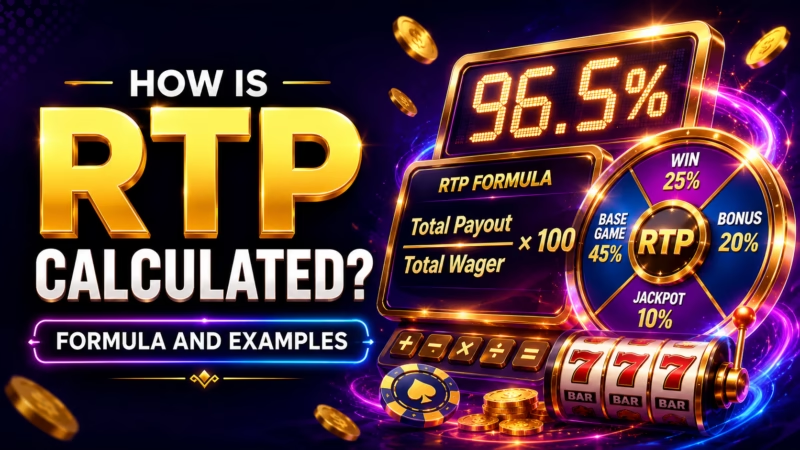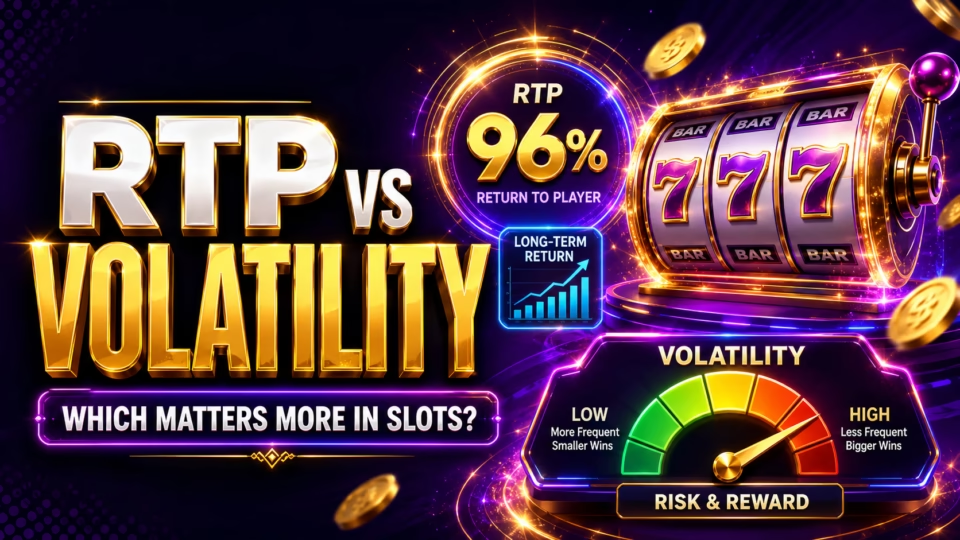
RTP and volatility measure different parts of a slot game. RTP estimates how much wagered money a game is designed to return over a very large number of spins, while volatility describes how wins are distributed between smaller frequent payouts and larger irregular payouts. Neither metric predicts the result of an individual session.
For most players, volatility has the greater effect on how a slot feels during a short session. RTP becomes more relevant when comparing the theoretical long-term return of different games.
Quick conclusions:
- A higher RTP generally means a lower theoretical house advantage.
- Volatility determines the typical balance between payout size and payout frequency.
- High RTP does not necessarily mean frequent wins.
- Low volatility does not necessarily mean a better long-term return.
- Neither RTP nor volatility can guarantee winnings or predict the next spin.
Players with a limited entertainment budget may prefer lower-volatility slots because their balances often fluctuate less sharply. Players who accept longer periods without meaningful payouts may prefer higher-volatility games. In both cases, the slot should be treated as paid entertainment rather than a source of income.
What Is RTP in Slots?
Return to Player, usually shortened to RTP, is the theoretical percentage of all wagered money that a slot is designed to return to players over an extremely large sample of spins.
For example, a slot with a 96% RTP is theoretically designed to return $96 for every $100 wagered across the game’s complete long-term activity. This does not mean one player will receive $96 after wagering $100. One session could finish with a profit, a partial loss or no remaining balance.
RTP is calculated across many results and usually includes both common base-game payouts and rare high-value outcomes. A small number of unusually large wins may account for part of the theoretical return, especially in high-volatility games.
The theoretical house edge can be estimated by subtracting RTP from 100%.
| Slot RTP | Approximate theoretical house edge |
| 97% | 3% |
| 96% | 4% |
| 95% | 5% |
| 94% | 6% |
A higher RTP is generally preferable when every other characteristic is equal. However, slot games are rarely identical in every other respect. Two games with the same RTP can produce completely different playing experiences because of their volatility, hit frequency, bonus structure and maximum payout distribution.
The exact RTP may also vary between casino versions of the same slot. Some developers allow operators to select from several RTP configurations. Players should therefore check the game information, help screen or official paytable rather than relying only on a review or promotional page.

What Is Slot Volatility?
Slot volatility describes the level of payout risk and the way a game’s theoretical return is distributed. It is also commonly called variance, although the terms may be calculated differently in technical mathematical models.
A low-volatility slot usually produces smaller payouts more regularly. A high-volatility slot usually concentrates more of its return in less frequent but potentially larger wins. Medium-volatility slots attempt to provide a balance between these patterns.
Low-Volatility Slots
Low-volatility slots are generally designed for players who prefer steadier balance movement and more regular payout activity. Individual wins may be modest, and the largest prizes can still be difficult to reach.
This format may suit:
- players with smaller budgets;
- beginners learning how slot features work;
- players who prefer longer sessions at low stakes;
- players who dislike extended periods without a payout.
Low volatility does not mean low risk. The casino retains a mathematical advantage when the RTP is below 100%, and a series of losing spins can still occur.
Medium-Volatility Slots
Medium-volatility slots usually combine regular small wins with occasional larger payouts or bonus rounds. The category is broad, and two games described as medium volatility may behave differently.
This format may suit players who want a mixture of base-game activity and meaningful bonus potential without choosing the most aggressive payout model.
High-Volatility Slots
High-volatility slots generally produce less predictable balance changes. A player may experience many low-value or losing spins before receiving a significant payout.
This format may appeal to:
- players interested in larger potential wins;
- bonus-feature enthusiasts;
- players who accept irregular results;
- players using strict loss and time limits.
High volatility does not increase the certainty of receiving a large payout. It only indicates that more of the game’s return may be concentrated in less frequent outcomes. A short session can end before any of those outcomes appear.
The Difference Between RTP and Volatility
The main difference between RTP and volatility is that RTP measures theoretical return, while volatility measures payout distribution.
| Factor | RTP | Volatility |
| Main purpose | Estimates long-term return | Describes the payout pattern |
| Usually shown as | Percentage | Low, medium or high |
| Influences | Theoretical house advantage | Balance swings and session experience |
| Predicts one session | No | No |
| Indicates win frequency | Not directly | Only indirectly |
| Higher value always preferable | Usually, when games are otherwise equal | No, it depends on player preference |
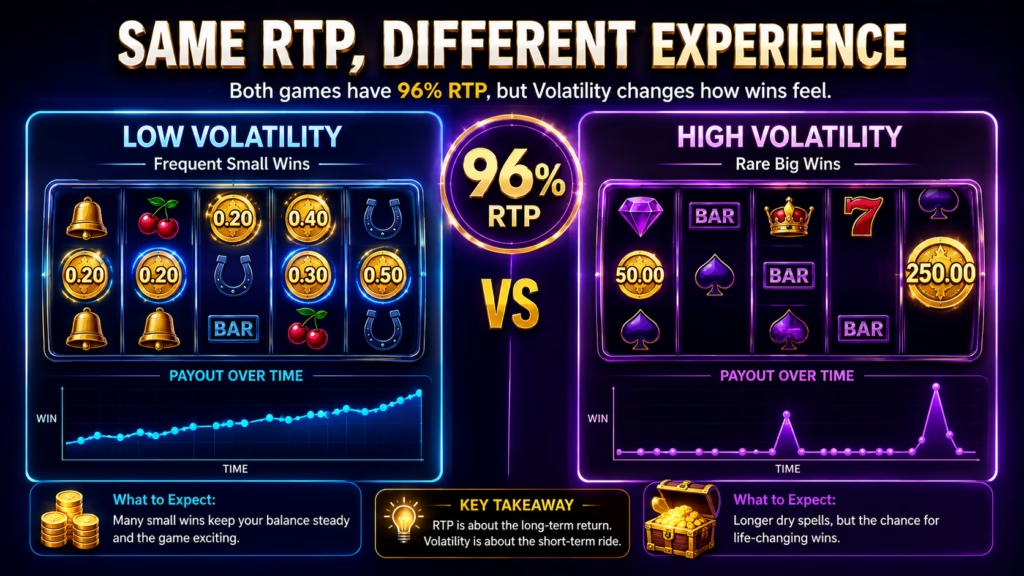
Consider two hypothetical slots with a 96% RTP:
- Slot A has low volatility. Its theoretical return may be spread across many smaller payouts.
- Slot B has high volatility. More of its theoretical return may depend on rare bonus combinations or large wins.
Both games can have the same long-term RTP while feeling completely different during 100, 500 or even several thousand spins.
Which Matters More: RTP or Volatility?
RTP matters more when comparing the theoretical cost of playing similar slots over the long term. Volatility matters more when deciding whether the payout pattern suits a player’s budget, expectations and tolerance for balance swings.
A player choosing between two otherwise similar games would normally have a mathematical reason to prefer the higher RTP. A difference between 96% and 94%, for example, represents a different theoretical house advantage. The difference still does not determine what will happen during one session.
Volatility is often more noticeable in practical play. A high-volatility game can consume a limited balance quickly if meaningful payouts do not appear. A low-volatility game may preserve the balance longer through smaller wins, but repeated wagering can still produce an overall loss.
The most useful decision is therefore not to choose RTP instead of volatility. Players should examine both:
- Use RTP to compare the theoretical return.
- Use volatility to evaluate the expected playing pattern.
- Check the paytable to understand where the game’s larger payouts come from.
- Set a fixed spending limit before starting.
- Choose a stake that allows enough spins without exceeding that limit.
RTP vs Volatility for Different Types of Players
Players with a Small Budget
Players with a small entertainment budget may find lower or medium volatility easier to manage. More regular low-value payouts can reduce extreme balance swings, although they cannot prevent losses.
A reasonably competitive RTP is still important. A low-volatility game with an unusually low RTP may offer smooth play while retaining a comparatively larger theoretical house advantage.
Players Looking for Longer Sessions
Low or medium volatility is usually more suitable for players who value playing time over rare high-value outcomes. Smaller stakes can also extend a session, but every additional spin creates another opportunity to lose money.
Session length should not be confused with profitability. A longer session may simply spread the cost of entertainment over more spins.
Players Interested in Large Potential Payouts
High-volatility games are generally more relevant to players who prioritize payout potential over regular win activity. These games can include large multipliers, complex bonus rounds or high maximum-win limits.
The advertised maximum win does not show how likely that outcome is. Players should examine the paytable and feature rules and should not increase stakes in an attempt to recover losses or reach a rare prize.
Beginners
Beginners may benefit from starting with a simple low-volatility or medium-volatility game. A clear paytable and understandable bonus structure are often more useful than a high maximum win.
RTP should still be checked, but beginners should avoid treating a small RTP difference as a strategy for winning. The outcome of every spin remains random.
Does Higher RTP Mean More Frequent Wins?
A higher RTP does not necessarily mean more frequent wins. RTP measures the total theoretical value returned, not how often winning combinations appear.
A game could theoretically achieve its RTP through frequent small payouts, rare large payouts or a mixture of both. Hit frequency is the more relevant metric for estimating how often a spin produces a listed win, although even hit frequency does not show whether those wins will exceed the original stake.
A slot can register a winning combination while returning less than the amount wagered on that spin. For that reason, frequent wins do not automatically mean the balance will increase.
Can a High-Volatility Slot Also Have High RTP?
A high-volatility slot can also have a high RTP because volatility and RTP measure separate characteristics.
For example, a game may have a competitive theoretical return while concentrating a significant share of that return in rare bonus events. The game may therefore offer a strong RTP percentage but still produce sharp short-term losses for many individual sessions.
Players should not interpret high RTP plus high volatility as an especially profitable combination. The RTP requires a huge number of outcomes to become statistically meaningful, while the volatility can dominate the experience of a normal session.
Common RTP and Volatility Myths
“A 96% RTP Means I Will Lose Only 4%”
A 96% RTP does not limit an individual player’s loss to 4%. The percentage applies to long-term game activity, not a specific deposit, balance or session.
“Low-Volatility Slots Are Safer”
Low-volatility slots may produce less dramatic balance swings, but they are not risk-free. Repeated wagering and long sessions can still result in substantial losses.
“High Volatility Means a Large Win Is Due”
High volatility does not make a payout due after a losing sequence. Each spin is generated independently according to the game’s programmed rules and random number generator.
“A Higher Bet Improves RTP”
Increasing the stake usually increases the amount at risk without improving the standard RTP. Some games may have stake-dependent features or jackpots, so the official rules should be checked, but a larger bet does not normally change random outcomes in the player’s favor.
“Recent Results Reveal the Game’s Volatility”
A short result history cannot reliably establish a slot’s mathematical volatility. Temporary streaks can occur in any random game. Use the developer’s published classification and the paytable rather than judging the game from a few spins.
How to Compare Slots Using Both Metrics
1. Verify the RTP Version
Open the game information or paytable and confirm the RTP offered by the casino. Do not assume every operator uses the same configuration.
2. Check the Volatility Rating
Use the official rating when available. Reviews can help explain the playing style, but descriptions such as “medium-high” are not always standardized across developers.
3. Examine the Paytable
Identify whether the largest prizes depend on free spins, multipliers, jackpots, bonus buys or rare symbol combinations. This shows where the theoretical return may be concentrated.
4. Review the Betting Range
The minimum stake should fit the predetermined entertainment budget. A slot is unsuitable when its normal stake would exhaust that budget after only a small number of spins.
5. Separate Potential from Probability
A high maximum win describes what may be possible under the rules. It does not reveal the probability of reaching that amount.
6. Use Demo Mode Carefully
A demo can help explain controls, paylines and bonus mechanics. Demo results cannot predict real-money results, and a favorable practice session does not make later outcomes more likely.
How This Information Was Reviewed
This comparison is based on the standard functions of RTP, volatility, hit frequency, payout distribution and theoretical house advantage. These criteria explain how a slot is designed, but they cannot predict a player’s personal result.
Players should verify the exact RTP, volatility information, betting limits and bonus rules in the game’s official paytable. Casino availability, RTP configurations and promotional conditions may differ between operators.
RTP, volatility and bonus features do not guarantee a payout. Players should set spending and time limits before playing, avoid chasing losses and stop when gambling is no longer enjoyable. Slots should be treated as entertainment rather than a way to earn money.
FAQ
Is RTP more important than volatility?
RTP is more important for comparing the theoretical long-term return of similar slots, while volatility is more important for understanding short-term balance swings. A sensible comparison uses both metrics rather than choosing only one.
What is a good RTP for a slot?
A higher RTP is generally preferable when games are otherwise comparable. Many online slots are offered with RTP values in the mid-90% range, but the exact percentage should be checked in the paytable because different casino configurations may be available.
Is high or low volatility better?
Neither volatility level is universally better. Low volatility may suit players who prefer smaller, more regular payouts, while high volatility may suit players who accept irregular results in exchange for larger potential prizes.
Can a low-RTP slot pay a large win?
Yes. A low-RTP slot can still produce a large individual payout because RTP describes aggregated theoretical return rather than the maximum result of one spin. A large payout does not remove the game’s long-term mathematical advantage.
Does high RTP make a slot easier to win?
No. High RTP does not make a specific spin or session easier to win. It indicates a lower theoretical house advantage over a very large number of outcomes, but short-term results remain random.
Is volatility the same as hit frequency?
No. Volatility describes the size and distribution of payouts, while hit frequency estimates how often a winning combination occurs. A game can have a relatively high hit frequency but remain volatile if most wins are small and a large share of the return comes from rare prizes.
Can casinos change a slot’s RTP?
Casinos cannot normally adjust RTP freely during a session, but a developer may supply several approved versions of a game with different RTP settings. The operator may select one of those versions, so players should check the active paytable.
Do bonus buys change volatility?
Bonus buys can increase the amount risked on a single game event and may create sharper balance swings. Their exact RTP and rules can differ from standard play, so the feature information should be checked before use. Availability also depends on the casino and jurisdiction.
How many spins are needed for RTP to become accurate?
There is no practical number of spins that guarantees an individual player will receive the advertised RTP. RTP is a theoretical long-term average calculated across a very large sample and should not be used to forecast a personal session.
Can RTP or volatility help guarantee a profit?
No. RTP and volatility are comparison tools, not winning strategies. They can help explain theoretical cost and payout behavior, but they cannot remove the house advantage or predict random outcomes.
Brief Conclusion
RTP shows the theoretical long-term return of a slot, while volatility shows how that return is distributed. RTP matters more for mathematical comparison, and volatility matters more for session experience and budget fluctuations. Check both metrics, verify the active paytable and play only with money set aside for entertainment.