
Mines game RTP connects four parts of the same mechanic: board size, bomb count, multiplier growth and cash-out timing. Adding bombs or opening more tiles can increase the available multiplier, but neither action removes the mathematical house edge or makes a winning round more likely.
Key points
- Mines RTP is a long-term theoretical return, not a promise for one session.
- More bombs create higher potential multipliers and a greater chance of losing the round.
- Opening more safe tiles raises the multiplier but reduces the probability of reaching the next cash-out point.
- Cashing out earlier lowers variance but does not eliminate the house edge.
- Tile selection patterns cannot predict bomb locations on a properly random board.
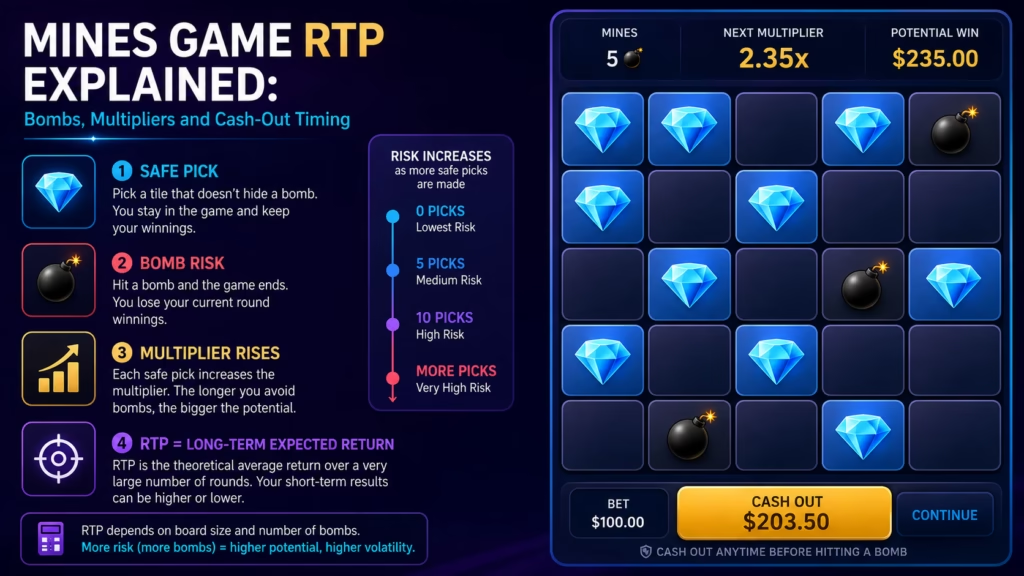
In a typical Mines game, the player chooses a stake and the number of hidden bombs before opening tiles. Each safe tile increases the payout multiplier. Revealing a bomb ends the round and loses the stake, while cashing out collects the current multiplier. Exact specifications can differ between providers and operators.
Mines may appeal to players who prefer short rounds, adjustable risk and a clear decision between collecting a smaller payout or continuing for a larger multiplier. Players who tend to chase losses, increase stakes impulsively or treat gambling as income should avoid the format because its rapid rounds can produce losses quickly.
What Is Mines Game RTP?
Mines game RTP is the theoretical percentage of all wagered money that the game is designed to return as payouts over a very large number of rounds. A Mines game with 99% RTP has a theoretical house edge of approximately 1%, meaning the game is designed to retain about 1% of turnover over the long term.
RTP does not mean that a player should receive $99 back after wagering $100. Actual results can be far above or below the theoretical percentage during a short session. RTP is measured across a significant volume of play and should not be interpreted as a guaranteed return for an individual player.
The exact Mines RTP must be checked in the game information, paytable or help menu. There is no universal RTP that applies to every Mines-style game. Different providers may use different house edges, board sizes, mine limits, multiplier rounding rules or payout formulas.
How Mines Multipliers Work
Mines multipliers are based primarily on the probability of surviving a chosen number of tile selections. When fewer safe tiles remain, successfully opening another tile becomes less likely, so the potential payout multiplier increases.
Consider a board with:
- N total tiles
- M mines
- S = N – M safe tiles
- K safe tiles that the player wants to reveal
The probability of revealing K safe tiles without selecting a mine can be calculated as:
Survival probability = C(S, K) / C(N, K)
The same probability can also be calculated one tile at a time:
Survival probability = (S / N) x ((S – 1) / (N – 1)) x …
The mathematically fair multiplier would be:
Fair multiplier = 1 / survival probability
A casino game normally pays slightly less than the fair multiplier because the difference creates the house edge. In a simplified constant-RTP model:
Displayed multiplier is approximately RTP / survival probability
Actual games may round multipliers or use a provider-specific payout table, so displayed values should always be checked inside the game.
Mines Multiplier Example
The following example assumes a 25-tile board and a constant 99% RTP. The values are mathematical illustrations rather than guaranteed multiplier values for every Mines game.
| Mines | Safe tiles opened | Survival probability | Fair multiplier | Approx. multiplier at 99% RTP |
| 3 | 1 | 88.00% | 1.1364x | 1.1250x |
| 3 | 3 | 66.96% | 1.4935x | 1.4786x |
| 3 | 5 | 49.57% | 2.0175x | 1.9974x |
| 5 | 3 | 49.57% | 2.0175x | 1.9974x |
| 5 | 5 | 29.18% | 3.4269x | 3.3926x |
| 10 | 3 | 19.78% | 5.0549x | 5.0044x |
With three mines, the probability that the first tile is safe is 22 divided by 25, or 88%. A fair payout would therefore be approximately 1.1364x. After applying a 1% house edge, the theoretical displayed payout becomes approximately 1.1250x.
With ten mines, only 15 of the 25 starting tiles are safe. The first-click survival probability falls to 60%, so the corresponding multiplier is much higher. The larger multiplier does not create better expected value because it compensates for the lower probability of surviving.
How the Number of Bombs Changes the Game
The number of bombs primarily controls volatility. Fewer bombs normally produce more frequent successful picks and slower multiplier growth. More bombs produce less frequent successful picks and faster multiplier growth.
A higher mine count does not automatically lower the RTP. Some implementations maintain the same house edge across every mine configuration. The practical difference is the distribution of results:
| Configuration | Typical experience | Main risk |
| Few bombs | More safe first picks and smaller multipliers | Players may continue clicking because the board feels safe |
| Moderate bombs | Balanced multiplier growth and survival probability | Several successful picks can encourage overconfidence |
| Many bombs | Rapid multiplier growth and frequent immediate losses | A short losing sequence can consume the budget quickly |
Bomb count should therefore be viewed as a volatility setting, not as a way to improve the underlying RTP.
Does Tile Position Affect the Odds?
Tile position should not affect the probability when mines are placed uniformly and the board does not provide genuine clues. Corners, central tiles, diagonals and repeating patterns are mathematically equivalent before any tile is revealed.
Some players repeatedly choose the same pattern because previous rounds appeared successful. That pattern does not become safer in the next independent round. Properly designed random games should produce unpredictable outcomes, and previous results should not determine the next result.
Provably fair Mines implementations may generate the board using a server seed, client seed, nonce and cryptographic hashing. This can help a player verify a completed result, but it does not reveal future mine positions or remove the house edge.
When Should You Cash Out in Mines?
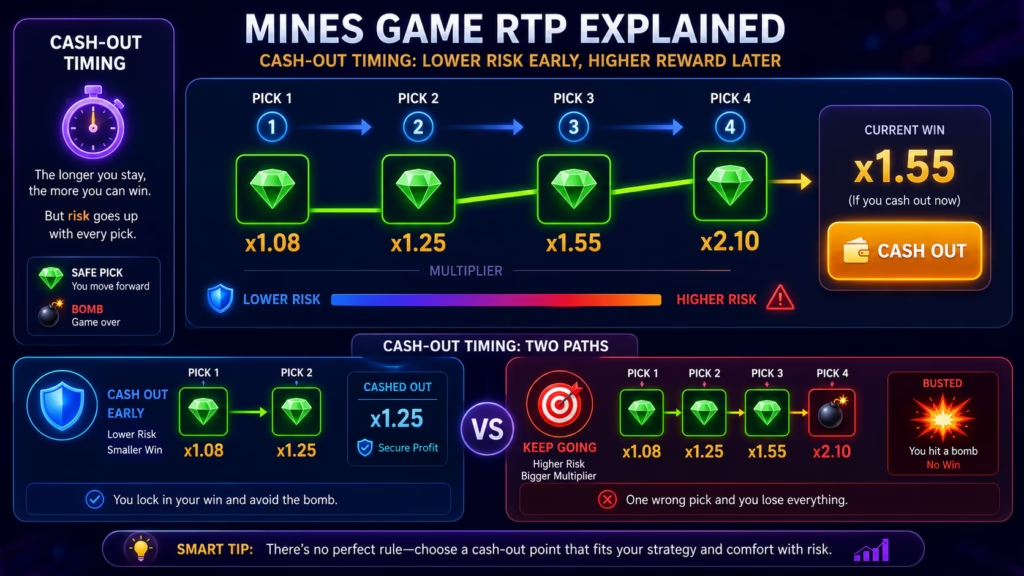
Cash-out timing changes the risk profile of a round, not the randomness of the board. Cashing out after one or two safe tiles usually produces smaller but more frequent successful payouts. Continuing deeper into the board produces larger potential multipliers but a lower chance of reaching them.
In a constant-RTP payout model, there is no mathematically superior cash-out target. A fixed strategy that always stops after one safe tile and a fixed strategy that always stops after five safe tiles may have approximately the same theoretical RTP. Their session results can still feel completely different because their variance is different.
For example:
- An early cash-out approach may create many small payouts mixed with occasional lost stakes.
- A medium target may create fewer successful rounds but more noticeable payouts.
- A late target may produce long losing sequences interrupted by rare large payouts.
A player who continues after a successful tile is not increasing the theoretical return. The next multiplier rises because the probability of surviving the next selection falls.
Does Continuing After a Safe Tile Improve Expected Value?
Continuing after a safe tile does not normally create additional expected value when the multiplier ladder is calculated consistently. Before rounding, the increased multiplier compensates for the reduced conditional probability of surviving the next click.
Suppose the current cash-out value is 2x and the chance of surviving one more tile is 50%. A mathematically equivalent next multiplier would be about 4x:
50% x 4x = 2x expected value
The player is choosing between a certain 2x cash-out and a 50% chance of approximately 4x. The expected amount may be similar, but the outcomes are not. One option secures the current payout, while the other can lose the entire round.
This is why cash-out timing should be chosen according to acceptable variance and budget limits, not because one target is believed to defeat the game.
Mines RTP vs Hit Frequency
Mines RTP and hit frequency measure different things. RTP describes the theoretical value returned over extensive play. Hit frequency describes how often a chosen cash-out target is reached.
A one-mine configuration with an early cash-out target can have a high hit frequency because most first selections are safe. A ten-mine configuration with a deep cash-out target can have a very low hit frequency. Both configurations may still use the same overall RTP if their multipliers are adjusted correctly.
A high hit frequency can therefore feel safer without being profitable over time. Many small payouts may be offset by losing rounds and by payouts that include part of the original stake.
Common Mines Game Myths
More mines mean a better RTP
More mines usually mean higher multipliers and lower survival probabilities. They do not necessarily improve the theoretical return.
A bomb is less likely after several losses
Previous rounds do not make the next board safer. This belief is the gambler’s fallacy.
The same tile cannot contain a bomb repeatedly
A position can contain a bomb in consecutive independent rounds. A random result does not deliberately alternate between safe and unsafe tiles.
Provably fair means the player has an advantage
Provably fair technology can allow verification of how an outcome was generated. It does not mean the game has zero house edge or positive expected value.
A betting system can recover every loss
Martingale and similar progression systems increase stake size after losses but do not change the probability of selecting a mine. A sufficiently long losing sequence can exceed the available balance or the casino’s betting limit.
How to Compare Mines Games
A useful Mines comparison should focus on transparent mathematical and operational details rather than the largest advertised multiplier.
Check the following criteria:
- Published RTP and house edge: Confirm the exact percentage in the game rules.
- Board size: Do not assume every version uses a 5×5 board.
- Mine range: Check how many bombs can be selected.
- Multiplier table: Compare actual payouts at the cash-out targets you would use.
- Rounding: Small multiplier differences can affect the effective RTP.
- Fairness information: Review the RNG, verification system and applicable operator information.
- Bet limits: Fast rounds can make even a small stake accumulate into substantial turnover.
- Demo availability: A free mode may help explain the interface without risking money.
- Responsible gambling controls: Deposit limits, loss limits, session reminders and self-exclusion tools are more important than cosmetic features.
Practical Risk Management
A responsible Mines plan cannot make the game profitable, but it can limit the amount exposed to random outcomes.
Set a total loss limit before starting and calculate it in currency, not in a number of bets. Use a fixed stake that remains affordable even during a losing sequence. Avoid increasing the wager because a bomb appeared early or because several rounds were lost.
Choose a cash-out target before the round begins. Changing the target after seeing several safe tiles can lead to risk escalation because the growing multiplier creates pressure to continue.
Track total turnover as well as the account balance. Fifty bets of $2 create $100 in turnover even when the balance appears to move only slightly. Since the house edge applies to turnover over time, faster play can increase the expected cost of a session.
Mines should be treated as paid entertainment, not as an investment or income source. Stop when the planned budget or time limit is reached, and do not use money required for bills, debt payments or essential expenses.
How This Information Was Reviewed
This explanation is based on combinatorial probability, common Mines game specifications and established principles for RTP and random game outcomes. The multiplier examples assume a 25-tile board, uniformly distributed mines and a constant 99% RTP. A specific game may use different rules, rounding or house-edge calculations.
Before playing, verify the provider, exact RTP, mine range, multiplier table, bet limits and cash-out rules inside the game. RTP describes long-term theoretical performance and cannot predict an individual round or session. Random outcomes, adjustable volatility and provably fair verification do not guarantee a win.
FAQ
What is the RTP of the Mines game?
The RTP of a Mines game depends on the provider and operator. Some 5×5 Mines implementations publish a 99% RTP and 1% house edge, but another version may use different mathematics. Check the game information or paytable before wagering.
How do Mines multipliers work?
Mines multipliers increase as the probability of surviving the selected number of tiles decreases. More bombs and more revealed tiles normally produce larger multipliers because reaching the cash-out point becomes less likely.
Do more bombs increase the Mines RTP?
More bombs do not necessarily increase the RTP. They usually increase volatility by combining larger potential multipliers with a higher probability of losing the round.
Is it better to cash out early in Mines?
Cashing out early is better for reducing variance and securing smaller payouts more frequently. It does not remove the house edge or guarantee that a session will finish in profit.
What is the safest number of bombs in Mines?
A low bomb count provides the highest probability that an individual tile will be safe. It is not completely safe, and repeated play still exposes the player to the game’s house edge.
Can tile patterns predict mines?
Tile patterns cannot predict mines on a properly random board without additional game information. Choosing corners, diagonals or previous safe positions does not create a mathematical advantage.
Does Mines use skill or luck?
The board result is determined by chance, while the player controls the stake, mine count and cash-out point. These decisions change volatility and exposure but do not allow the player to identify hidden mines in advance.
Can a Mines strategy beat the house edge?
No Mines strategy can guarantee that the house edge will be beaten. Betting systems can change stake size, target frequency and volatility, but they cannot change the underlying probabilities.
What does provably fair mean in Mines?
Provably fair means that a player may be able to verify that the completed board was generated from committed cryptographic inputs. It does not predict the next board, guarantee a payout or prove that the game has no house edge.
Key Takeaway
Mines game RTP represents a long-term theoretical return, while bomb count and cash-out timing control how that return is distributed between frequent small payouts and rare larger multipliers. More bombs or additional tile selections increase potential payouts only because they reduce the probability of survival. Check the exact game rules, set strict limits and treat every Mines round as a random form of entertainment rather than a way to make money.