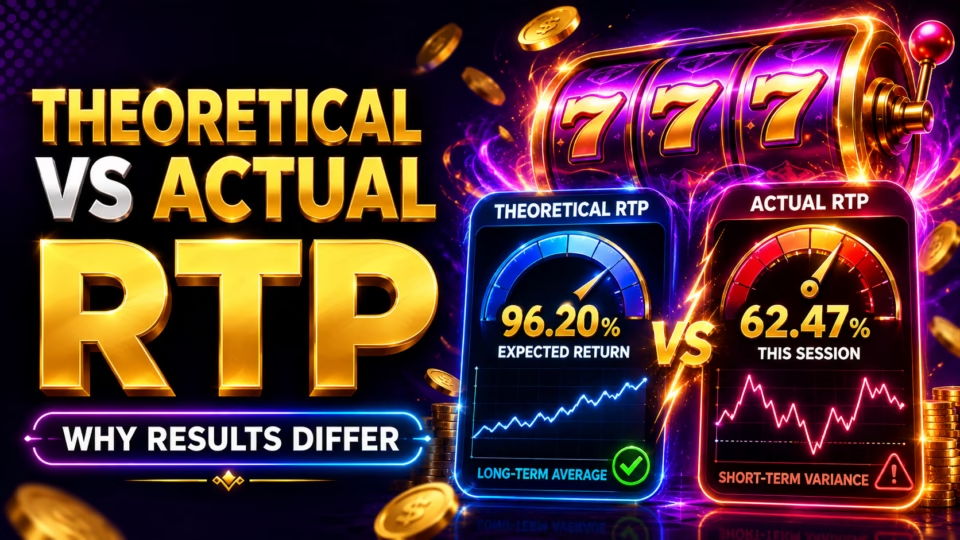
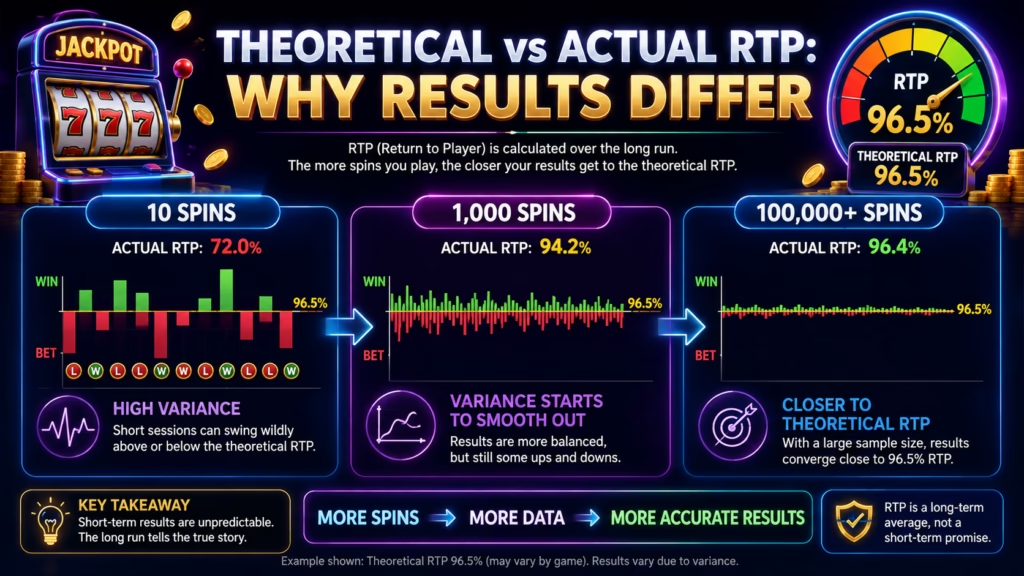
Theoretical RTP is the percentage of total wagers a casino game is mathematically designed to return as prizes over a very large number of plays. Actual RTP is the percentage the game has returned within a specific set of recorded results. The two figures can differ substantially over short periods because random outcomes do not distribute themselves evenly in every session.
Quick Takeaways
- Theoretical RTP describes the game’s long-term mathematical design, not the result of one player’s session.
- Actual RTP is calculated from real wagering data using total wins divided by total stakes.
- A small sample can produce an actual RTP far above or below the theoretical percentage.
- High-volatility games may require especially large samples because a small number of rare payouts can heavily affect the result.
- RTP does not predict the next spin, guarantee a return or tell a player when a game is likely to pay.
Understanding the difference is useful for players comparing casino games, analysts reviewing game performance and operators monitoring whether a game is behaving as expected. Players should be cautious about using personal session results as evidence that a displayed RTP is inaccurate.
What Is Theoretical RTP?
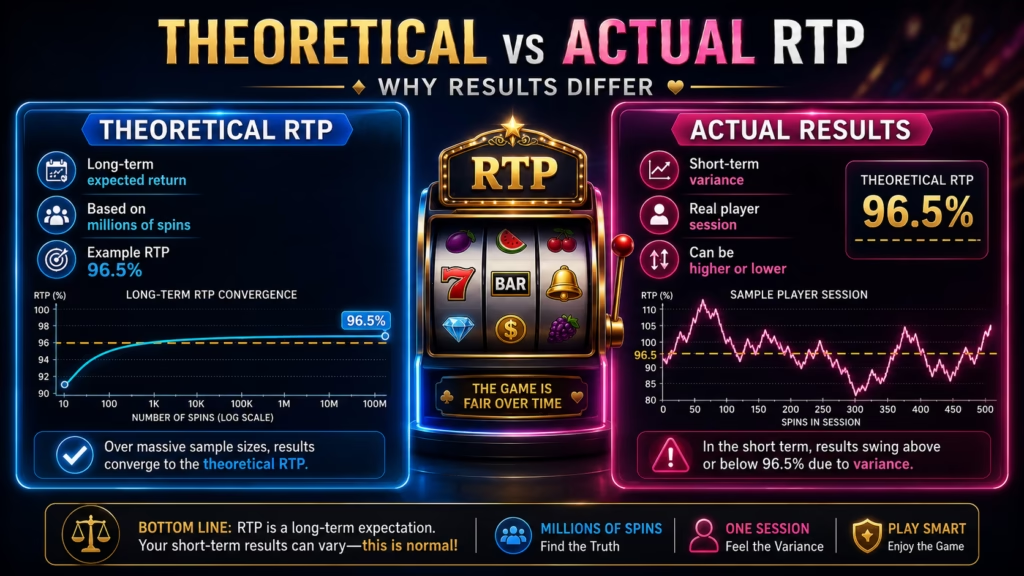
Theoretical RTP is the designed return-to-player percentage calculated from a game’s mathematical model. It represents the expected proportion of wagers returned as prizes when all possible outcomes, probabilities and payouts are considered across a sufficiently large volume of play.
For example, a theoretical RTP of 96% means that the game is designed to return an average of $96 for every $100 wagered across the complete long-term dataset. It does not mean that an individual player will receive $96 back after wagering $100.
The theoretical value may be established through mathematical analysis, game simulation or a combination of both methods.
Theoretical RTP normally includes the full mathematical structure of the selected game configuration, such as:
- regular symbol wins;
- wild and scatter payouts;
- free spins;
- multipliers;
- bonus rounds;
- jackpot contributions, when included in the stated RTP;
- the probability of triggering each feature.
Different versions of the same game may have different theoretical RTP settings. A casino may therefore offer a version with a different percentage from the version described on a review website. The RTP shown inside the game rules or paytable is the most relevant figure for the version currently being played.
What Is Actual RTP?
Actual RTP is the return percentage produced by recorded gameplay during a defined period or sample. It is calculated by dividing the total amount won by the total amount wagered and multiplying the result by 100.
Actual RTP = Total player wins ÷ Total wagers × 100
Suppose players wager a combined $10,000 on a game and receive $8,700 in prizes. The actual RTP for that dataset is:
$8,700 ÷ $10,000 × 100 = 87%
An 87% actual RTP does not automatically mean that a game advertised at 96% is malfunctioning. The sample may simply be too small for the results to resemble the theoretical distribution.
Actual results should generally move closer to the theoretical percentage as more gameplay is recorded, although an exact match is not guaranteed.
Theoretical RTP vs Actual RTP
| Factor | Theoretical RTP | Actual RTP |
| Source | Mathematical game design | Recorded gameplay |
| Time frame | Long-term expectation | A specific period or dataset |
| Calculation | Probabilities and payout values | Total wins divided by total wagers |
| Stability | Fixed for a particular configuration | Changes as new results are added |
| Use for players | Comparing long-term game economics | Reviewing what happened in a sample |
| Predictive value | Does not predict individual outcomes | Does not predict future outcomes |
Theoretical RTP answers the question, “What return is this game designed to produce over the long run?” Actual RTP answers, “What return did this group of recorded plays produce?”
Neither figure tells an individual player what will happen during the next session.
Why Actual RTP Differs From Theoretical RTP
1. The Sample Is Too Small
Sample size is the main reason actual RTP differs from theoretical RTP. A few hundred or even several thousand spins may represent only a tiny portion of the outcomes needed to reflect a complex slot’s full mathematical model.
A slot can contain millions of possible combinations, including rare bonus sequences and high-value wins. If those rare outcomes do not appear in the sample, actual RTP may remain below the theoretical percentage. If one unusually large win appears early, actual RTP may temporarily rise far above it.
RTP is an average achieved over a significant number of game plays, not a percentage returned each time someone plays.
2. Random Variation Creates Short-Term Extremes
Random variation means that real results naturally fluctuate around the expected value. A fair coin has a 50% probability of landing heads, but ten tosses do not have to produce exactly five heads. Casino games behave similarly, although their payout structures are usually much more complex.
A game with a 96% theoretical RTP can produce short samples with actual returns of 40%, 150% or other extreme values. The exact range depends on the game’s prize distribution, sample size and volatility.
Regulated random number generators are expected to produce unpredictable outcomes that follow the game’s theoretical probabilities over the appropriate statistical scale. They are not expected to balance every player, session or short period individually.
3. Volatility Affects the Speed of Convergence
Volatility describes how widely and irregularly a game’s payouts may be distributed. A high-volatility slot may allocate a meaningful part of its theoretical RTP to rare but large wins. Until one or more of those wins appear, its actual RTP can remain well below the theoretical level.
A lower-volatility game generally relies more heavily on smaller, more frequent payouts. Its actual RTP may appear more stable over moderate samples, although it can still move above or below the theoretical percentage.
Volatility does not change the stated theoretical RTP by itself. Two games can both have a 96% RTP while producing completely different short-term experiences.
4. Rare Jackpots and Bonus Features May Be Missing
Progressive jackpots, maximum-win outcomes and difficult-to-trigger bonus combinations can significantly affect the mathematical return of some games. A sample that includes no major prize may not capture the portion of RTP assigned to that prize.
For example, a progressive slot may combine a base-game return with a jackpot contribution. Players who are not eligible for a progressive prize may have a different relevant RTP. The game rules should explain how the jackpot works and whether the stated percentage combines the base game and jackpot components.
This is why comparing actual results with a headline RTP can be misleading unless both figures cover the same game version, features and eligibility conditions.
5. The Wrong RTP Version Is Being Compared
Some casino games are available in several mathematical configurations. The graphics, name and bonus features may look identical while the theoretical RTP differs.
A review might list a 96.2% version, while the operator offers a 94%, 95% or another approved configuration. In that situation, actual results should be compared with the percentage displayed in the rules of the version being played, not with a percentage found on another website.
Theoretical RTP is tied to a specific mathematical design. It is not necessarily a universal figure shared by every casino offering the game.
6. The Data May Use Different Boundaries
Actual RTP depends on what the calculation includes. A result can change when the dataset covers:
- one player instead of all players;
- one casino instead of an aggregated network;
- one day instead of several months;
- the base game without a jackpot;
- incomplete bonus data;
- selected bet modes rather than all eligible wagers.
A meaningful comparison requires the actual and theoretical figures to refer to the same game configuration and return components.
How Many Spins Are Needed for Actual RTP to Match?
There is no universal number of spins that guarantees actual RTP will match theoretical RTP. The required sample depends on the game’s volatility, maximum payout, bonus frequency, probability distribution and mathematical complexity.
A simple, low-variance game may approach its expected return faster than a slot whose RTP includes extremely rare prizes. Even a large dataset can remain above or below the exact theoretical figure because convergence is not a deadline or guarantee.
Professional monitoring therefore uses statistical tolerances rather than expecting actual RTP to equal the theoretical percentage exactly. Measurement frequency may also depend on the volume of play.
For an ordinary player, a personal spin history is almost never large or controlled enough to test whether the published RTP is mathematically accurate.
Can One Player Calculate Personal RTP?
A player can calculate session RTP, but the result only describes that session.
Suppose a player wagers $500 in total and finishes with $350 returned as wins. The session RTP is:
$350 ÷ $500 × 100 = 70%
That figure does not replace the theoretical RTP. It also does not prove that the game has a 70% long-term return.
Personal RTP can be useful for recording spending and understanding what happened, but it should not be used to predict the next result. A player who has received a low return is not “due” a win, and a player who has recently won is not guaranteed to lose immediately afterward.
RTP Does Not Mean Every Player Gets the Same Return
RTP is normally calculated across total wagering activity rather than assigned evenly to individual players. One player might lose an entire budget while another receives a large payout during the same period.
The combined result can still move toward the game’s theoretical RTP even though the individual experiences are completely different.
This distinction is important because the phrase “return to player” can sound like a personal promise. It is actually a statistical property of the game model, not a guaranteed refund percentage for each account.
Common RTP Myths
“A 96% RTP game returns 96% during every session”
A 96% theoretical RTP is a long-term expectation. Individual sessions can return nothing, return part of the amount wagered or finish with a profit.
“The game must pay after a long losing streak”
Previous losses do not make a random winning result due. Properly functioning random games produce outcomes according to their programmed probabilities rather than trying to correct an individual player’s balance.
“Actual RTP below the advertised number proves the game is unfair”
A low actual RTP can result from normal variation, especially when the sample is small or the game has high volatility. Persistent deviations across a statistically meaningful dataset may require investigation, which is why regulated operators monitor live performance for both underpayments and overpayments.
“Higher RTP means a player is likely to win today”
Higher RTP generally indicates a lower mathematical house advantage when comparing otherwise equivalent games. It does not determine whether a player will win during a specific session.
“RTP can be used to predict the next bonus”
RTP contains no information about when the next bonus, jackpot or winning spin will occur. Random outcomes remain unpredictable, and a game’s average return does not create a schedule of wins.
How Players Should Use RTP
Players can use theoretical RTP as a comparison tool, but it should be considered alongside volatility, game rules and budget limits.
Before playing:
- Open the game’s information panel or paytable.
- Check the RTP for the exact version offered by the casino.
- See whether the figure includes jackpots or optional features.
- Review volatility and maximum payout information when available.
- Set a spending limit that does not depend on receiving the theoretical return.
- Avoid increasing bets to recover previous losses.
A game with a higher RTP may have more favorable long-term mathematics, but no RTP percentage removes short-term risk. Casino games should be treated as paid entertainment rather than a method of earning money.
How This Information Was Reviewed
This explanation uses the standard distinction between designed RTP and recorded RTP applied in game mathematics and regulatory monitoring. The theoretical figure should be checked in the game’s player-facing rules, while actual RTP must be calculated from matching turnover and win data.
Game testing can include reviews of mathematical design, theoretical RTP, software implementation, random number generation and simulated actual returns. Live monitoring then compares recorded performance with the expected result to identify deviations that may require investigation.
RTP, volatility and bonus features do not guarantee a particular outcome. Players should stop when they reach their predefined time or spending limit and should not gamble with money needed for essential expenses.
FAQ
What is the difference between theoretical and actual RTP?
Theoretical RTP is the return percentage built into a game’s mathematical design. Actual RTP is the percentage returned by real gameplay within a specific dataset. Actual RTP can be much higher or lower over short periods.
Why is my actual RTP lower than the theoretical RTP?
Your actual RTP may be lower because your sample is small, a rare payout has not occurred or the game has a volatile prize structure. A personal session is not large enough to reproduce every outcome included in the theoretical calculation.
Can actual RTP be higher than theoretical RTP?
Yes. Actual RTP can temporarily exceed theoretical RTP when a sample includes one or more unusually large wins. This does not mean the game’s long-term mathematical return has permanently increased.
Does actual RTP eventually become exactly equal to theoretical RTP?
Not necessarily. Actual RTP may move closer to theoretical RTP as the sample grows, but there is no fixed number of plays that guarantees an exact match. Random variation can remain present even in large datasets.
Does RTP reset every day?
The theoretical RTP does not reset because it is part of the game’s mathematical configuration. An actual RTP report may restart when a new reporting period begins, but this only changes the dataset used for measurement.
Is RTP calculated for each player separately?
Theoretical RTP is not normally a personal percentage. It describes the game’s overall mathematical return. A player can calculate a personal session RTP, but it only summarizes that player’s recorded stakes and wins.
Does a low personal RTP mean a slot is broken?
No. A low personal RTP is usually insufficient evidence of a fault because individual results can vary widely. Concerns about incorrect rules, payouts or technical errors should be reported to the casino and, where appropriate, the relevant regulator.
Does higher theoretical RTP guarantee better results?
No. Higher RTP may reduce the game’s mathematical house advantage over the long run, but it cannot guarantee better results in a particular session. Volatility and random variation still affect the experience.
Can casinos offer different RTP versions of the same slot?
Some games can be supplied in multiple mathematical configurations. Players should check the RTP displayed in the paytable or rules of the exact version offered by the casino rather than relying only on third-party reviews.
Can RTP predict when a slot will pay?
No. RTP cannot predict the next result or show when a bonus is due. Each random outcome is generated according to the game’s rules, and previous wins or losses do not create a guaranteed future result.
Brief Conclusion
Theoretical RTP describes how a casino game is designed to perform over a very large volume of wagers. Actual RTP shows what happened within a specific sample.
The difference between them is usually caused by sample size, volatility, rare payouts, random variation or comparison with the wrong game configuration. RTP is useful for comparing long-term game mathematics, but it cannot predict a session or guarantee that any player will recover a particular percentage of their wagers.