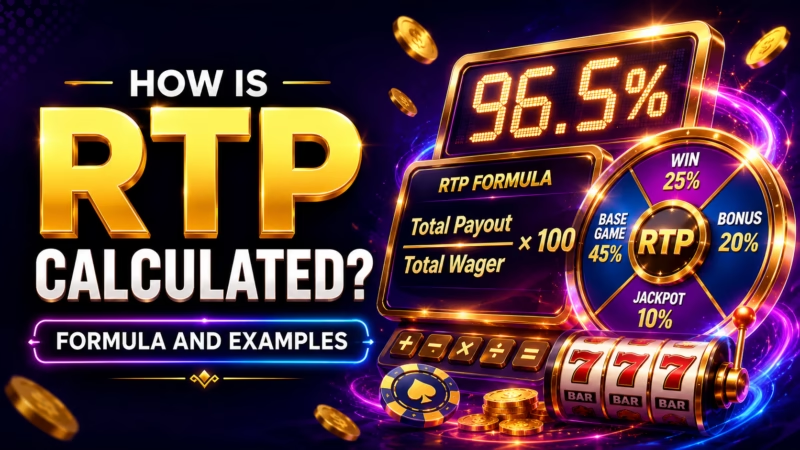
RTP and house edge describe the same mathematical relationship from opposite perspectives. RTP shows the theoretical percentage of wagered money returned to players over the long term, while house edge shows the theoretical percentage retained by the casino. This guide explains the difference between RTP and house edge, how to calculate both figures, and how to use them when comparing casino games.
Quick takeaways
- A game with 96% RTP has a 4% house edge.
- RTP represents the player side of the calculation.
- House edge represents the casino side of the calculation.
- Neither figure predicts the result of an individual bet or session.
- Rules, game variants and RTP configurations can change the percentages.
- A higher RTP generally means a lower theoretical cost over extensive play.
RTP and house edge are useful for players who want to compare the mathematical cost of different games. However, these percentages should not be treated as promises. Short sessions can produce results that are far above or below the theoretical average because casino game outcomes remain random.
What Is RTP?
Return to Player, commonly shortened to RTP, is the theoretical percentage of all wagered money that a casino game is designed to return to players over a very large number of rounds.
For example, a slot with a 96% RTP is theoretically designed to return $96 for every $100 wagered across its complete long-term game cycle. The remaining $4 represents the mathematical advantage of the casino.
This does not mean that every player will receive $96 after betting $100. The RTP calculation may be based on millions or billions of simulated or actual game rounds. An individual player might win more than the amount wagered, lose the entire amount, or finish close to the theoretical percentage.
RTP applies to total wagering volume, not simply the amount deposited. A player who deposits $100 and repeatedly wagers the same funds may generate $1,000 or more in total bets. The theoretical return is calculated from that total wagering volume.
RTP Formula
RTP = Total amount returned to players ÷ Total amount wagered × 100
If a game accepts $1,000,000 in total wagers and returns $960,000 in prizes, its calculated return would be:
$960,000 ÷ $1,000,000 × 100 = 96% RTP
For commercial casino games, the displayed RTP is normally a theoretical value based on the game’s mathematical model rather than a prediction of what will happen during one day, one session or one player’s activity.
What Is House Edge?
House edge is the theoretical percentage of each wager that the casino expects to retain over the long term.
A game with a 4% house edge has a theoretical average casino advantage of $4 for every $100 wagered. This does not mean that the casino wins exactly $4 from every player. It means that the game’s mathematical model favors the casino by that percentage across extensive play.
House edge is commonly used when discussing table games such as roulette, blackjack, baccarat and craps. RTP is more frequently displayed for slots, although both percentages can be calculated for most casino games.
House Edge Formula
House edge = 100% − RTP
For a game with a 96% RTP:
100% − 96% = 4% house edge
The reverse calculation also works:
RTP = 100% − house edge
For a game with a 2.7% house edge:
100% − 2.7% = 97.3% RTP
These formulas are accurate when the RTP and house edge refer to the same game, the same rules, the same bet and the same mathematical configuration.
RTP vs House Edge at a Glance
| Factor | RTP | House Edge |
| Perspective | Player | Casino |
| What it measures | Theoretical percentage returned | Theoretical percentage retained |
| Higher percentage means | Better theoretical return for players | Greater theoretical casino advantage |
| Commonly used for | Slots and digital casino games | Table games and casino mathematics |
| Example | 96% RTP | 4% house edge |
| Predicts one session? | No | No |
| Changes with game rules? | Yes | Yes |
The main difference between RTP and house edge is perspective. RTP focuses on how much wagering volume theoretically returns to players, while house edge focuses on how much wagering volume theoretically remains with the casino.
How RTP and House Edge Are Connected
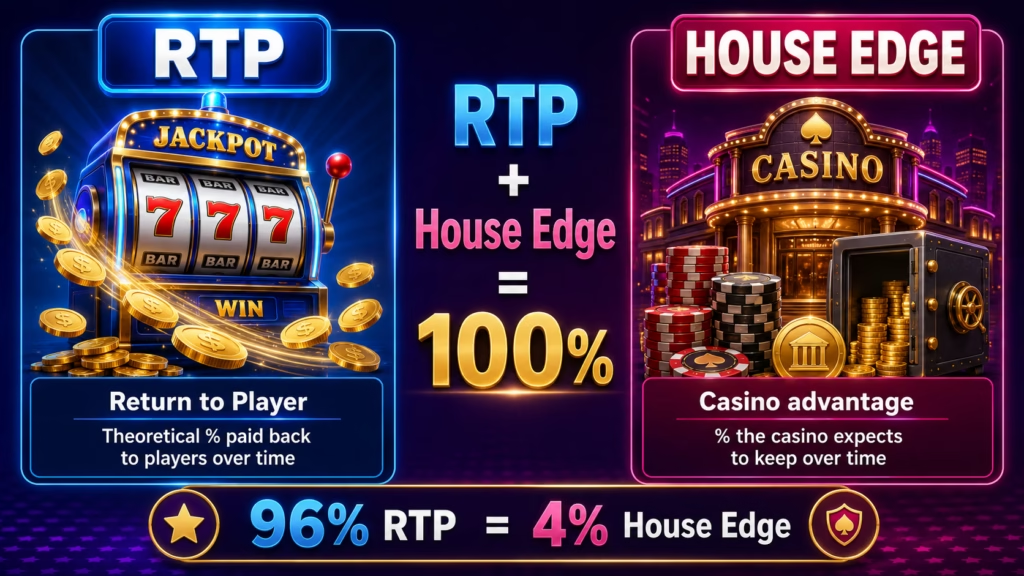
RTP and house edge normally add up to 100%.
A 97% RTP corresponds to a 3% house edge. A 94% RTP corresponds to a 6% house edge. The relationship remains the same regardless of whether the percentage is used for a slot, table game or other fixed-odds casino product.
| RTP | House Edge |
| 99% | 1% |
| 98% | 2% |
| 97% | 3% |
| 96% | 4% |
| 95% | 5% |
| 94% | 6% |
| 90% | 10% |
A higher RTP therefore means a lower house edge when all other conditions are equal. However, RTP alone does not describe how frequently a game pays, how large the prizes may be or how unstable the balance can become during play.
Practical Example of Expected Loss
Expected loss estimates the theoretical cost of wagering over the long term.
Expected loss = Total amount wagered × house edge
Suppose a player makes $1,000 in total wagers on a game with a 4% house edge:
$1,000 × 0.04 = $40 theoretical expected loss
The corresponding RTP is 96%, producing a theoretical expected return of:
$1,000 × 0.96 = $960
This calculation does not guarantee that the player will finish with $960. The actual result could be a profit, a smaller loss or a complete loss of the available bankroll. Expected loss becomes more relevant as the number of bets increases, but random variation can remain substantial.
Total amount wagered is also different from starting bankroll. A player may begin with $100 but wager a total of $1,000 by recycling wins and remaining funds through additional rounds.
Why Actual Results Differ from Theoretical RTP
Actual session results differ from RTP because the percentage is a long-term statistical expectation, not a session-level repayment rate.
A player can lose quickly on a 98% RTP game or win on a game with a much lower RTP. In a limited number of rounds, random variation can be much stronger than the game’s theoretical average.
Several factors affect short-term results:
- Number of rounds played
- Size of each wager
- Game volatility
- Prize distribution
- Bonus feature frequency
- Maximum payout structure
- Random sequence of outcomes
The law of large numbers means that aggregated results may move closer to the theoretical average as the sample becomes extremely large. It does not mean that a player’s balance must recover after losses or that the next result becomes more likely to win.
RTP Is Not the Same as Hit Frequency
RTP measures the total theoretical value returned, while hit frequency measures how often a game produces a winning result.
A slot can have a high RTP but a relatively low hit frequency if a significant portion of its theoretical return comes from occasional larger wins. Another slot may produce frequent small wins while still having a lower overall RTP.
A winning spin can also return less than the amount wagered. For example, a $1 spin that awards $0.40 may count as a winning result in the game statistics, even though the player’s balance decreases by $0.60.
Players should therefore avoid using hit frequency as a replacement for RTP. The two measurements answer different questions.
RTP Is Not the Same as Volatility
RTP describes the theoretical long-term return. Volatility describes how prizes are distributed and how widely short-term results may fluctuate.
Low-volatility games generally concentrate more of their returns in smaller, more frequent payouts. High-volatility games tend to place more value in less frequent but potentially larger payouts.
Two slots can both have a 96% RTP while creating very different playing experiences. One may generate many small payouts, while the other may have extended periods without meaningful wins followed by occasional larger prizes.
Volatility does not change the basic relationship between RTP and house edge. It changes the path through which the game produces its theoretical return.
How Game Rules Affect House Edge
The same casino game can have different house edges depending on its rules and available bets.
European roulette with one zero has a house edge of approximately 2.70% on standard bets, corresponding to an RTP of approximately 97.30%. American roulette adds a double-zero pocket, increasing the standard house edge to approximately 5.26% and reducing the RTP to approximately 94.74%.
Blackjack percentages can change based on rules such as:
- Number of decks
- Dealer actions on soft 17
- Blackjack payout
- Doubling restrictions
- Splitting rules
- Surrender availability
Blackjack also differs from most slots because player decisions can affect the effective house edge. Poor decisions may increase the casino advantage, while mathematically informed basic strategy may reduce it under favorable rules. No strategy removes randomness or guarantees a profit.
Why a Slot’s RTP May Vary Between Casinos
Some slots are available in multiple RTP configurations. The visual design, features and title may remain the same while the mathematical return differs.
For example, a provider may offer several approved versions of a slot to casino operators. One casino could use a 96% version, while another uses a lower-return configuration.
Players should check the information panel, paytable or official game rules at the specific casino where the game is available. An RTP figure taken from a review, database or another operator may not match the active version.
RTP may also differ between the base game, bonus bets, jackpots or optional features. A feature-buy option can have its own theoretical return, which should be checked separately rather than assumed to match the standard spin.
Which Is More Useful: RTP or House Edge?
RTP and house edge are equally valid when they describe the same mathematical model. The more useful term depends on the type of comparison being made.
RTP is usually easier when comparing slots because providers commonly publish the return percentage directly. House edge is often more practical for table games because it shows the theoretical cost of each betting option.
A player comparing games should consider:
- The exact RTP or house edge: Check the active game rules rather than relying only on a general figure.
- Total wagering volume: The mathematical cost applies to every wager, including funds wagered repeatedly.
- Volatility: Similar RTP values can produce very different balance swings.
- Game speed: Faster play creates more wagers in the same amount of time.
- Bet rules: Side bets and optional features often have different mathematical returns.
- Personal limits: A favorable percentage does not make continued gambling financially safe.
A lower house edge reduces theoretical long-term loss compared with a higher house edge, but it does not turn a casino game into a positive-expectation investment.
Common RTP and House Edge Mistakes
Believing 96% RTP Guarantees a $96 Return
A 96% RTP does not guarantee that a player receives $96 after wagering $100. The percentage applies across a very large number of wagers and players.
Confusing Deposit Size with Wagering Volume
A $100 deposit can generate much more than $100 in total wagers. Expected loss is based on the total amount bet, not the initial deposit.
Assuming a Game Is Due to Pay
Past losses do not force a random game to produce a future win. Each independent outcome follows the game’s rules and random number generation.
Choosing Games Based Only on RTP
RTP does not reveal volatility, hit frequency, maximum payout, game speed or the distribution of prizes. These factors can significantly affect the playing experience.
Ignoring Different Bets Within the Same Game
A table game can contain bets with very different house edges. Roulette straight-up bets and even-money bets have the same house edge on a standard wheel, but many side bets in other games carry a substantially higher casino advantage than the main wager.
Treating a Small House Edge as a Winning Strategy
A low house edge reduces the theoretical cost of play. It does not eliminate the casino advantage, predict outcomes or guarantee that a session will last longer.
How to Use RTP and House Edge Responsibly
RTP and house edge should be used as comparison tools, not as systems for predicting wins.
Before playing:
- Confirm the RTP or house edge in the current game rules.
- Check whether optional bets have separate percentages.
- Set a fixed spending limit before the first wager.
- Avoid increasing bets to recover previous losses.
- Consider game speed because rapid play increases total wagering.
- Stop when the planned time or money limit is reached.
Casino games should be treated as paid entertainment rather than a source of income. A player who feels pressure to recover losses, borrow money, hide gambling activity or continue beyond planned limits should stop playing and consider seeking support from an appropriate responsible gambling service.

How This Information Was Reviewed
This comparison is based on the mathematical relationship between theoretical player return, casino advantage and total wagering volume. The calculations assume that RTP and house edge refer to the same game configuration, rules and betting option.
Players should verify the active RTP, paytable, bonus rules and optional bet conditions inside the game or through official provider information. Casino implementations may differ, and theoretical percentages cannot predict individual sessions.
RTP, volatility, hit frequency and bonus mechanics describe different parts of a game’s mathematical design. None of these measurements guarantees a win or removes the risk of losing the amount wagered.
FAQ
Is RTP the opposite of house edge?
Yes. RTP represents the theoretical percentage returned to players, while house edge represents the theoretical percentage retained by the casino. A 96% RTP normally corresponds to a 4% house edge.
How do you convert RTP into house edge?
Subtract the RTP from 100%. For example, 100% minus 97% RTP equals a 3% house edge. The calculation assumes that both figures refer to the same rules and game configuration.
Does 96% RTP mean I will get $96 back from $100?
No. A 96% RTP is a long-term theoretical average across extensive wagering. An individual $100 session can return more than $100, less than $96 or nothing at all.
Is a higher RTP always better?
A higher RTP means a lower theoretical casino advantage when comparing equivalent wagers. However, it does not guarantee better short-term results, and it does not describe volatility, hit frequency or prize distribution.
Can a casino change a slot’s RTP?
A casino operator may be able to select from RTP configurations supplied and approved by the game provider. The operator does not normally create an arbitrary percentage. Players should check the RTP shown in the active game’s rules or information panel.
Does house edge apply to every individual bet?
House edge describes a long-term mathematical average, not a fixed charge deducted from each result. A single bet can win or lose its full amount, but extensive wagering is expected to reflect the casino advantage more closely.
Does a low house edge mean I can make money?
No. A low house edge reduces theoretical expected loss but does not create guaranteed profit. Random outcomes can produce temporary wins, while continued wagering generally increases exposure to the casino advantage.
Are RTP and volatility the same?
No. RTP measures theoretical long-term return, while volatility describes the frequency and size pattern of payouts. Games with identical RTP percentages can have very different levels of volatility.
Why is total wagering more important than the deposit?
House edge applies to every wager made. A player who deposits $100 but generates $1,000 in repeated bets has exposed $1,000 of wagering volume to the game’s mathematical advantage.
Can RTP predict when a slot will pay?
No. RTP cannot predict the timing of wins, bonus rounds or large payouts. Random game outcomes do not become guaranteed because a slot has recently produced losses.
Brief Conclusion
RTP and house edge express the same casino mathematics from opposite sides. RTP shows the theoretical percentage returned to players, while house edge shows the theoretical percentage retained by the casino. A 96% RTP equals a 4% house edge.
These percentages can help compare games and betting options, but they cannot predict an individual result. Players should verify the exact rules, consider volatility and total wagering volume, set strict limits and treat casino games as entertainment rather than a way to earn money.