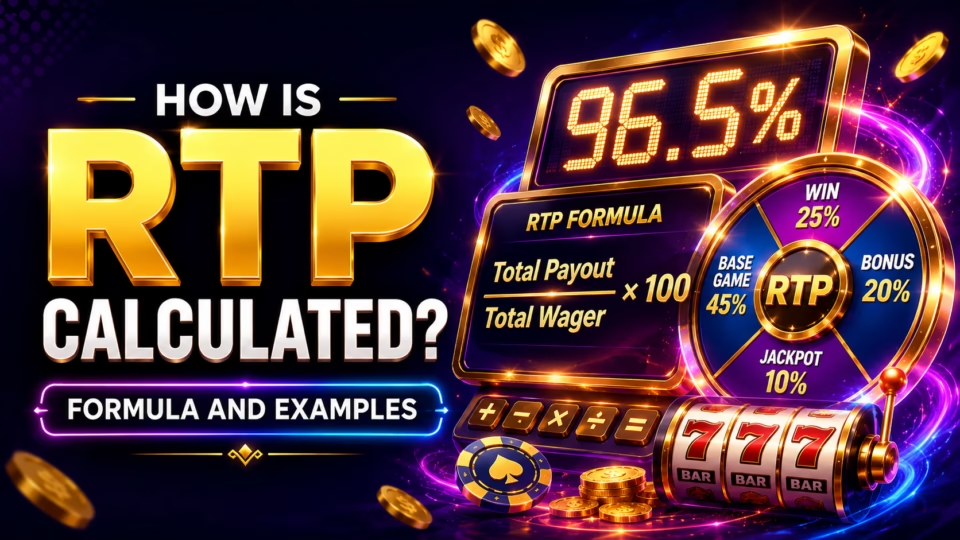
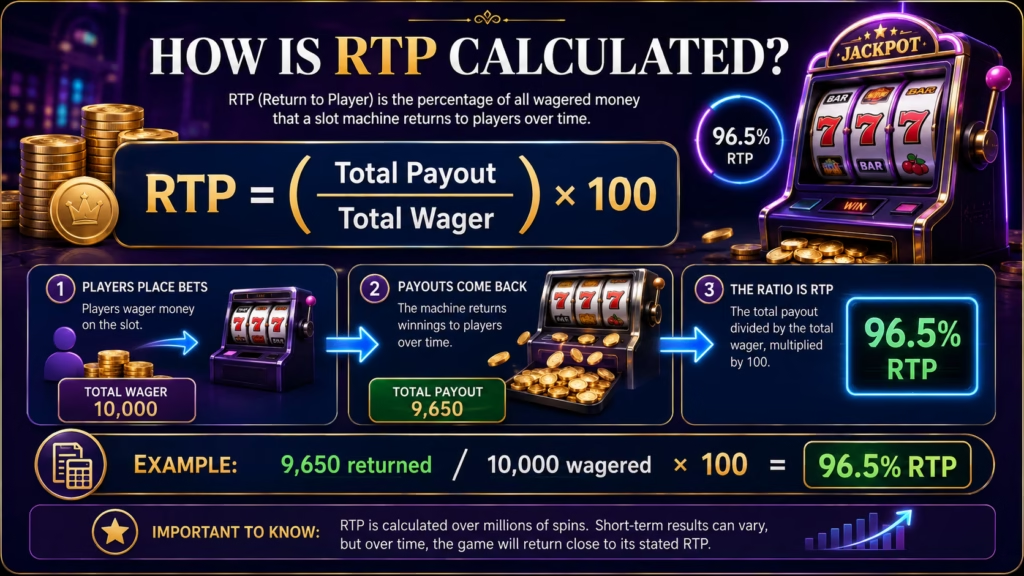
RTP is calculated by dividing the amount a casino game is expected to return to players by the total amount wagered, then multiplying the result by 100. For a game with a theoretical RTP of 96%, the mathematical model is designed to return an average of $96 for every $100 wagered over a very large number of rounds.
The basic RTP calculation formula is:
| RTP = Expected Return ÷ Total Amount Wagered × 100 |
For individual game outcomes, the more precise formula is:
| RTP = Σ (Probability of Outcome × Payout of Outcome) × 100 |
The symbol Σ means that the probability-weighted returns of all possible outcomes are added together.
Quick takeaways
- RTP is a long-term mathematical percentage, not a prediction for one session.
- A 96% RTP does not mean every player receives $96 after wagering $100.
- Game developers calculate theoretical RTP from every possible outcome and its probability.
- Actual or observed RTP is calculated from real wagers and payouts over a selected period.
- RTP does not show how frequently a game pays or how large individual wins may be.
Understanding the RTP calculation formula is useful for players who want to compare casino games more accurately. However, RTP should not be used as a promise of a particular result because individual rounds remain random.
What Does RTP Mean?
RTP stands for Return to Player. It represents the theoretical percentage of all wagered money that a casino game is expected to return to players over the long term.
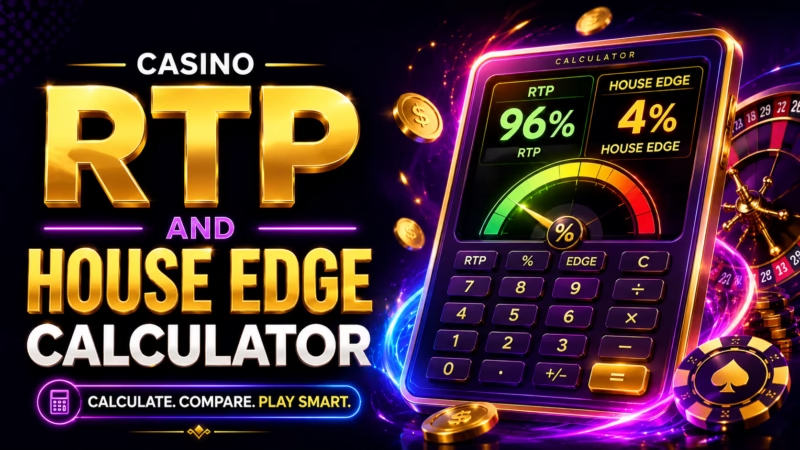
A slot with a 96% RTP has a theoretical house edge of 4%. The relationship between RTP and house edge is:
| House Edge = 100% − RTP |
For example:
| 100% − 96% = 4% house edge |
This does not mean the casino takes exactly $4 from every $100 wagered by an individual player. The percentage describes the mathematical expectation across a very large number of bets made by many players.
A player can wager $100 and finish with $150, $40 or nothing. These short-term results do not contradict the stated RTP because random variation can be substantial over small samples.
The Basic RTP Calculation Formula
The simplest RTP formula compares the expected or recorded amount returned with the amount wagered:
| RTP = Total Returned to Players ÷ Total Wagered × 100 |
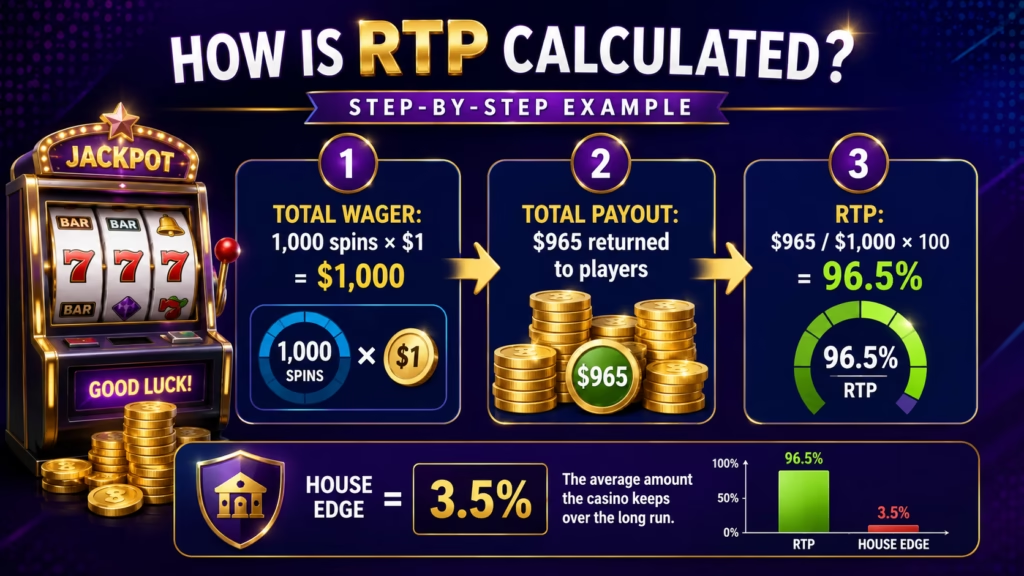
Suppose players wager a combined total of $1,000,000 on a game, and the game returns $960,000 in prizes:
| RTP = $960,000 ÷ $1,000,000 × 100 |
| RTP = 96% |
This calculation can describe observed performance over a particular dataset. A theoretical RTP is calculated differently because it is based on the probabilities built into the game rather than a limited history of real play.
How Is Theoretical RTP Calculated?
Theoretical RTP is calculated by multiplying the probability of every possible outcome by the amount returned for that outcome. All probability-weighted returns are then added together.
The formula is:
| Theoretical RTP = Σ (Outcome Probability × Outcome Return) |
The result is normally expressed as a percentage of the original wager.
For a simple game, every possible result can be listed directly. Modern slots are more complicated because the calculation may include:
- weighted reel symbols;
- paylines or ways to win;
- wild substitutions;
- scatter prizes;
- free spins;
- multipliers;
- expanding symbols;
- bonus games;
- progressive jackpots;
- feature purchase options;
- different game states.
Every feature that can return money must be included in the complete mathematical model. If a bonus round contributes 20 percentage points to the total RTP, removing that bonus contribution would produce an incomplete and misleading calculation.
Simple RTP Calculation Example
Consider a fictional game that costs $1 per round and has four possible outcomes.
| Outcome | Probability | Total Return | Probability × Return |
| No prize | 60% | $0 | $0.00 |
| Small prize | 25% | $1 | $0.25 |
| Medium prize | 10% | $2 | $0.20 |
| Large prize | 5% | $10 | $0.50 |
The probability-weighted returns are added together:
| $0.00 + $0.25 + $0.20 + $0.50 = $0.95 |
The expected return for each $1 wager is $0.95.
| RTP = $0.95 ÷ $1 × 100 = 95% |
The theoretical RTP of this fictional game is therefore 95%, while its house edge is 5%.
This example does not mean that a player receives 95 cents after every $1 round. Most rounds in the example return nothing, while a small percentage produce larger prizes. The 95% figure becomes meaningful only when the results are averaged across a sufficiently large number of rounds.
RTP Calculation Using Payout Multipliers
RTP can also be calculated with payout multipliers instead of currency amounts. When a one-unit wager is used, the payout multiplier represents the number of wager units returned.
Suppose a game has these possible results:
- 70% chance of returning 0× the wager;
- 20% chance of returning 1× the wager;
- 8% chance of returning 3× the wager;
- 2% chance of returning 25× the wager.
The calculation is:
| RTP = (0.70 × 0) + (0.20 × 1) + (0.08 × 3) + (0.02 × 25) |
| RTP = 0 + 0.20 + 0.24 + 0.50 |
| RTP = 0.94 or 94% |
The game has a theoretical RTP of 94%.
When using this method, it is important to confirm whether a listed payout includes the original stake. Some game rules describe the total amount returned, while others describe profit in addition to the original wager. Mixing these two formats can produce the wrong RTP.
How Slot Machine RTP Is Calculated
Slot machine RTP is calculated from the probability of every possible symbol combination and the prize assigned to each winning combination. The probabilities depend on the game’s reel strips, symbol weighting and feature rules.
A digital slot can display five reels with several visible symbols, but the displayed grid does not reveal the complete mathematical model. Each reel may use a virtual reel strip containing symbols with different frequencies.
For example, a jackpot symbol may appear once on a virtual reel, while a low-paying symbol may appear many times. The random number generator selects positions from these reel strips. The probability of landing a particular combination depends on how frequently each required symbol appears.
For a basic three-reel game, the probability of a specific three-symbol combination can be represented as:
| Combination Probability = Probability on Reel 1 × Probability on Reel 2 × Probability on Reel 3 |
The return from that combination is then:
| Expected Contribution = Combination Probability × Combination Payout |
The expected contributions of all winning combinations, bonus triggers and special features are added together to produce the total theoretical RTP.
Real video slots may contain thousands or millions of possible outcomes, so the calculation is normally performed using mathematical models and simulation tools rather than manually.
Base Game RTP and Bonus Feature RTP
A slot’s total RTP can be divided into contributions from different parts of the game.
For example, a fictional 96% RTP slot might be structured as follows:
- 70% from regular line or ways wins;
- 6% from scatter prizes;
- 18% from free spins;
- 2% from another bonus feature.
The combined return is:
| 70% + 6% + 18% + 2% = 96% RTP |
This breakdown explains why bonus features can be important to the mathematical return. A player who does not trigger the bonus during a short session may experience a return far below the theoretical RTP.
The exact division between the base game and bonus features should be checked in the official game information when available. Not every provider publishes a detailed RTP contribution breakdown.
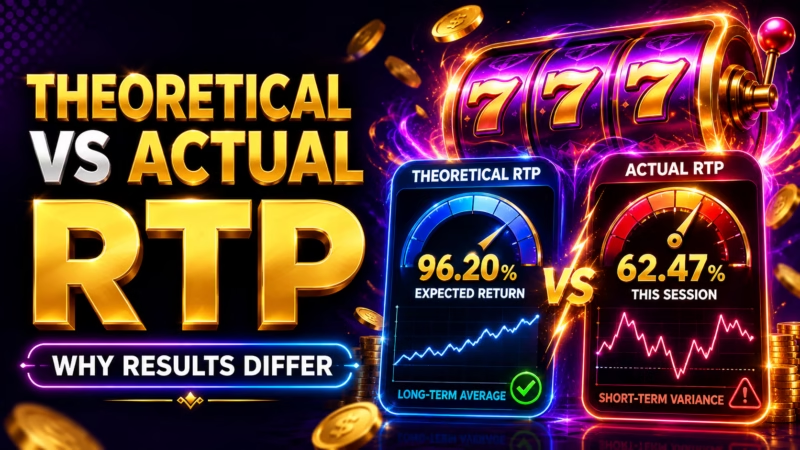
Theoretical RTP vs Actual RTP
Theoretical RTP is the percentage produced by the game’s mathematical design. Actual RTP, also called observed RTP, is calculated from real wagers and real payouts during a selected period.
The actual RTP formula is:
| Actual RTP = Recorded Payouts ÷ Recorded Wagers × 100 |
Suppose a game receives $50,000 in wagers during one day and pays out $44,000:
| Actual RTP = $44,000 ÷ $50,000 × 100 = 88% |
An 88% actual return over one day does not necessarily mean the stated theoretical RTP is incorrect. The sample may be too small, especially when the game includes rare high-value prizes.
Over another period, the game might return more than 100% because one or several players received large wins. As the number of rounds increases, observed RTP may move closer to the theoretical percentage, but there is no fixed number of spins that guarantees an exact match.
RTP per Spin vs RTP per Session
RTP is not normally calculated as a guaranteed return for one spin or one player session. RTP describes an expected average across the game’s complete probability model.
A 96% RTP means that the expected loss is four units per 100 units wagered over the mathematical long run. It does not mean a player should expect to lose exactly 4% during every session.
The amount wagered also matters more than the initial deposit when evaluating theoretical loss. A player who deposits $100 and repeatedly reuses returned funds may place $500 in cumulative wagers.
At a 96% theoretical RTP:
| Expected Return = $500 × 0.96 = $480 |
| Expected Loss = $500 − $480 = $20 |
The $20 figure is a mathematical expectation, not a guaranteed session result.
Does Bet Size Change RTP?
Bet size usually does not change RTP when all bet levels use the same paytable and game rules. A $1 bet and a $5 bet would have the same theoretical percentage, although the monetary wins and losses would be five times larger at the higher stake.
However, RTP can change when:
- different bet levels unlock different paylines or features;
- jackpot eligibility requires a specific wager;
- the casino uses another RTP configuration;
- different game modes have separate paytables;
- a feature purchase has its own theoretical return.
Players should check the paytable and game information instead of assuming that every stake or mode uses the same RTP.
Why the Same Slot May Have Different RTP Values
The same slot title may be available in several RTP configurations. A provider may supply versions such as 96%, 94% or 92%, allowing the operator to select one of the approved mathematical settings.
The game’s graphics and features may appear identical even when the configured return is different. The active RTP should therefore be checked inside the game information, help menu or paytable at the casino where the game is being played.
A provider’s promotional page may show the highest or standard RTP configuration, but that value may not match every casino implementation. The in-game information is generally more relevant to the version currently available to the player.
RTP Does Not Show Hit Frequency
RTP and hit frequency measure different parts of a casino game.
| RTP measures the proportion of wagered money expected to be returned over the long term. Hit frequency measures how often a spin produces a winning result. |
Two slots can both have a 96% RTP but feel completely different:
- one may produce frequent small wins;
- the other may produce long losing sequences followed by occasional larger wins.
A frequent win is not always profitable. A $1 spin that returns $0.40 may count as a winning hit even though the player lost $0.60 on the round.
Players should not use hit frequency as a replacement for RTP or assume that frequent prizes create a higher long-term return.
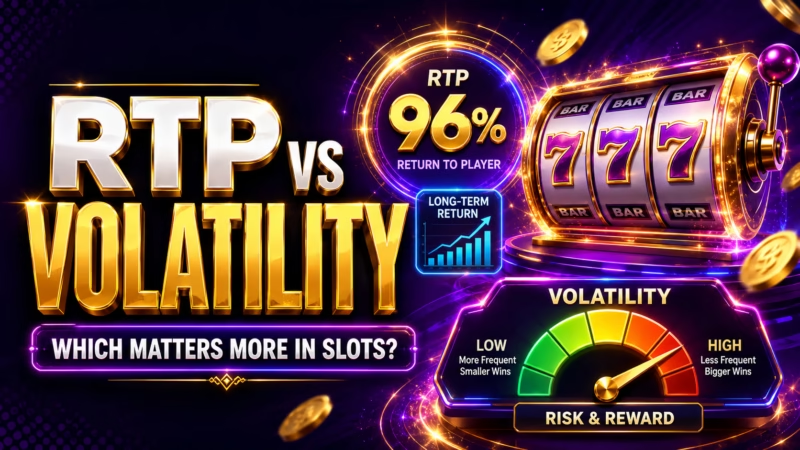
RTP Does Not Measure Volatility
RTP measures expected long-term return, while volatility describes how that return may be distributed across wins.
A low-volatility game usually distributes more of its return through smaller and more frequent prizes. A high-volatility game may concentrate more of its return in less frequent, larger outcomes.
Two games can have identical RTP values but very different bankroll requirements and session experiences. Players with smaller budgets may find high-volatility games difficult because longer losing sequences can occur before a meaningful prize appears.
Volatility does not increase the certainty of winning. It only describes the general distribution and variability of potential results.
Common RTP Calculation Mistakes
Treating RTP as a session guarantee
A 96% RTP does not guarantee that a player will recover $96 from a $100 session. Short-term results can vary widely.
Using the deposit instead of total wagers
RTP calculations use the cumulative amount wagered, not only the amount originally deposited. Rebetting returned funds increases total wagering volume.
Ignoring bonus rounds
A slot’s advertised RTP may include free spins, jackpots or bonus features. Calculating only regular spins can leave out a significant part of the theoretical return.
Confusing total return with profit
A 2× payout may mean a total return of twice the stake, or it may describe two times the stake as profit. The game rules must be checked before using payout figures in an RTP formula.
Assuming every casino offers the same RTP
Some games support several mathematical configurations. The exact percentage can depend on the operator and game version.
Comparing RTP without considering volatility
A higher RTP can improve the long-term mathematical expectation, but it does not guarantee smoother results or more frequent prizes.
How to Compare Casino Games Using RTP
RTP is most useful as one comparison factor rather than the only selection criterion.
When comparing two games, check:
- The active RTP: Use the value displayed in the game rules or paytable.
- Volatility: Decide whether the game’s likely win distribution suits the available budget.
- Hit frequency: Check whether the game is designed around frequent small wins or less frequent outcomes.
- Maximum win: Consider whether a large advertised maximum depends on an extremely rare combination.
- Bonus contribution: Determine whether a substantial part of the return comes from free spins or jackpots.
- Bet requirements: Confirm whether all features remain available at the intended stake.
- RTP configuration: Make sure the percentage applies to the casino version being considered.
A slightly higher RTP can be mathematically preferable over the long term, but the difference may be difficult to observe during a short session. For example, the theoretical difference between 96% and 95% is one unit per 100 units wagered, averaged across the mathematical long run.
How This Information Was Reviewed
The RTP formulas in this guide are based on expected-value calculations, probability-weighted payouts and the standard relationship between RTP and house edge.
The exact RTP of a specific game should be verified through its paytable, help screen or official rules because providers and casino operators may offer multiple configurations. Players should also check whether the displayed return includes jackpots, bonus features or optional game modes.
RTP, volatility and hit frequency describe mathematical characteristics. None of these metrics can predict the next spin or guarantee a profitable session. Casino games should be treated as paid entertainment, and players should set firm time and spending limits before playing.
FAQ
How do you calculate RTP?
RTP is calculated by dividing the expected or recorded amount returned to players by the total amount wagered, then multiplying by 100. For theoretical RTP, the probability of each possible outcome is multiplied by its payout, and all results are added together.
What is the RTP calculation formula?
The basic RTP calculation formula is RTP = Total Return ÷ Total Wagered × 100. For a mathematical game model, the formula is RTP = Σ (Outcome Probability × Outcome Return) × 100.
What does a 96% RTP mean?
A 96% RTP means the game is mathematically designed to return an average of 96 units for every 100 units wagered over a very large number of rounds. It does not guarantee a 96% return for an individual player or session.
How is RTP calculated for a slot machine?
Slot RTP is calculated from the probability and payout of every possible reel combination, bonus trigger, jackpot and special feature. The probability-weighted returns are added together to determine the total theoretical percentage.
Can actual RTP be higher than 100%?
Actual RTP can exceed 100% over a limited period if players receive unusually large prizes. This does not change the game’s theoretical RTP and does not mean the game will continue returning more than it receives.
How many spins are needed to reach the stated RTP?
There is no universal number of spins that guarantees the observed result will match the theoretical RTP. Games with rare high-value prizes may require extremely large samples before actual results move close to the mathematical percentage.
Does a higher RTP mean more frequent wins?
A higher RTP does not necessarily mean more frequent wins. Win frequency is measured by hit frequency, while RTP measures the expected proportion of wagers returned over the long term.
Is RTP calculated before or after the casino bonus?
A game’s RTP is normally based on its internal paytable and mathematical model, not on a casino deposit bonus. Bonus wagering requirements, restricted games and maximum bet rules are separate casino terms that should be checked before accepting an offer.
Can a casino change a slot’s RTP?
A casino may be able to choose from RTP configurations supplied for a particular game, but it does not normally create an arbitrary percentage. The active value can vary by operator, so players should check the information displayed inside the game.
Can RTP predict whether the next spin will win?
RTP cannot predict the next spin. Each result is generated according to the game’s random process, and a previous win or loss does not reveal what the next outcome will be.
Key Takeaway
RTP is calculated from the relationship between wagers, outcome probabilities and payouts. The formula provides a useful long-term comparison between casino games, but it does not predict individual results. Always verify the active RTP in the game rules, consider volatility and hit frequency separately, and treat casino games as entertainment rather than a source of income.