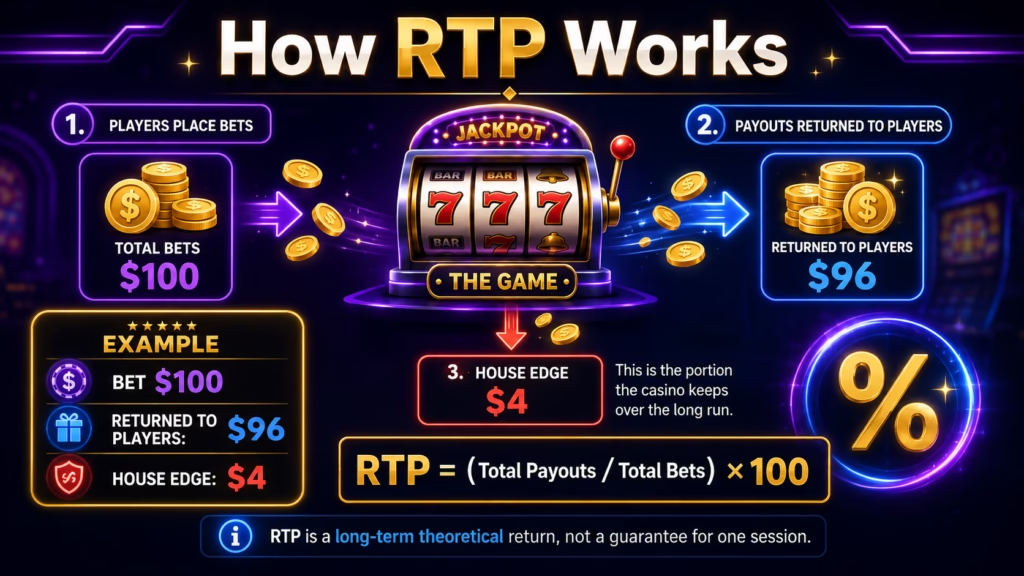
RTP in casino games means Return to Player, a theoretical percentage showing how much of all money wagered on a game is expected to be returned to players over a very large number of rounds. A casino game with 96% RTP is designed to return approximately $96 for every $100 wagered in the long term, while the remaining $4 represents the theoretical house edge.
RTP does not tell you how much you will win or lose during one session. A player can win more than the advertised RTP suggests, lose an entire budget quickly, or finish close to the starting balance. The percentage becomes meaningful only across a large volume of bets involving many players.
Key points
- A higher RTP generally means a lower theoretical casino advantage.
- RTP describes long-term mathematical performance, not short-term results.
- Two games with the same RTP can feel completely different because of volatility and hit frequency.
- Some casino games have several RTP configurations, so the exact percentage should be checked in the paytable.
- RTP cannot predict the next spin, bonus round, card, dice roll, or winning session.
Understanding RTP is useful for players comparing slots, table games, video poker, live casino games, and other formats. Extra caution is needed when RTP is presented as a way to guarantee profit, because casino outcomes remain uncertain and the mathematical advantage normally stays with the operator.
What Does RTP Mean in Casino Games?
Return to Player is a mathematical estimate of the proportion of wagered money that a casino game returns as prizes over time. The RTP percentage is calculated from the game’s rules, probability model, paytable and possible winning outcomes.
For example, consider a slot with an advertised RTP of 96%. If players collectively wagered $10 million under the same game configuration, the mathematical model would expect approximately $9.6 million to be returned as winnings over the long term. The remaining $400,000 would represent the theoretical casino advantage.
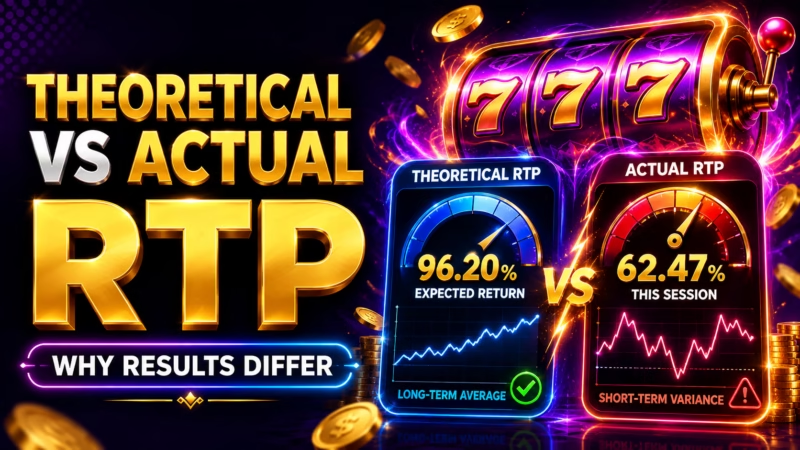
This example does not mean every group of players will receive exactly 96% back. Actual results can move above or below the theoretical figure, especially over shorter periods. The larger the number of rounds, the more likely the overall result is to move toward the mathematical expectation.
How Does RTP Work in Casino Games?
RTP works by combining the probability of every possible outcome with the amount paid for that outcome. The game’s mathematical model considers losing rounds, small wins, medium wins, bonus prizes and rare large wins.
RTP = expected amount returned to players ÷ total amount wagered × 100
Suppose a basic game accepts $100,000 in total wagers and pays $95,000 back to players. Its observed return for that sample would be 95%. However, this observed return is not automatically the official RTP. The official percentage is based on the theoretical game model rather than one limited period of real results.
In slots, RTP is distributed across thousands or millions of possible spin combinations. Part of the percentage may come from regular line wins, while another part may come from free spins, multipliers, jackpots or bonus features. A player who never triggers an important bonus feature may experience a return far below the game’s theoretical RTP.
RTP Example in a Casino Session
Imagine that you deposit $100 and play a slot with 96% RTP using $1 bets. It would be incorrect to expect a final balance of $96 after 100 spins.
- $0 after an unfavorable sequence;
- $60 after receiving several small wins;
- $110 after a profitable session;
- $500 after triggering a strong bonus round.
All four results are possible without changing the game’s published RTP. The 96% figure describes the game’s long-term mathematical return across an enormous number of spins. It does not control the result of an individual session.
The same principle applies when winnings are reused. If you wager $100, win $80 and then wager that $80 again, your total amount wagered is $180 even though you originally deposited only $100. RTP calculations are based on total wagers, not deposits.
RTP and House Edge
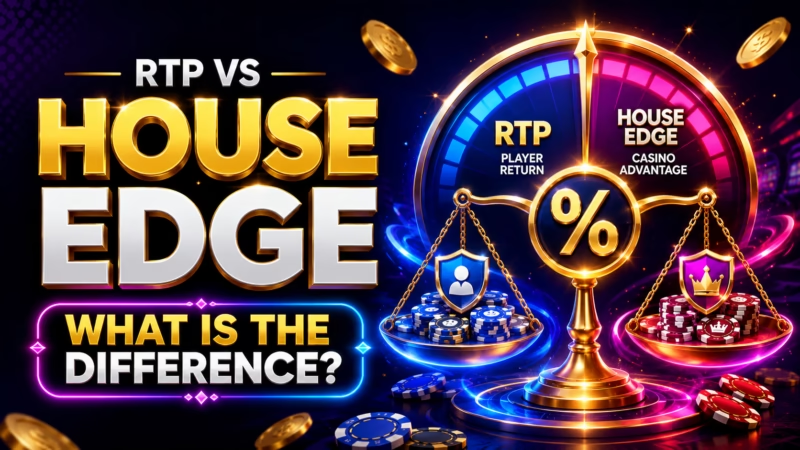
RTP and house edge describe opposite sides of the same mathematical relationship.
| RTP | Theoretical house edge |
| 99% | 1% |
| 97% | 3% |
| 96% | 4% |
| 94% | 6% |
| 90% | 10% |
The basic relationship is:
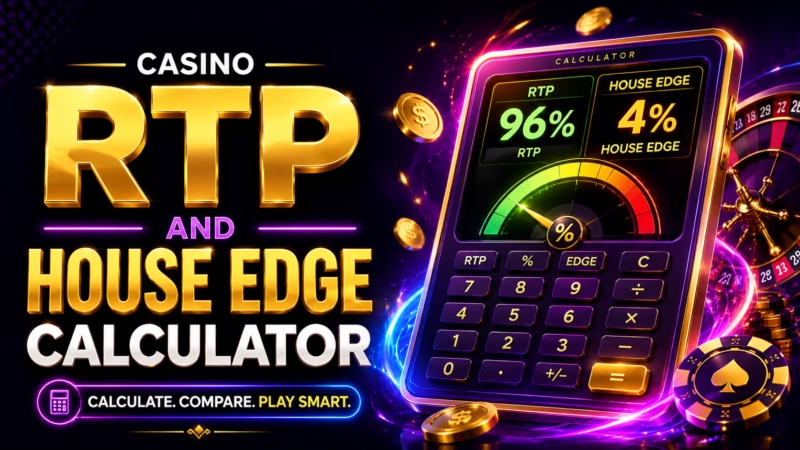
House edge = 100% – RTP
A game with 96% RTP therefore has a theoretical house edge of 4%. Over the long term, the game is mathematically expected to retain approximately 4% of the total amount wagered.
The house edge should not be confused with a guaranteed loss rate. A 4% house edge does not mean a player will lose exactly $4 from every $100 deposit. It means the expected loss is approximately $4 per $100 wagered across a sufficiently large number of rounds.
RTP vs Volatility
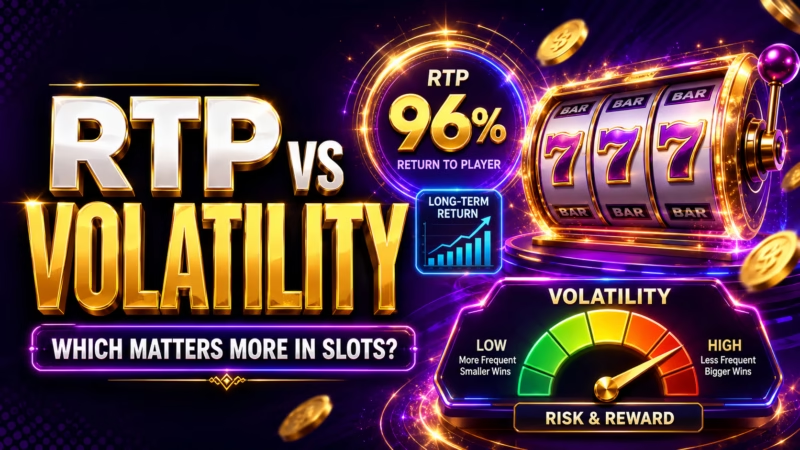
RTP measures the expected long-term return, while volatility describes how that return may be distributed between wins.
A low-volatility game usually produces smaller wins more frequently. A high-volatility game may produce longer losing periods followed by less frequent but potentially larger prizes. Two slots can both have 96% RTP while delivering very different playing experiences.
For example:
- Game A: 96% RTP with low volatility and frequent small payouts.
- Game B: 96% RTP with high volatility and rare large bonus prizes.
Game A may preserve a balance for longer, although it can still produce losses. Game B may reduce the balance quickly when the main bonus features do not appear. Neither game offers a guaranteed advantage, because both retain the same theoretical RTP.
Players with smaller budgets often find low or medium volatility easier to manage. High-volatility games may appeal to players who accept greater balance swings, but strict spending limits remain important.
RTP vs Hit Frequency
Hit frequency estimates how often a game produces any winning result. RTP measures the value of all expected winnings rather than simply how often wins occur.
A slot with a 30% hit frequency might produce a winning combination on approximately 30% of spins over the long term. Some of these wins may be smaller than the original bet. A $1 spin that returns $0.40 is technically a winning result, but the player still loses $0.60 overall.
A high hit frequency does not automatically mean high RTP. A game can award frequent small payouts while retaining a relatively large house edge. A low hit frequency game can have a competitive RTP if occasional wins are large enough to compensate mathematically for the longer losing periods.
RTP, volatility and hit frequency should therefore be evaluated together.
Can the Same Casino Game Have Different RTP Values?
Yes. Many online casino games are supplied in several mathematical configurations. A slot may be available with RTP settings such as 96%, 94% or 92%, depending on the version selected by the casino.
The graphics, features and title can remain identical even when the underlying return percentage is different. This makes checking the game information important before playing.
The exact RTP may appear in:
- the paytable;
- the help menu;
- the game rules;
- the information screen;
- the provider’s official documentation.
Casino review pages and external databases can provide useful guidance, but the value displayed inside the game should take priority because it reflects the version currently offered by that operator.
What Is Considered a Good RTP?
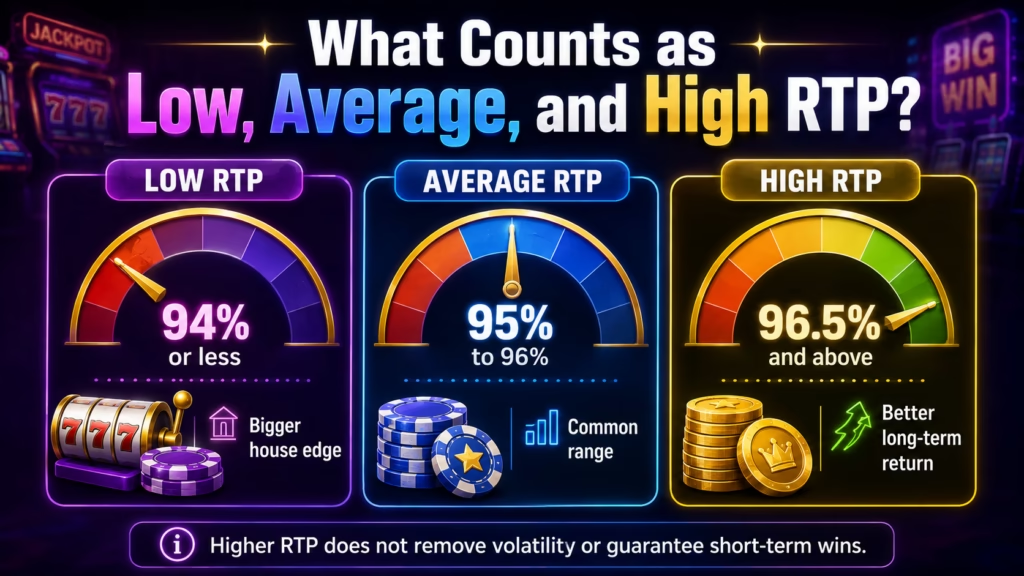
A good RTP is one that compares favorably with similar games in the same category. There is no single percentage that is ideal for every casino format.
For online slots, an RTP close to 96% is commonly treated as a useful comparison point. A slot above that level may offer a lower theoretical house edge, while a substantially lower value means more of the total wagered amount is expected to remain with the casino over time.
Table games often require a different comparison because their RTP can depend on rules and player decisions. Blackjack RTP may change according to the number of decks, dealer rules, doubling options and the strategy used. Video poker return can vary with the paytable and the accuracy of the player’s decisions.
Players should compare games within the same category instead of assuming that a percentage considered competitive for a slot is equally competitive for blackjack, roulette or video poker.
Does Higher RTP Mean Better Chances of Winning?
A higher RTP improves the theoretical long-term return, but it does not guarantee a winning session. The difference becomes more relevant as the total amount wagered increases.
Consider two slots:
- Slot A has 96% RTP.
- Slot B has 92% RTP.
Slot A has a theoretical house edge of 4%, while Slot B has a theoretical house edge of 8%. Over a very large amount of wagering, Slot A is expected to retain less money for the casino.
During a short session, Slot B could still produce the larger win. Random variation can dominate short-term results. Higher RTP is therefore a sensible comparison criterion, but it cannot identify which game will pay on a particular day.
Does Bet Size Change RTP?
Bet size normally does not change RTP when every stake level uses the same paytable and game configuration. A $0.20 spin and a $2 spin would have the same theoretical percentage, although the financial consequences would be ten times larger at the higher stake.
Exceptions can exist. Some games unlock jackpots, bonus features or enhanced paytables only at specific bet levels. Certain table games may also apply different rules or side bets depending on the stake.
Players should check whether all features are active at the selected bet. Increasing the stake solely because a larger bet appears more likely to win is not supported by RTP mathematics.
Common Myths About Casino RTP
“A game must pay after a long losing streak”
A losing streak does not force the next result to be a win. In games based on independent random outcomes, previous rounds do not determine the next spin or deal.
“A slot that recently paid a jackpot will stop paying”
A recent jackpot does not prove that a game has entered a colder period. The next result is generated according to the game’s rules and probability model.
“96% RTP means I will keep 96% of my deposit”
RTP applies to total wagers over the long term, not to the original deposit. Replaying winnings increases the total amount wagered and exposes the balance to the house edge repeatedly.
“Casinos can change RTP during my session”
A casino may offer a game configuration chosen in advance, but the displayed RTP should not dynamically rise or fall because one player is winning or losing. Players should use regulated operators and check the game information for the active configuration.
“High RTP makes a game profitable”
High RTP reduces the theoretical disadvantage compared with a lower-RTP alternative. It does not turn a negative-expectation casino game into a reliable source of income.
How to Use RTP When Choosing Casino Games
RTP should be used as a comparison tool rather than a prediction tool.
1. Check the exact game version. Do not assume every casino offers the same RTP configuration.
2. Compare similar games. Evaluate slots against other slots and table games against versions with comparable rules.
3. Consider volatility. A high-RTP game can still produce severe short-term losses if it has high volatility.
4. Review the paytable. Check how much RTP is tied to rare jackpots, bonus rounds or maximum prizes.
5. Choose a manageable stake. Smaller bets allow more rounds from the same budget, although they do not remove the house edge.
6. Set limits before playing. Decide how much money and time you can afford to spend before starting.
7. Avoid chasing losses. Increasing bets after losses does not improve the game’s theoretical return or make a win due.
RTP is most useful when combined with clear spending limits, realistic expectations and an understanding that casino games are paid entertainment.
How This Information Was Reviewed
This guide evaluates RTP through its mathematical definition, its relationship with house edge, and its interaction with volatility, hit frequency, bet size and game rules.
Players should verify the exact RTP in the paytable or information screen because casinos may offer different configurations of the same game. Rules, side bets, jackpot contributions and bonus features can also affect the theoretical return.
RTP does not guarantee a particular result, and it cannot predict a winning round. Casino games should not be treated as a method of earning money. Stop playing when gambling is no longer enjoyable, when you reach a predetermined limit, or when losses begin affecting essential spending.
FAQ
What does RTP stand for in casino games?
RTP stands for Return to Player. It is the theoretical percentage of all wagered money that a casino game is expected to return as prizes over a very large number of rounds.
How does RTP work in casino games?
RTP works by combining the probability of each possible result with its payout. The final percentage represents the game’s expected long-term return, not the amount an individual player will receive during one session.
Is 96% RTP good?
A 96% RTP is generally a useful benchmark for online slots, but it should be compared with similar games. Some slots offer higher percentages, while table games may have different return ranges depending on their rules and strategy requirements.
Can I lose all my money on a 99% RTP game?
Yes. A 99% RTP game can still produce a complete loss during a short session. The percentage describes a long-term average and does not limit how much an individual player can lose.
Does RTP reset every day?
No. RTP does not reset according to a daily schedule. It is a theoretical property of the game’s mathematical model rather than a balance that must be distributed to players within a specific period.
Is higher RTP always better?
Higher RTP normally means a lower theoretical house edge, but it does not describe volatility, hit frequency or the size of possible balance swings. A slightly lower-RTP game may feel less volatile, although its long-term mathematical return is still lower.
Can a casino lower a slot’s RTP?
A casino may select a lower-RTP configuration if the provider supplies several approved versions. The active value should be checked inside the game because the same slot title may have different RTP settings at different operators.
Does RTP include bonus rounds and jackpots?
Yes, the advertised RTP normally includes all qualifying outcomes in the game’s mathematical model, including base-game wins, bonus rounds and jackpot contributions. The exact distribution should be checked in the paytable or official game rules.
Can RTP help me predict when a slot will pay?
No. RTP cannot predict the next winning spin or identify when a bonus is due. Individual outcomes remain random, and previous losses do not guarantee a future payout.
Can a betting strategy increase RTP?
A betting system cannot change the fixed RTP of a slot. In skill-influenced games such as blackjack or video poker, correct decisions may help a player approach the published optimal return, but they do not remove risk or guarantee profit.
Brief Conclusion
RTP shows the theoretical percentage a casino game returns to players over the long term. A higher RTP generally means a lower house edge, but it cannot predict short-term results or guarantee a win. Check the exact game configuration, consider volatility and hit frequency, use affordable stakes, and treat casino games as entertainment rather than a way to make money.