
Blackjack RTP is the theoretical percentage of total wagers returned to players over a very large number of hands under a defined set of rules and a defined playing strategy. Unlike slot RTP, blackjack RTP is not fixed by one paytable alone. It changes with the table rules and with the player’s decisions.
Under favorable standard rules and accurate basic strategy, blackjack may offer a theoretical return of roughly 99.4% to 99.7%. Poor rules, especially a 6:5 payout for a natural blackjack, can reduce the return by more than one percentage point. Strategy errors reduce it further.
Quick takeaways
- Prefer blackjack paying 3:2 rather than 6:5.
- A dealer who stands on soft 17 gives a better return than one who hits soft 17.
- Double after split, late surrender and resplitting aces can improve expected return.
- Basic strategy reduces avoidable losses but cannot guarantee a profitable session.
- RTP is a long-run mathematical average, not a prediction for one session.
Blackjack RTP is useful when comparing tables, selecting a strategy chart or deciding whether a game’s rules justify its minimum bet. Be cautious when the rules are incomplete, the blackjack payout is 6:5 or optional side bets dominate the game.
What Does Blackjack RTP Mean?
Blackjack RTP is the mathematical opposite of the house edge. If a rule set has a 0.50% house edge when played with correct basic strategy, its theoretical RTP is approximately 99.50%.
Blackjack RTP = 100% − house edge
A 99.50% RTP does not mean every $100 wagered will return exactly $99.50. Results can vary widely during a short session. RTP becomes meaningful only across a large volume of play, because actual results normally move closer to the theoretical figure as the number of completed hands increases.
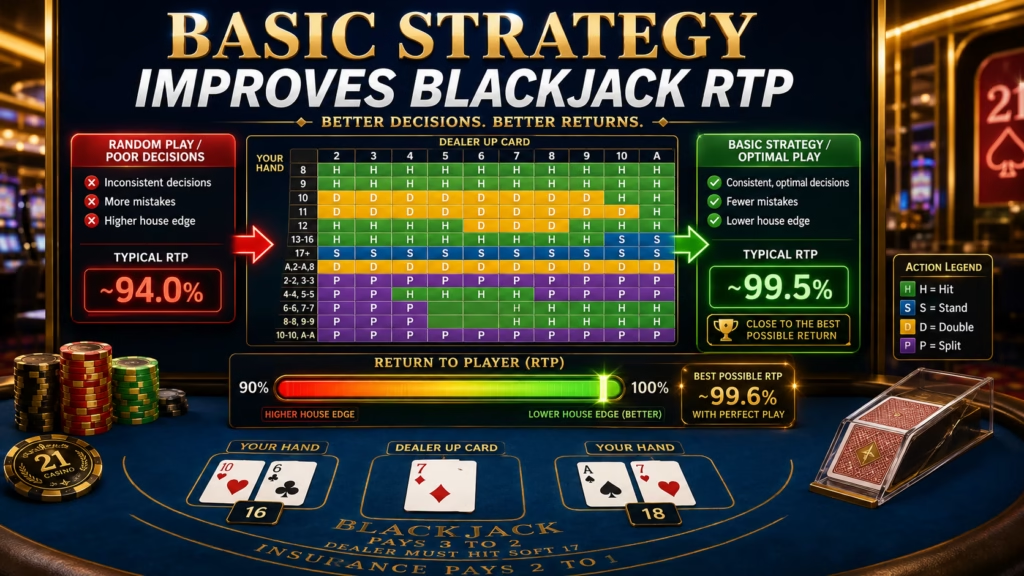
Blackjack also involves decisions. Hitting, standing, doubling, splitting and surrendering change the expected value of a hand. A calculated blackjack RTP therefore normally assumes a particular strategy, usually mathematically correct basic strategy.
How Basic Strategy Affects Blackjack RTP
Basic strategy identifies the action with the highest expected value for each player hand against each dealer upcard. It does not predict the next card or remove the casino advantage. It simply avoids decisions that lose more money on average than the available alternatives.
For example, hitting a hard 16 against a dealer 10 can result in an immediate bust, but standing usually has an even worse expected value. Basic strategy chooses the less costly long-run decision, not the action most likely to feel safe on one hand.
The strategy chart must match the game. A six-deck S17 chart may differ from a double-deck H17 chart, while surrender and doubling restrictions can change individual decisions. Correct recommendations depend on the number of decks, dealer soft-17 rule, surrender availability and other table conditions.
A favorable table played inaccurately can produce a worse effective return than a slightly weaker table played correctly. The rules define the game’s best theoretical return, while the player’s decisions determine how closely their play follows that figure.
How Blackjack Rules Affect RTP
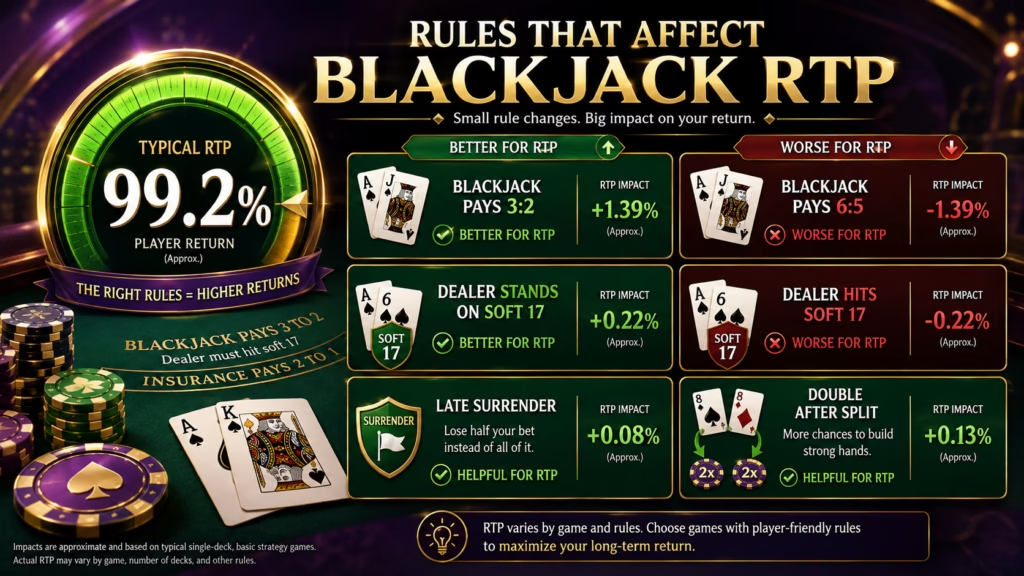
The figures below show approximate changes in player return compared with otherwise similar standard rules. Exact values can vary because blackjack rules interact.
| Rule change | Approximate effect on player return | Better choice |
| Blackjack pays 6:5 instead of 3:2 | −1.39 percentage points | 3:2 |
| Dealer hits soft 17 instead of standing | −0.22 percentage points | Dealer stands |
| No double after split | −0.14 percentage points | Double after split allowed |
| Doubling limited to totals of 10 and 11 | −0.18 percentage points | Double on any first two cards |
| Late surrender available | About +0.08 percentage points | Surrender available |
| Resplitting aces allowed | About +0.07 percentage points | Resplitting aces allowed |
| Eight decks instead of six | About −0.03 percentage points | Fewer decks, all else equal |
These effects should not simply be added together as a guaranteed final RTP. The most accurate result comes from calculating the complete combination of rules.
Blackjack Payout: 3:2 Versus 6:5
The blackjack payout is usually the most important rule to check. A 3:2 payout gives a $15 profit on a $10 natural blackjack. A 6:5 payout gives only $12.
Changing the payout from 3:2 to 6:5 reduces player return by about 1.39 percentage points under common rules. This can outweigh several smaller favorable conditions. A single-deck sign does not make a 6:5 game attractive simply because fewer decks are normally better.
Dealer Stands or Hits on Soft 17
A soft 17 contains an ace counted as 11, such as ace-six. If the dealer hits soft 17, the house gains a small advantage because the dealer can improve that hand without the same immediate bust risk as a hard 17.
H17 reduces player return by about 0.22 percentage points compared with S17. The rule also changes some basic-strategy decisions, so the correct chart must identify whether the dealer hits or stands.
Doubling Rules
Doubling down increases the wager after the first two cards, gives the player one additional card and then forces a stand. The option is valuable when the player has a strong starting position against a weaker dealer upcard.
Prefer tables allowing doubles on any first two cards and double after split. Restricted doubling lowers RTP because the player cannot increase the wager in some favorable situations. Removing double after split reduces expected return by approximately 0.14 percentage points, while limiting doubles to totals of 10 and 11 costs approximately 0.18 percentage points under common rules.
Doubling more often is not automatically better. The option creates value only when it is used according to the appropriate strategy.
Splitting, Resplitting and Aces
Splitting converts a pair into two hands and requires another wager. Rules may limit the number of split hands, prohibit resplitting aces or give only one card to each split ace.
Double after split and resplitting aces improve expected return because they preserve useful options after a pair is separated. Their individual effect is smaller than the difference between 3:2 and 6:5, but they matter when two tables otherwise look similar. Under common six-deck rules, resplitting aces can improve expected return by about 0.07 percentage points.
Surrender Rules
Late surrender lets the player forfeit half the original wager after the dealer checks for blackjack. Basic strategy uses it only in selected weak situations against strong dealer cards.
Surrender does not create a winning hand. It reduces the expected loss when continuing would be mathematically worse than giving up half the bet. Late surrender can add roughly 0.08 to 0.09 percentage points to player return under common six-deck conditions.
Confirm whether the game offers late surrender, early surrender or no surrender because these rules are not equivalent.
Number of Decks
Fewer decks generally improve player return when every other rule is identical. However, casinos may pair fewer decks with a weaker blackjack payout or stricter doubling rules.
A single-deck 6:5 game can therefore have a lower RTP than a six-deck 3:2 game. Compare deck count only after checking the payout, soft-17 rule and player options. The difference between six and eight decks is normally much smaller than the effect of changing the blackjack payout from 3:2 to 6:5.
Dealer-Blackjack Procedure
Some games check the dealer’s hidden card for blackjack before the player splits or doubles. In other games, the dealer receives the second card after player actions.
Check what happens to added split and double wagers if the dealer later has blackjack. Some rules return the additional wagers and take only the original bet, while others take every exposed wager. This difference can affect the game’s theoretical return.
The game information should clearly explain insurance, splitting, resplitting, doubling restrictions, surrender and other special rules.
How to Compare Blackjack Tables
Use this order when checking a table:
- Blackjack payout: choose 3:2 over 6:5.
- Soft 17: S17 is better than H17.
- Doubling: prefer double on any first two cards and double after split.
- Surrender and ace rules: late surrender and resplitting aces add value.
- Dealer blackjack: check whether added split and double bets are protected.
- Strategy chart: match it to the deck count and rules.
- Minimum bet: do not choose a table that conflicts with your spending limit.
For online blackjack, open the rules or help screen before wagering. It should state the deck count, blackjack payout, dealer behavior, split limits, doubling rules and surrender conditions.
A displayed RTP is difficult to assess when the rules needed to reproduce that figure are missing.
Common Blackjack RTP Mistakes
The most common mistake is treating RTP as a session forecast. A 99.5% theoretical RTP does not limit a player’s loss to $0.50 per $100 during one session. Results vary, and splitting or doubling can increase the money exposed during a hand.
Another mistake is using one universal strategy chart. Small rule differences can change the correct play, so the chart should match the actual game.
Insurance and even money are also misunderstood. For a player without reliable card-counting information, standard basic strategy normally rejects both. Insurance is a separate wager on dealer blackjack, not a tool that improves the main hand’s RTP.
Optional wagers such as Perfect Pairs or 21+3 have separate paytables and house edges. A strong main-game RTP does not mean the side bets offer a similar return.
Practical Recommendations
Choose a 3:2 table, verify every important rule and use a matching basic-strategy chart. These steps reduce avoidable disadvantages but do not guarantee a win.
Evaluate side bets separately, set fixed money and time limits, and never increase wagers simply to recover losses. Basic strategy controls decision quality, not short-term variance. Blackjack should be treated as entertainment rather than a dependable source of income.
How This Information Was Reviewed
This guide uses standard blackjack mathematics, rule-specific house-edge analysis and the assumption of correct basic strategy. Approximate rule effects are useful for comparison, but the exact RTP depends on the complete rule set.
Before playing, verify the payout, deck count, soft-17 rule, doubling restrictions, split rules, surrender option, dealer-blackjack procedure and side-bet paytables. Stop when the planned spending or time limit is reached.
FAQ
What Is a Good RTP for Blackjack?
A good blackjack RTP is generally around 99.5% or higher when the game pays 3:2 for blackjack and the player follows the correct basic strategy. Some favorable rule combinations may return slightly more, while restrictive rules can push RTP below 99%.
The exact figure should always be checked against the complete rules rather than estimated from one condition.
Does Basic Strategy Guarantee a 99.5% Return?
No. Basic strategy does not guarantee that a player will receive 99.5% of their wagers back during a particular session.
The percentage is a theoretical long-run average. Basic strategy reduces the house edge by selecting mathematically efficient decisions, but individual sessions can still produce large wins or losses.
How Much Does 6:5 Blackjack Reduce RTP?
A 6:5 blackjack payout reduces player return by approximately 1.39 percentage points compared with a standard 3:2 payout under otherwise similar rules.
For example, a game that would theoretically return about 99.5% with 3:2 payouts might return only about 98.1% after changing to 6:5, although the precise result depends on the other rules.
Is Single-Deck Blackjack Always Better?
No. Single-deck blackjack is not always better because the payout and player options can matter more than the number of decks.
A single-deck table paying 6:5 may offer a worse return than a six-deck table paying 3:2. Check the payout, soft-17 rule, doubling rules and split restrictions before comparing deck counts.
Is S17 Better Than H17?
Yes. A dealer standing on soft 17 is better for the player than a dealer hitting soft 17.
Under common rules, H17 reduces player return by approximately 0.22 percentage points. The soft-17 rule can also change some basic-strategy decisions.
Do Side Bets Affect the Main Blackjack RTP?
Side bets do not normally change the mathematics of the main blackjack wager, but they can reduce the combined return of all money wagered during a session.
Each side bet has its own paytable, probability structure and house edge. Evaluate Perfect Pairs, 21+3 and similar wagers independently instead of assuming they share the main game’s RTP.
Can Blackjack RTP Vary Between Online Casinos?
Yes. Blackjack RTP can vary between online casinos when operators offer different versions, paytables or rule configurations.
Check the game rules for the blackjack payout, deck count, dealer soft-17 behavior, doubling options, splitting limits and surrender availability. Do not assume that two games with the same title use identical mathematics.
Can a Player Increase Blackjack RTP?
A player can move closer to the game’s stated theoretical RTP by using the correct basic strategy and avoiding optional wagers with unfavorable paytables.
The player cannot change the underlying rules or guarantee a winning outcome. Choosing a better table improves expected return, but card distribution and short-term results remain uncertain.
Is Blackjack RTP Calculated Per Hand?
No. Blackjack RTP is not calculated as a guaranteed return for each individual hand.
The theoretical figure represents expected results over a very large number of hands. One hand can lose the full wager, push, pay even money, pay 3:2 for blackjack or involve additional money through splitting and doubling.
Brief Conclusion
Blackjack RTP depends on both table rules and player decisions. The strongest practical combination is usually a 3:2 payout, S17, flexible doubling, double after split and a strategy chart matched to the exact game.
Basic strategy can reduce avoidable losses, but it cannot predict cards or guarantee profit. Compare the full rules, avoid treating RTP as a short-session promise and keep blackjack within fixed spending and time limits.