
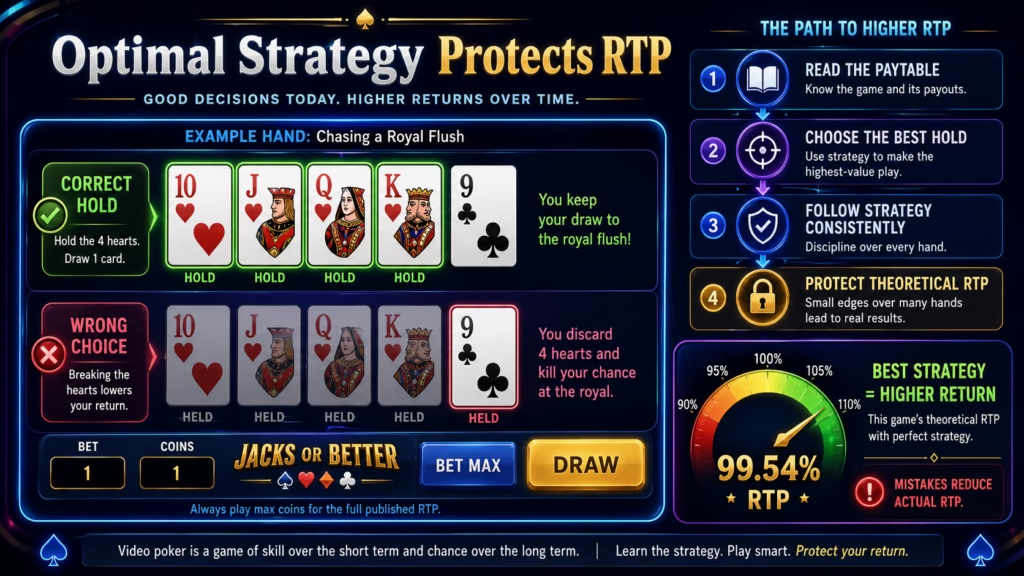
Video poker RTP is determined by two connected factors: the game’s paytable and the decisions used to hold or discard cards. A favorable paytable provides better potential returns, but the published maximum RTP normally assumes that every hand is played with the correct strategy.
Unlike a slot, video poker gives the player a decision after the initial deal. The cards remain random, but the hold and discard choices affect the mathematical value of the hand. Choosing the wrong cards does not change the paytable, but it reduces the return a player can realistically achieve.
Key takeaways
- Video poker RTP is a long-term theoretical percentage, not a prediction for one session.
- Two games with the same name can have different RTP values because their paytables differ.
- Optimal strategy depends on the exact game variant and payout schedule.
- Small reductions in full house or flush payouts can remove more than one percentage point from RTP.
- A high theoretical RTP does not prevent short-term losses or guarantee a profit.
Video poker may appeal to players who prefer making structured decisions instead of pressing a spin button without any strategic input. It requires more caution from players who do not want to study strategy charts, check paytables or manage the higher volatility found in bonus poker variants.
What Is Video Poker RTP?
Video poker RTP is the theoretical percentage of all wagered money that a particular game returns as prizes over a very large number of hands. For example, a game with a 99.54% RTP theoretically returns $99.54 for every $100 wagered in the long run, leaving a mathematical difference of $0.46.
That calculation does not mean a player should expect to lose exactly $0.46 during a $100 session. RTP is an average calculated across extensive play, while an individual session may finish with a large win, a small win or a complete loss of the available bankroll.
In video poker, the quoted RTP normally assumes:
- the stated paytable is being used;
- the correct number of coins is wagered;
- every initial hand is played according to optimal strategy;
- no strategy errors are made;
- the game operates according to its published rules.
This is why a theoretical RTP should be treated as a comparison tool, not a promise about future results.
How Video Poker Paytables Determine RTP
A video poker paytable lists how much each winning hand pays. Common winning hands include a pair of jacks or better, two pair, three of a kind, a straight, a flush, a full house, four of a kind, a straight flush and a royal flush.
The paytable matters because video poker RTP is calculated from the probability of each final hand multiplied by its payout. Reducing the reward for a frequently occurring hand can have a greater effect on total RTP than changing a rare jackpot.
Jacks or Better Paytable Comparison
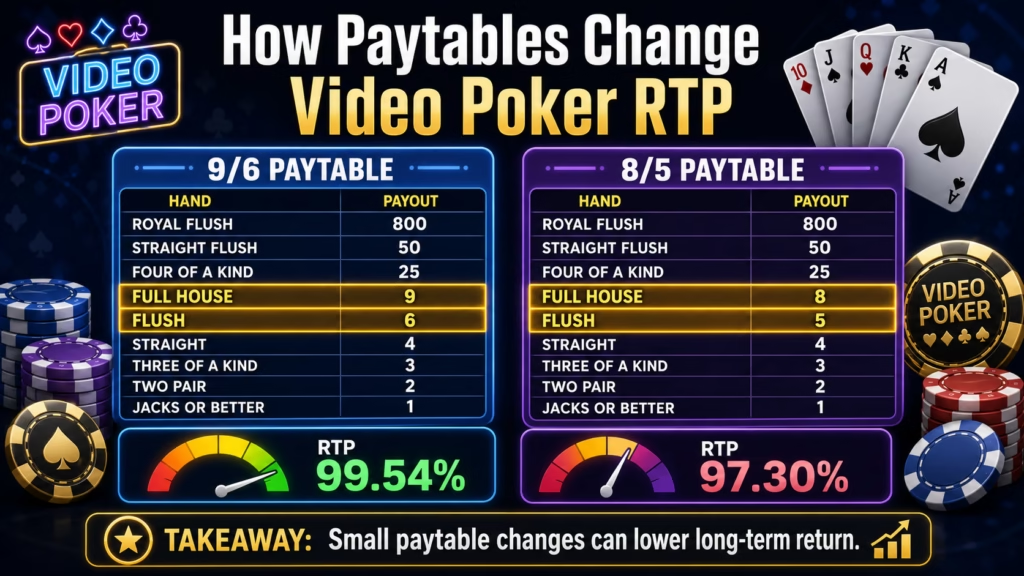
Jacks or Better paytables are commonly described using the payouts for a full house and a flush. A 9/6 game pays nine coins per coin wagered for a full house and six for a flush when the standard maximum-coin schedule is used.
| Jacks or Better paytable | Full house | Flush | Approximate optimal RTP |
| 9/6 | 9 | 6 | 99.54% |
| 9/5 | 9 | 5 | 98.45% |
| 8/5 | 8 | 5 | 97.30% |
| 6/5 | 6 | 5 | 95.00% |
The difference between 9/6 and 8/5 Jacks or Better is more than two percentage points, even though most of the paytable may look identical. The 9/6 version returns approximately 99.54% with optimal strategy, while the 8/5 version returns about 97.30%.
A player comparing video poker games should therefore inspect the complete paytable instead of relying on the game title, graphics or advertised jackpot.
How to Read Paytable Names
The numbers used in a paytable name do not always refer to the same hands across every video poker variant.
- 9/6 Jacks or Better normally refers to nine for a full house and six for a flush.
- 8/5 Bonus Poker normally refers to eight for a full house and five for a flush.
- 9/6 Double Double Bonus uses the same full house and flush shorthand, but also includes separate payouts for different four-of-a-kind combinations.
- Deuces Wild may be identified by several numbers because wild cards create additional hands such as five of a kind, four deuces and a wild royal flush.
Players should confirm which hands the shorthand represents before comparing two games.
Why the Royal Flush Bet Level Matters
Many conventional video poker paytables give a disproportionately larger royal flush payout when the maximum number of coins is wagered. A common schedule pays 250 coins for a royal flush on a one-coin wager but 4,000 coins on a five-coin wager. That maximum payout equals 800 coins per coin wagered rather than 250.
Because part of the theoretical RTP comes from the royal flush, playing fewer than the required maximum coins can reduce the game’s effective return.
However, this does not mean a player should exceed a comfortable spending limit. A more controlled approach is to select a lower coin denomination and play the required number of coins, rather than choosing a high denomination that makes the total wager unaffordable.
The exact royal flush structure should always be checked in the displayed paytable. Some online games, multi-hand versions and feature-based variants use different betting systems.
How Optimal Strategy Affects Video Poker RTP
Optimal video poker strategy is the mathematically strongest hold or discard decision for every possible initial hand under a specific paytable. The strategy compares the expected value of each available choice, including immediate payouts and the probability of improving the hand after the draw.
For example, a player may be dealt both a low pair and four cards to a flush. In full-pay 9/6 Jacks or Better, the optimal strategy ranks four cards to a flush above the low pair. Keeping the pair may feel safer because it is already formed, but the flush draw has a higher expected value under that paytable.
Optimal strategy does not predict which replacement cards will appear. It only identifies the decision with the highest average value across all possible draws.
Strategy Must Match the Paytable
A strategy chart is not universal. Changing a full house, flush, straight or four-of-a-kind payout can change the correct decision for borderline hands.
A chart designed for 9/6 Jacks or Better may therefore be slightly inaccurate for 8/5 Jacks or Better. Differences are especially important in games such as Deuces Wild, Double Bonus and Double Double Bonus, where altered payouts can significantly change the value of particular draws.
Using the wrong strategy may still be better than making random decisions, but it will not produce the theoretical RTP advertised for the selected paytable.
Simple Strategy Versus Perfect Strategy
A simplified strategy chart usually removes rare exceptions so that the game is easier to learn. This creates a small mathematical cost, but it may be more practical for many players.
For full-pay 9/6 Jacks or Better, one published intermediate strategy produces an estimated return of 99.52%, compared with 99.54% for optimal play. A simpler chart is estimated at 99.46%. These values show that a well-designed basic strategy can come close to optimal play, although repeated errors still reduce the return.
Players should first learn the main hand priorities consistently. Advanced penalty-card exceptions are useful only after the basic decisions are understood.
Video Poker RTP Does Not Predict Session Results
A high RTP does not make video poker low risk. Even a game with a theoretical return close to 100% can produce long losing periods because prizes are not distributed evenly.
Royal flushes and other rare hands contribute part of the calculated return. A player who does not hit those hands during a limited session may experience a return far below the published percentage.
Volatility also changes the experience:
- Lower-volatility games tend to return more value through ordinary hands.
- Higher-volatility games place more value in four-of-a-kind combinations, kickers or other premium hands.
- Two games with similar RTP values can therefore produce very different bankroll swings.
- Multi-hand games increase the total amount wagered per round unless the denomination is reduced.
RTP measures average return. Volatility describes how unevenly that return may be delivered. Neither measurement guarantees a particular result.
Comparing Popular Video Poker Variants
| Game and paytable | Approximate optimal RTP | General playing profile |
| 9/6 Jacks or Better | 99.54% | Relatively straightforward strategy and lower volatility |
| 8/5 Bonus Poker | 99.17% | Familiar structure with enhanced four-of-a-kind payouts |
| 9/6 Double Double Bonus | 98.98% | Higher volatility with large rewards for selected four-of-a-kind hands |
| Full-pay Deuces Wild | 100.76% | Complex wild-card strategy and substantial variance |
Published mathematical analyses place 8/5 Bonus Poker at approximately 99.17%, 9/6 Double Double Bonus at approximately 98.98% and full-pay Deuces Wild at approximately 100.76% when each game is played optimally.
The full-pay Deuces Wild figure does not guarantee profit. It applies to a specific paytable, requires highly accurate strategy and may be difficult to find. Shorter-pay Deuces Wild versions can have substantially lower returns.
Game selection should account for both RTP and volatility. A player may find Jacks or Better easier to learn, while someone choosing Double Double Bonus should expect a larger part of the return to depend on rare four-of-a-kind results.
How to Compare Video Poker Games Correctly
Before choosing a video poker game, use the following process:
1. Identify the exact variant. Confirm whether the game is Jacks or Better, Bonus Poker, Deuces Wild or another version.
2. Read every payout. Do not compare games using the title alone.
3. Check the maximum-coin royal flush. Confirm how many coins are required for the enhanced payout.
4. Find the RTP for that exact paytable. A generic RTP for the game family may not apply.
5. Use a matching strategy chart. The strategy should name the same variant and payout schedule.
6. Consider volatility. A high RTP game may still produce severe short-term swings.
7. Review optional features. Multipliers, extra hands and bonus bets may require additional wagers and may use a different return calculation.
8. Check casino terms. Game availability, bonus contribution, wagering limits and promotional rules may vary by operator.
A video poker analyzer can calculate hand probabilities and theoretical return for a specified paytable under optimal strategy. This can be useful when a casino offers a payout schedule that is not covered by a common strategy chart.
Common Video Poker RTP Mistakes
Assuming Every Version Has the Same RTP
Casinos and software providers may offer several paytables under the same game name. A familiar title is not proof that the favorable version is being used.
Choosing a Game by Jackpot Size Alone
A large royal flush or four-of-a-kind payout may be funded by weaker payouts elsewhere. The full paytable must be evaluated.
Using Strategy for the Wrong Variant
Jacks or Better strategy should not be applied directly to Deuces Wild or Double Double Bonus. Even two paytables within the same variant may require different decisions.
Confusing Hit Frequency With RTP
A game can produce frequent small wins while having a lower overall RTP. Another game may have fewer winning hands but a stronger theoretical return because its rare prizes are larger.
Betting More Than the Bankroll Allows
Playing the maximum number of coins may preserve the royal flush return, but it does not justify an unaffordable wager. Lowering the denomination is more sensible than increasing financial risk.
Treating RTP as a Profit Forecast
RTP is not an earnings rate. It does not show what one player will receive, and it cannot remove the possibility of losing the entire session budget.
A Practical Way to Learn Video Poker Strategy
Start with one game and one paytable, preferably a straightforward version such as Jacks or Better. Constantly switching between variants makes it harder to remember the correct hand priorities.
Use this progression:
1. Learn the order of made hands and major draws.
2. Study a simplified strategy chart for the exact paytable.
3. Practise with a free trainer that identifies incorrect holds.
4. Review recurring mistakes rather than memorizing every exception immediately.
5. Check the paytable again before playing for money.
6. Set a fixed spending and time limit before the session begins.
Video poker should be treated as paid entertainment. Strategy may reduce the mathematical disadvantage, but it cannot control the cards, eliminate volatility or guarantee a winning session.
How This Information Was Reviewed
The comparisons in this guide are based on published paytable calculations, hand probabilities and optimal-strategy returns for specific video poker variants. RTP is presented as a long-term theoretical measurement rather than an expected result for one player or one session.
Before playing, users should verify the exact paytable, required bet level, game rules and strategy assumptions displayed by the casino. Optional features and operator-specific versions may change the total cost or theoretical return.
Players should stop when the predetermined spending or time limit is reached. Anyone who feels pressure to recover losses, increase bets or continue beyond an affordable limit should leave the game rather than relying on RTP or strategy to reverse the result.
FAQ
What is a good RTP for video poker?
A video poker RTP of around 99% or higher is generally competitive compared with many casino games, but the percentage must apply to the exact paytable and assume a strategy the player can follow accurately. A high RTP does not guarantee a winning session.
Does video poker strategy really change RTP?
Yes. Video poker strategy changes the effective return because different hold and discard decisions have different expected values. The maximum published RTP generally assumes optimal decisions on every hand.
What does 9/6 mean in Jacks or Better?
In Jacks or Better, 9/6 normally means the game pays nine coins per coin wagered for a full house and six for a flush under the standard maximum-coin paytable. A 9/6 version has a higher theoretical return than common 9/5, 8/5 or 6/5 versions.
Can video poker have an RTP above 100%?
Some specific paytables have a calculated optimal RTP above 100%. Full-pay Deuces Wild is a well-known example at approximately 100.76%, but this assumes flawless strategy, the exact full-pay schedule and long-term play. It does not guarantee profit and the paytable may be rare.
Is 99.54% RTP guaranteed in 9/6 Jacks or Better?
No. The 99.54% figure is a theoretical long-term return based on the full-pay 9/6 schedule and optimal strategy. Actual sessions can finish far above or below that percentage.
Should I always bet five coins in video poker?
Five coins are commonly required to receive the enhanced royal flush payout, but players should not make an unaffordable bet. Choosing a lower denomination may allow the required coin level without exceeding a fixed budget. The exact paytable should be checked because betting structures can differ.
Is Jacks or Better the easiest video poker game to learn?
Jacks or Better is often considered one of the more accessible variants because the payout structure and basic strategy are relatively straightforward. Advanced strategy still contains exceptions, and the paytable must match the chart being used.
Does a higher hit frequency mean a higher RTP?
No. Hit frequency measures how often a hand returns a prize, while RTP measures the average value returned over extensive play. Frequent low-value wins can coexist with a relatively weak RTP.
Can I use one strategy chart for every video poker game?
No. Strategy charts are built for specific variants and paytables. Using a Jacks or Better chart for Bonus Poker, Deuces Wild or a different payout schedule can produce incorrect holds and reduce the effective return.
Can optimal strategy beat random card results?
Optimal strategy cannot control or predict the cards. It only selects the hold or discard decision with the highest mathematical expected value. Losing hands and losing sessions remain possible.
Brief Conclusion
Video poker RTP depends on both the paytable and the quality of the player’s decisions. A favorable game such as 9/6 Jacks or Better can offer a strong theoretical return, but weaker paytables and strategy mistakes quickly reduce that percentage.
Compare the complete payout schedule, use a strategy designed for that exact version and choose a denomination that fits a fixed budget. RTP and optimal strategy can improve decision quality, but neither guarantees winnings or removes the risks of gambling.