Online slots usually have higher published RTP percentages than land-based slot machines. However, this is a general market pattern, not a rule that applies to every game. The exact return depends on the slot version, casino operator, jurisdiction, jackpot structure and payout configuration. A carefully selected land-based machine may have a higher RTP than a poorly configured online slot.
Quick takeaways
- Online slots generally offer more competitive RTP configurations.
- Land-based slot RTP can vary by casino, machine category and game configuration.
- The same slot name may not mean the same payout percentage everywhere.
- RTP describes a long-term theoretical return, not the result of one session.
- A higher RTP reduces the mathematical house edge, but it does not guarantee a win.
- The game rules or paytable should be checked before playing.
This comparison is most useful for players choosing between playing a slot online and visiting a physical casino. It is also relevant to players who want to compare the long-term mathematical cost of different games. Players should be especially cautious when a casino does not clearly display the RTP or when the game includes a progressive jackpot with separate payout rules.
What Does RTP Mean in Slots?
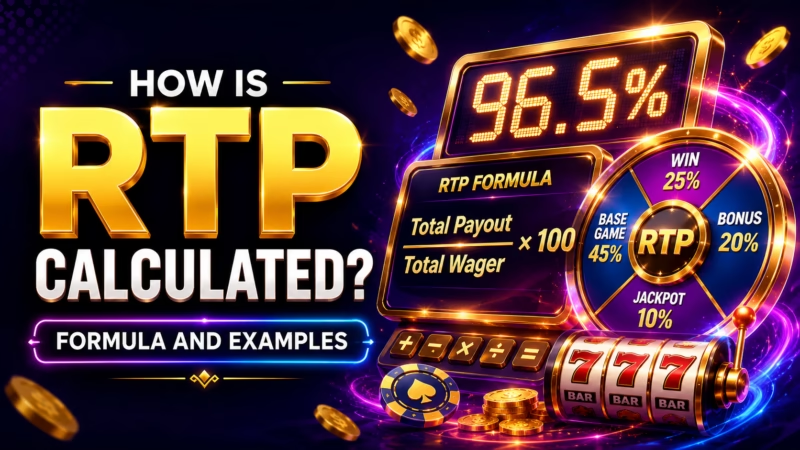
Return to Player, usually shortened to RTP, is the theoretical percentage of total stakes that a slot is designed to return as prizes over a very large number of spins.
For example, a slot with a theoretical RTP of 96% is designed to return approximately $96 from every $100 wagered across its full statistical sample. The remaining 4% represents the theoretical house edge.
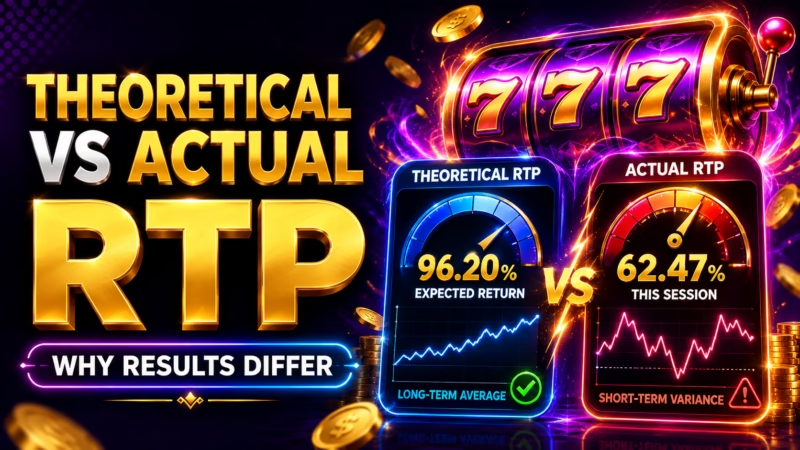
That example does not mean an individual player will receive $96 after wagering $100. One session may produce no meaningful return, while another session may produce a result far above the amount wagered. RTP is achieved over a significant number of games and cannot be measured from one player’s short session.
The basic relationship is:
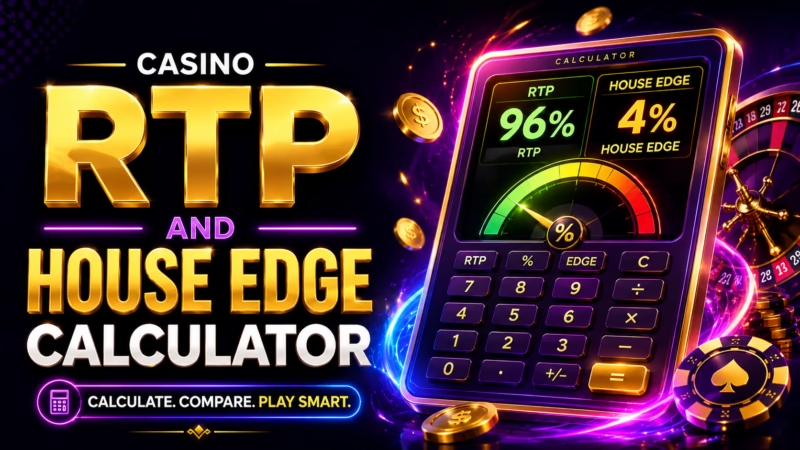
House edge = 100% minus RTP
A slot with 96% RTP therefore has a theoretical house edge of 4%. A slot with 90% RTP has a theoretical house edge of 10%.
The higher-RTP game is mathematically less expensive over a sufficiently large number of equal-value spins. It is not necessarily more likely to produce a profit during a short session.
Online vs Land-Based Slots RTP Comparison
| Factor | Online slots | Land-based slots |
| General RTP pattern | Often higher | Often lower |
| RTP visibility | Usually available in the paytable, help screen or game information | May be displayed on the cabinet, information screen or help menu |
| Number of games available | Often hundreds or thousands | Limited by physical floor space |
| Ability to compare games | Relatively easy | Often requires checking machines individually |
| RTP configurations | Different operators may offer different versions | Configuration may depend on the manufacturer and casino |
| Progressive jackpots | Jackpot contribution may reduce the base-game return | Local or wide-area jackpots may affect total return |
| Short-term predictability | Not predictable | Not predictable |
| Result generation | Usually based on an independently tested RNG in regulated markets | Random or approved compensated systems may be used, depending on the machine and jurisdiction |
Regulatory requirements vary worldwide. In regulated markets, remote operators are commonly required to make information such as RTP, house edge or the probability of winning available before a customer commits to gamble. Physical gaming machines may also be required to provide payout or RTP information under local machine rules.

Do Online Slots Have Higher RTP Than Land-Based Slots?
Online slots frequently have higher RTP than land-based slots, particularly when comparing modern regulated online games with ordinary machines on a physical casino floor. Industry comparisons commonly place online slots in a more competitive RTP range, although exact percentages vary too widely to treat any single range as universal.
The important word is frequently, not always.
An online casino can offer a low-RTP version of a game. A land-based casino can install a machine with a comparatively strong payout configuration. Players must compare the actual percentages rather than assuming that every online slot is better.
There is also no worldwide minimum RTP applying to every casino and machine. The manufacturer, operator and regulator can all influence the permitted or selected payout setting.
Why Online Slots Often Have Higher RTP
Online casinos can offer more competing games
An online casino can display a large number of slots without dedicating physical floor space to every title. Players can compare games quickly and leave a low-RTP slot for another option.
This creates stronger pressure to offer competitive game configurations. A physical casino floor has a limited number of cabinets, and players may compare fewer machines during a visit.
Lower digital distribution costs are also commonly identified as one reason online slots can support higher theoretical returns. However, lower costs do not force an operator to select the highest available RTP. The operator’s commercial decision still matters.
Online RTP information is easier to inspect
In regulated online markets, the RTP is commonly shown inside the game’s information, help or paytable section. Players can check the percentage before placing a real-money spin.
Regulated remote games are often required to provide information that allows customers to understand their chances of winning. This information may include the house edge, RTP percentage or probability of winning events.
A physical machine may also display its theoretical RTP, but the information can be less convenient to locate. It may appear on the cabinet, in a help screen or within a multi-game menu.
Physical casinos have different commercial priorities
A land-based slot machine occupies floor space, requires hardware and serves a limited number of players at one time. A casino may also evaluate a cabinet according to its location, denomination, popularity and revenue per unit.
These factors can influence which machine configurations are selected. They do not prove that every physical machine has a low RTP, but they help explain why land-based casino floors may contain a wider range of payout settings.
Can the Same Slot Have Different RTP Percentages?
The same slot title may be supplied in more than one RTP configuration. The graphics, symbols and bonus features may look identical while the mathematical payout settings differ.
For example, one operator might offer a version with a stronger theoretical return, while another operator offers a lower-return configuration. The exact available settings depend on the provider, market and casino agreement.
Players should therefore check the active game’s paytable instead of relying on an RTP percentage found in an old review, promotional page or another casino.
This check should include:
- The displayed theoretical RTP.
- Whether the percentage includes a jackpot contribution.
- Whether different betting modes change the return.
- Whether a bonus feature changes the RTP.
- Whether the casino identifies the game provider and version.
The game shown on the screen is the relevant source. A percentage listed elsewhere may describe a different configuration.
Does a Higher RTP Mean More Frequent Wins?
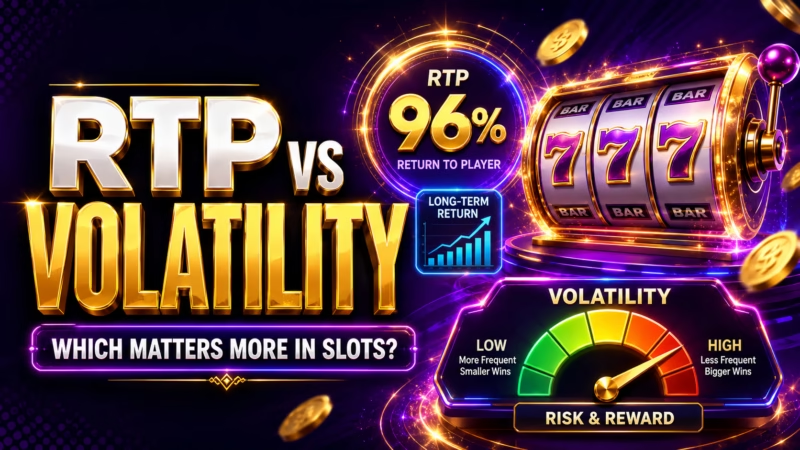
A higher RTP does not necessarily mean more frequent wins. RTP measures the total theoretical value returned, while hit frequency measures how often a winning result occurs.
A high-RTP slot can still have high volatility, rare bonus rounds and long periods without a substantial payout. A lower-RTP slot may produce frequent small wins that rarely cover the total amount wagered.
Volatility describes the distribution of prizes. Highly volatile games may contain very large but rare prizes, while low-volatility games tend to produce smaller and more frequent prizes.
Players comparing online vs land-based slots RTP should consider three separate factors:
- RTP: The theoretical long-term return.
- Volatility: The size and irregularity of payouts.
- Hit frequency: How often a paying result occurs.
None of these metrics can predict the outcome of the next spin.
Higher RTP Does Not Automatically Mean Lower Spending
A higher RTP reduces the theoretical loss per unit wagered, but total spending also depends on stake size and the number of spins.
Consider two simplified sessions:
- Game A has 96% RTP, but the player wagers $500 in total.
- Game B has 92% RTP, but the player wagers only $100 in total.
The theoretical loss on Game A is $20. The theoretical loss on Game B is $8.
Game A has the better RTP, but the larger total amount wagered produces a higher expected loss. This is why session length, spin speed and bet size matter as much as the displayed percentage.
Online slots can make it easy to move rapidly between games and continue playing. Some regulated markets impose design requirements intended to reduce the intensity of online play, including minimum game-cycle times and restrictions on simultaneous games.
Do Progressive Jackpot Slots Have Lower RTP?
Progressive jackpot slots may direct part of every qualifying bet into a growing jackpot pool. This can make the ordinary base game feel less rewarding, particularly when a meaningful portion of the total RTP is allocated to a jackpot that is rarely won.
The displayed RTP may be presented as:
- One combined percentage for the base game and jackpot.
- A base-game RTP plus a separate jackpot contribution.
- A percentage that applies only when the player is eligible for the jackpot.
Players should check how the jackpot component is calculated. Progressive jackpot rules should explain how the jackpot is funded and how its RTP is presented.
A large jackpot does not improve the predictability of the game. It usually increases the importance of rare outcomes.
How to Compare Online and Land-Based Slot RTP Correctly
1. Check the exact game information
Open the paytable or help section and locate the theoretical RTP. Do not assume the percentage based on the game’s provider or title.
2. Compare equal betting conditions
A meaningful comparison uses the same stake, similar game type and similar jackpot structure. Comparing a simple fixed-jackpot online slot with a wide-area progressive land-based machine can be misleading.
3. Separate RTP from volatility
Choose RTP for mathematical value and volatility for the preferred style of play. A high-volatility slot may require a stricter session budget because short-term results can change sharply.
4. Check whether bonus features affect RTP
Some games offer optional features, additional wagers or alternative modes. These may have separate payout calculations. The rules should state whether using the feature changes the theoretical return.
5. Use licensed operators
A regulated casino is expected to provide game information and use approved or tested software according to its jurisdiction’s requirements.
6. Set limits before playing
RTP does not control how much a player spends. A deposit limit, session budget and time limit provide more practical protection than choosing a game based only on a percentage.
Common Myths About Online and Land-Based RTP
“A machine that has not paid recently is due to win”
Previous losses do not make the next random spin more likely to win. On a random machine, the odds of the current outcome are not changed by previous wins or losses.
“A 96% RTP means I will lose only 4% today”
A 96% RTP describes a theoretical average across a very large volume of play. A short session can finish far above or below that figure.
“Online casinos can change the result after I press spin”
A properly regulated RNG game determines outcomes according to its approved game rules and mathematical model. That does not mean every website is trustworthy, which is why the operator’s licence and the exact domain should be checked.
“Land-based machines pay more when a casino is busy”
Casino traffic does not change the probability of the next result on a random slot. Busy periods may create more jackpot activity because more spins are occurring across the network, but they do not make one player’s next spin more favorable.
“The highest RTP slot is always the best choice”
The highest RTP provides the lowest theoretical house edge under equal conditions. It may still be unsuitable for a player who dislikes high volatility, complicated features or rapid gameplay.

How This Information Was Reviewed
This comparison is based on the difference between theoretical RTP, actual RTP, volatility, jackpot contribution and game configuration. Regulatory guidance was used to verify how RTP should be displayed, tested and understood.
Players should confirm the exact RTP in the active paytable because provider settings, operator configurations and local rules may differ. The theoretical percentage does not guarantee that an individual session will approach the advertised return.
Slots should be treated as paid entertainment, not as a way to generate income. Stop playing when the session limit is reached, when gambling is no longer enjoyable or when losses begin to affect essential spending.
FAQ
Do online slots have higher RTP than land-based slots?
Online slots often have higher published RTP percentages than land-based slots, but the difference is not guaranteed. The exact game configuration matters more than the platform alone. Check the active paytable before playing.
What is considered a good RTP for a slot?
A good RTP is one that is competitive with other comparable slots available in the same regulated market. Higher is mathematically better when stake size, volatility and game rules are otherwise equal. RTP should not be used as a promise of short-term results.
Can two casinos offer the same slot with different RTP?
Yes, two casinos may offer different RTP configurations of the same slot title. The game can look almost identical while using a different mathematical setting. The percentage displayed inside the active game is more reliable than a general review.
Does higher RTP mean I am more likely to win each spin?
No. RTP does not show the probability of winning an individual spin. Hit frequency describes how often wins occur, while volatility describes how prize values are distributed. Every random spin remains unpredictable.
Are land-based slot RTP percentages displayed?
Land-based RTP information may be displayed on the machine cabinet, within a help menu or on the game information screen, depending on the jurisdiction and machine type. Ask casino staff for assistance when the percentage cannot be located.
Can a casino lower the RTP while someone is playing?
A regulated casino should not secretly change the approved mathematical rules during an active spin. However, casinos may offer different approved game versions. Players should reopen the information screen after major game or platform updates and verify the displayed percentage.
Do progressive jackpot slots have lower RTP?
Progressive jackpot slots can have a lower base-game return because part of the wager may fund the jackpot. The total advertised RTP may include the rare jackpot payout, so the jackpot rules and contribution should be checked separately.
Does RTP apply to one player or all players?
RTP applies to the game’s long-term mathematical performance across a large volume of play. It does not promise a particular result for one account, machine, session or number of spins.
Are online slots safer than physical slot machines?
Neither format is automatically safer. Safety depends on regulation, game transparency, spending controls and player behavior. Online casinos may offer deposit and time limits, while a physical casino may make it easier to use cash and leave without instant access from home.
Can a strategy improve slot RTP?
A betting strategy cannot change the fixed RTP of a random slot. Players may reduce their theoretical cost by selecting a higher-RTP game, lowering the stake and making fewer spins, but none of these actions guarantees a win.
Short Conclusion
Online slots generally have higher RTP than land-based slots, but the platform alone does not determine the better game. The exact RTP configuration, volatility, jackpot contribution, stake size and number of spins all affect the practical cost of playing.
Check the active paytable, compare equal game conditions and remember that RTP is a long-term mathematical average. It cannot predict a session or guarantee a return.