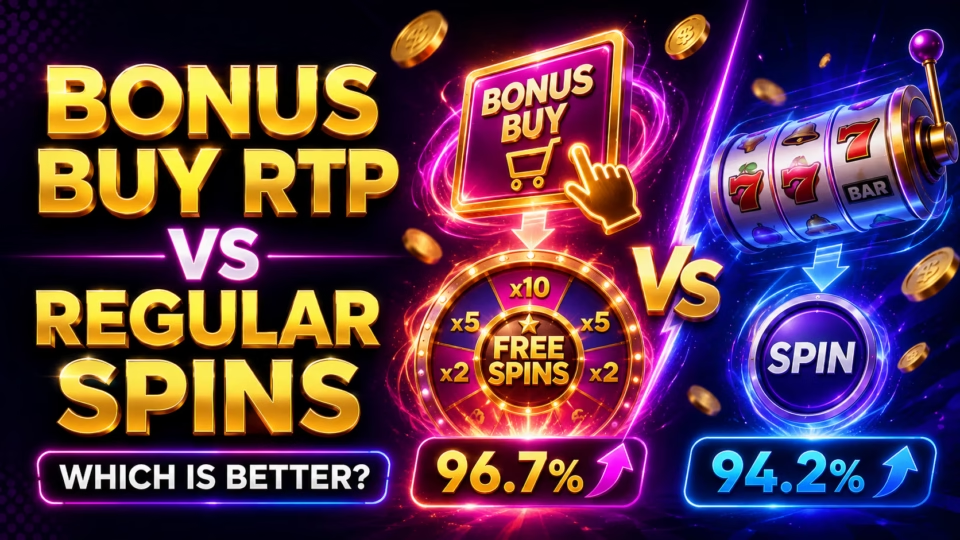
Bonus buy RTP is not automatically better than the RTP of regular spins. The mathematically stronger option is the mode with the higher confirmed RTP for the same amount wagered, but regular spins usually provide better session control because the bankroll is not committed to one expensive feature.
Key points
- Compare the RTP of each game mode, not only the headline RTP shown on the casino page.
- A bonus buy guarantees access to a feature, not a profitable feature result.
- Regular spins distribute wagering across more game rounds.
- Bonus buys concentrate a large part of the bankroll into one random outcome.
- A slightly higher RTP may not compensate for the greater short-term financial risk.
Bonus buys may appeal to players who primarily want free spins or another special feature and accept substantial result variation. Regular spins are generally more suitable for smaller bankrolls, longer sessions and players who want to experience the complete game.
What Is Bonus Buy RTP?
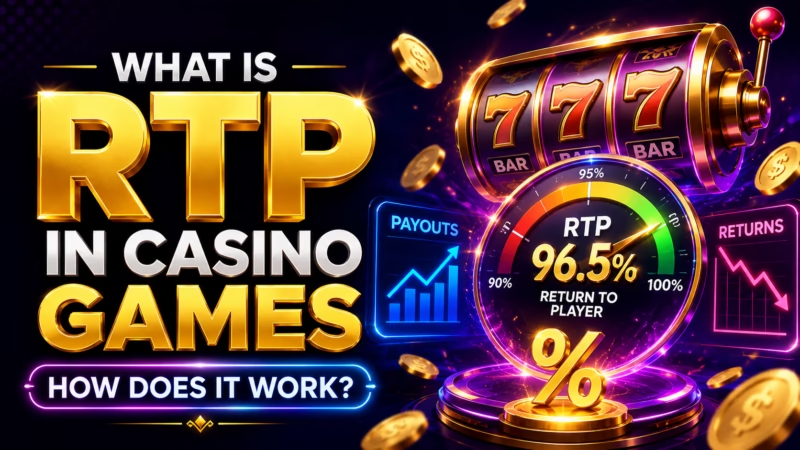
Bonus buy RTP is the theoretical percentage of money returned to players when a bonus feature is purchased directly. Regular-spin RTP normally represents the complete base-game model, including ordinary symbol wins and the value contributed by features triggered naturally.
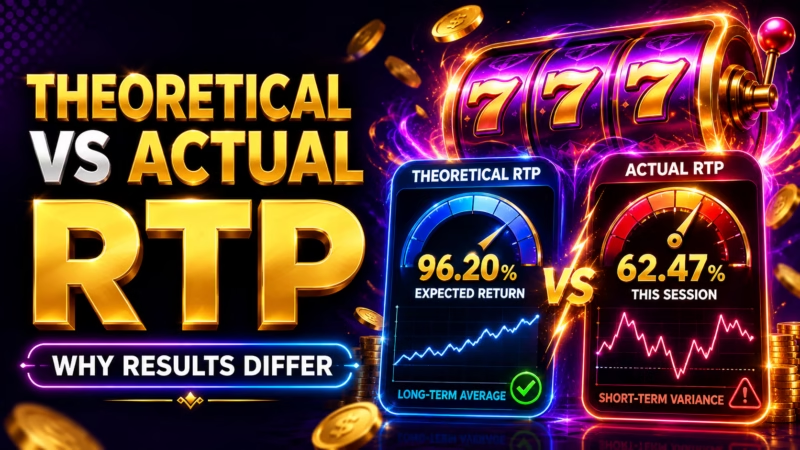
RTP is calculated over a very large number of game rounds. It does not indicate how much one player will receive from a single spin, bonus buy or short session. A slot with 96% RTP can still return nothing during a particular bonus, while another bonus may pay substantially more than its purchase price.
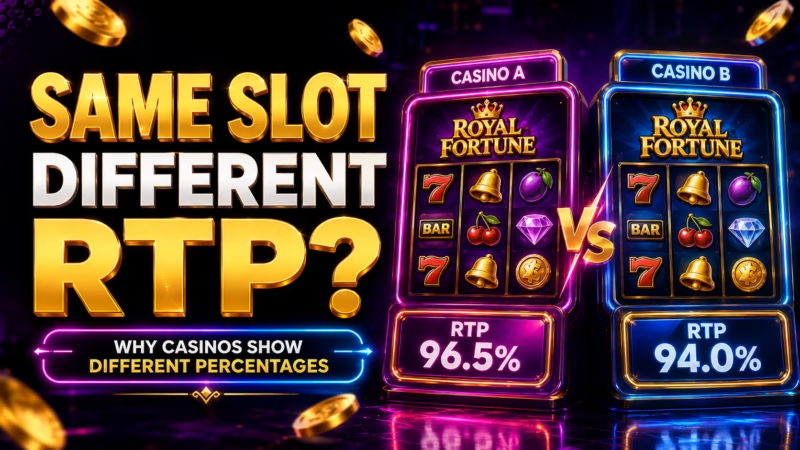
Some slots use separate RTP calculations for different bonus choices. Official game rules can list different RTP values for the base game, enhanced spins and individual purchased features. Players should not assume that one displayed percentage applies identically to every available mode.
How Does a Bonus Buy Change the Wager?
A bonus buy converts multiple potential base-game wagers into one larger wager. When a feature costs 100 times the selected bet, purchasing it at a $1 bet level requires a $100 payment immediately.
The correct comparison is therefore not one $100 bonus buy against one $1 regular spin. It is one $100 bonus buy against $100 in total regular-spin turnover, such as 100 spins at $1 each.
Consider a hypothetical slot with these values:
- Regular-spin RTP: 96%
- Bonus buy RTP: 96.5%
- Bonus buy price: 100 times the bet
- Selected bet: $1
Over $100 of theoretical turnover, the regular mode has an expected return of $96 and an expected loss of $4. The bonus buy mode has an expected return of $96.50 and an expected loss of $3.50.
The bonus buy has a theoretical advantage of only $0.50 per $100 wagered in this example. That small mathematical difference does not mean the purchased feature will return $96.50. The actual result of one feature may be zero, a small fraction of the cost, more than the cost or, very rarely, a much larger amount.
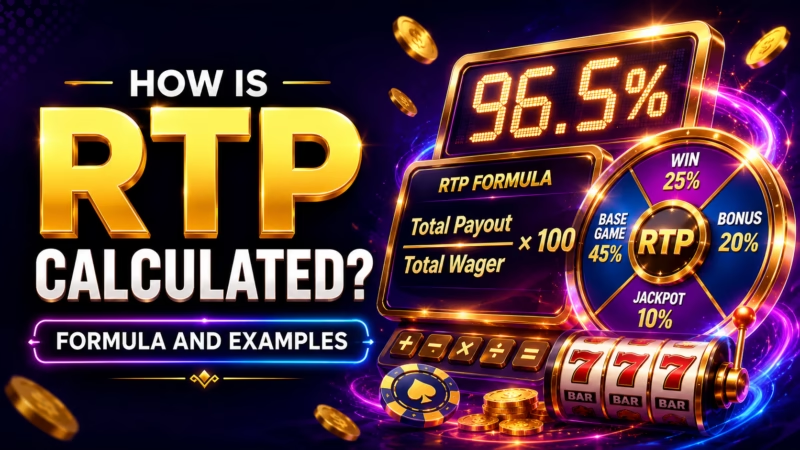
Expected loss = total amount wagered x (1 – RTP)
This formula describes a long-term statistical expectation. Actual RTP can remain above or below the theoretical value across a limited sample, particularly in volatile games.
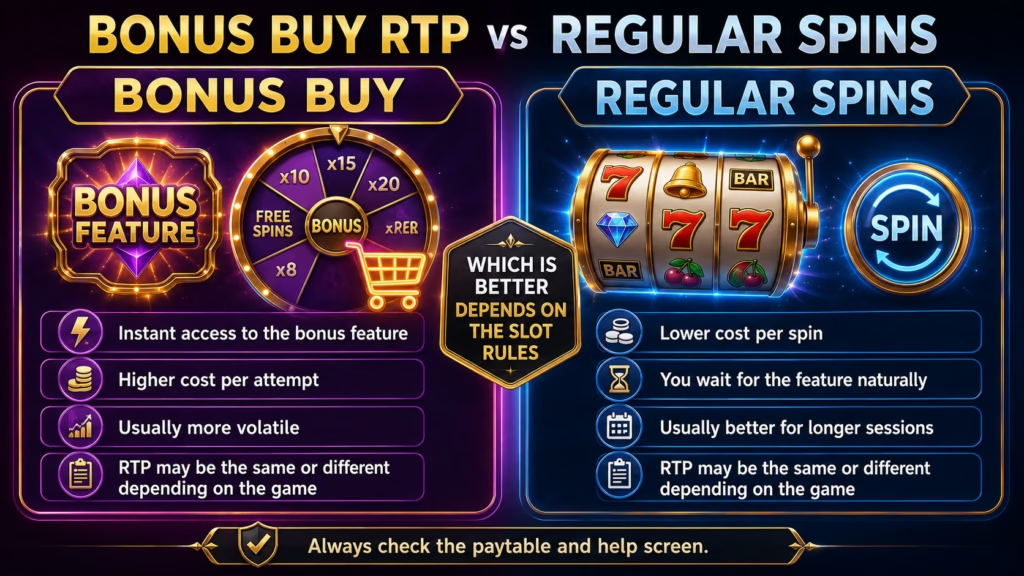
Bonus Buy vs Regular Spins Comparison
| Factor | Bonus Buy | Regular Spins |
| Feature access | Immediate access to the selected feature | Feature must normally trigger through the base game |
| Wager size | A large multiple of the standard bet | One standard wager per spin |
| RTP | May be higher, lower or equal depending on the game | Usually includes base-game wins and natural feature triggers |
| Short-term variation | Highly concentrated into fewer results | Distributed across more individual rounds |
| Session length | Bankroll can be spent quickly | Usually supports a longer session at the same bet level |
| Base-game experience | Mostly skipped | Fully included |
| Budget control | Requires strict limits because each purchase is expensive | Easier to adjust one spin at a time |
| Availability | Depends on the game, operator and jurisdiction | More widely available |
Bonus buy availability is not universal. Availability depends on the provider, game, casino and local market. Some developers offer purchased features only in selected jurisdictions, while other developers do not include bonus buys in their games.
When Is Bonus Buy RTP Mathematically Better?
Bonus buy RTP is mathematically better when its verified percentage is higher than the regular-spin RTP for the same slot version and the comparison uses equal total turnover.
Four conditions should be checked:
- The RTP values apply to the same game version. Casinos may offer different mathematical configurations of the same slot.
- The percentage applies specifically to the purchased feature. A general RTP displayed in the lobby may not describe every bonus option.
- The comparison uses equal wagering. A $100 purchase should be compared with $100 of regular spins, not with one base spin.
- The bonus buy price is included. The feature should be evaluated against its full cost, not against the underlying $1 bet.
Even when all four conditions are satisfied, “better” only means a lower theoretical house edge. It does not mean safer, more profitable or more likely to produce a winning session.
For example, an RTP of 96.5% represents a theoretical house edge of 3.5%. An RTP of 96% represents a theoretical house edge of 4%. Both modes still produce a negative long-term expectation for the player.
When Are Regular Spins the Better Choice?
Regular spins are usually better for bankroll control, longer playing time and a less concentrated experience. Each wager uses only the selected base bet, allowing the player to stop without committing a large amount to one feature.
Regular spins may be preferable when:
- The bankroll would cover only one or two bonus purchases.
- The mode-specific bonus buy RTP is not clearly disclosed.
- The player wants to experience the base-game mechanics.
- The RTP difference between the two modes is very small.
- The player is unfamiliar with the slot’s volatility.
- Spending speed is more important than immediate bonus access.
Regular spins do not remove gambling risk. A high-volatility slot can still consume a bankroll quickly through ordinary play. However, the ability to stop after any individual spin provides more control than repeatedly purchasing expensive features.
Does Buying a Bonus Increase the Chance of Profit?
A bonus buy increases the chance of entering a selected feature immediately, but it does not necessarily increase the chance of finishing the round with a profit.
The purchase price already reflects the mathematical value and probability distribution of the feature. A feature costing 100 times the bet is not required to return at least 100 times the bet. Many purchased bonuses may return less than their cost because occasional larger results contribute heavily to the theoretical RTP.
The game does not owe the player a stronger feature after a weak purchase. Previous wins and losses do not make the next independent random result more favorable.
RTP and Volatility Are Not the Same
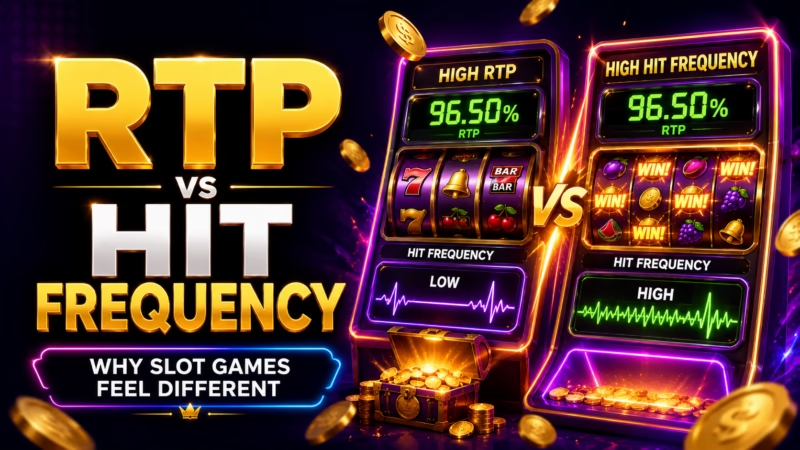
RTP measures the theoretical proportion of wagers returned over a large sample. Volatility describes how those returns may be distributed.
Two modes can have the same RTP but create very different experiences. One may produce frequent smaller returns, while the other relies more heavily on rare high-value outcomes. The long-term percentage can be similar even though the short-term results feel completely different.
Bonus buys often feel harsher because the wager is concentrated. Losing $100 through 100 separate $1 spins may take time and include several small wins. A $100 feature purchase can produce a result worth $10 within minutes. The net loss is similar, but the speed and presentation make the purchased feature feel more severe.
Volatility also explains why a limited sample cannot reliably confirm whether a mode is returning its advertised RTP. A much larger number of rounds is required before observed results begin to approach the theoretical model.
A Practical Bankroll Example
Suppose a player has a $200 entertainment budget and selects a $1 base bet.
If the bonus costs 100 times the bet, the bankroll allows only two purchases. Two poor bonus results could end the session almost immediately.
The same $200 could fund up to 200 regular spins before accounting for wins returned during play. The regular-spin session would include more individual outcomes and more opportunities to stop, reduce the bet or leave with the remaining balance.
Assume the regular RTP is 96% and the bonus buy RTP is 96.5%. Over $200 of turnover, the theoretical expected losses would be $8 for regular spins and $7 for bonus buys.
The bonus mode has only a $1 theoretical advantage over that amount of wagering. In an actual two-purchase session, random variation is far more influential than the $1 difference in expected loss.
This example shows why RTP should not be the only selection criterion. Bet concentration, volatility, purchase price and bankroll size may matter more during real short-term play.
Common Bonus Buy RTP Myths
“A purchased bonus should return at least its cost”
A bonus buy guarantees entry to the specified feature, not a minimum payout. The return can be lower or higher than the purchase price.
“Bonus buys always have better RTP”
Bonus buy RTP can be higher, lower or equal to regular-spin RTP. The exact value must be checked in the game information or paytable.
“A higher RTP means the next bonus is more likely to win”
RTP does not predict an individual result. A higher percentage changes the long-term mathematical expectation, not the guaranteed result of the next round.
“Several weak bonuses make a large win due”
Independent random rounds do not become more favorable because earlier purchases performed poorly. Increasing the bet or buying another feature to recover losses creates additional risk.
“The casino lobby RTP applies to every mode”
Some slots calculate different returns for different feature choices, enhanced spins or bonus purchases. The official game rules may provide a separate percentage for each option.
How to Compare Bonus Buy RTP Correctly
Before choosing between a bonus buy and regular spins:
- Open the official game information or paytable.
- Confirm the exact regular-spin RTP.
- Look for a separate RTP for each purchasable feature.
- Check whether the casino offers a reduced-RTP version.
- Convert the purchase price into a base-bet multiple.
- Compare both modes using equal total turnover.
- Review the volatility and maximum exposure.
- Set a fixed loss limit before starting.
- Do not increase the bet to recover a previous purchase.
- Stop when the planned budget or time limit is reached.
Players should avoid a bonus buy when the price, RTP or feature rules are unclear. A transparent paytable should explain what the purchase activates, how much it costs and whether different feature choices use different mathematical returns.
Which Option Is Better for Different Players?
Regular spins are generally more suitable for players with smaller bankrolls. The lower wager per round provides more control and usually extends playing time.
Bonus buys may suit players interested only in feature gameplay. This assumes the feature is available legally, the cost is understood and the player accepts that one result can consume a large percentage of the session budget.
The higher confirmed RTP is more relevant to mathematically focused players. The comparison must use mode-specific percentages and equal turnover.
Regular spins are better for learning a slot. They reveal the base-game hit pattern, symbols, modifiers and natural feature-trigger mechanics.
Neither option is suitable as a way to make money. Both retain a house edge, and all results remain random.
How This Information Was Reviewed
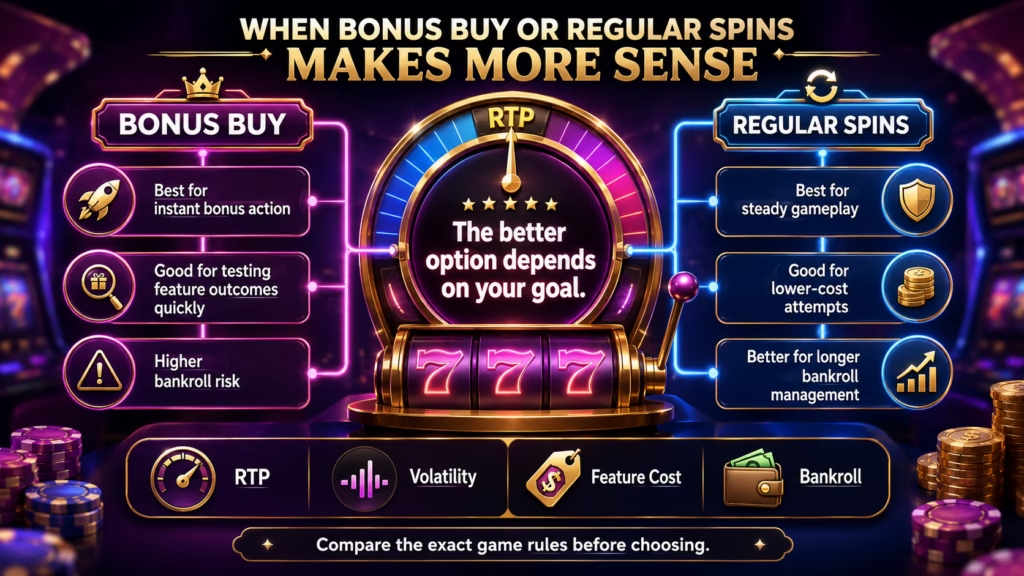
This comparison is based on mode-specific RTP, total turnover, feature cost, volatility, bankroll concentration and availability. Players should verify the current game version, paytable, regular-spin RTP and bonus buy RTP directly inside the slot because configurations can vary between operators.
RTP describes long-term theoretical performance and cannot guarantee the outcome of a spin or purchased feature. Volatility and random variation can produce substantial short-term losses even when a mode has a comparatively high RTP.
Online slots should be treated as paid entertainment rather than a source of income. Set spending and time limits before playing. Do not chase losses, borrow money to gamble or continue when gambling stops being enjoyable.
FAQ
Is bonus buy RTP usually higher than regular RTP?
Bonus buy RTP is sometimes higher, but there is no universal rule. Some slots use a higher return for purchased features, while others use the same or a lower percentage. Check the mode-specific value in the official paytable.
Does a bonus buy guarantee free spins?
A traditional bonus buy usually guarantees entry to the feature described on the purchase screen. It does not guarantee a minimum number of wins, a profitable result or a return equal to the purchase price.
How do I compare a bonus buy with regular spins?
Compare equal total wagering. A bonus costing 100 times a $1 bet should be compared with $100 of regular spins, not with a single $1 spin. Then compare the confirmed RTP and expected loss for each mode.
Can regular spins have better RTP than bonus buys?
Yes. The regular mode can have a higher RTP than the purchased feature. The exact relationship depends on the game’s mathematical model and the configuration selected by the operator.
Why can a bonus buy pay much less than it costs?
A bonus buy price is based on the complete distribution of possible results. Many features may return less than the cost, while less frequent larger outcomes contribute to the long-term average. No individual feature must return its theoretical RTP.
Does a failed bonus buy improve the next one?
No. A weak result does not make the next purchase more likely to perform well. Random slot outcomes are not influenced by the player’s previous wins or losses.
Are bonus buys available in every country?
No. Availability depends on local regulations, the casino, the game provider and the specific slot. A feature shown in one market may be removed or disabled in another.
Are bonus buys suitable for beginners?
Bonus buys are generally a poor starting point for beginners because they concentrate a large wager into one random feature. Learning the game through demo play or low-stake regular spins provides a clearer understanding of its mechanics without the same spending speed.
Brief Conclusion
Bonus buy RTP is better only when its confirmed mode-specific percentage is higher and the comparison uses equal total turnover. Even then, the advantage may be very small.
Regular spins usually offer stronger bankroll control and longer sessions. Bonus buys provide immediate feature access but concentrate risk and can deplete a budget quickly. Check the paytable, compare the exact RTP values and treat both options as entertainment rather than a strategy for profit.