
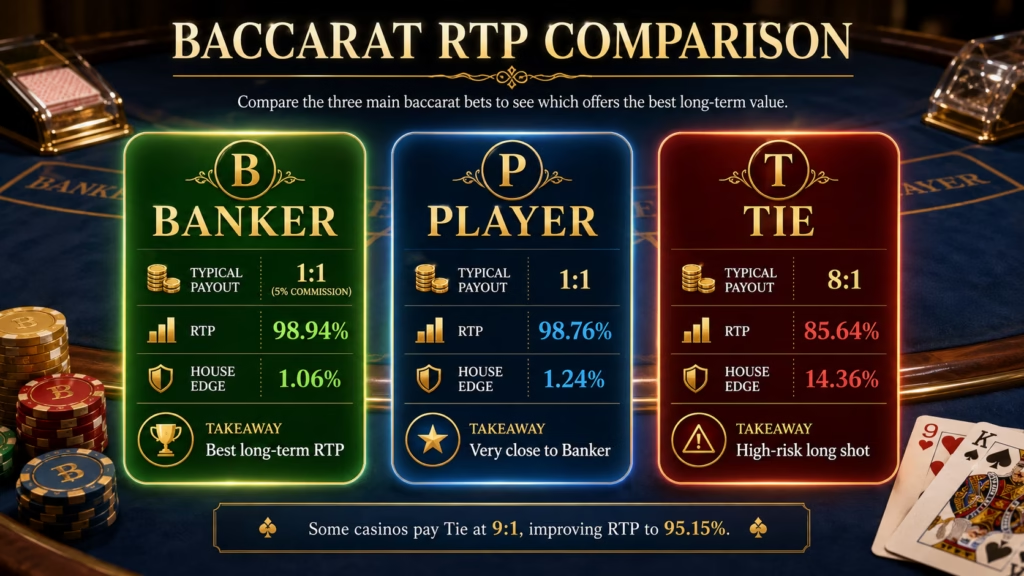
Baccarat RTP describes how much of the total money wagered a baccarat bet is expected to return over a very large number of rounds. In standard eight-deck commission baccarat, the Banker bet has an RTP of about 98.94%, the Player bet returns about 98.76%, and an 8:1 Tie bet returns only about 85.64%.
The practical conclusion is simple: the Banker bet normally offers the lowest baccarat house edge, the Player bet is a close second, and the Tie bet is usually much more expensive over time.
Quick takeaways
• Banker bet: approximately 98.94% RTP and 1.06% house edge.
• Player bet: approximately 98.76% RTP and 1.24% house edge.
• Tie bet at 8:1: approximately 85.64% RTP and 14.36% house edge.
• Banker wins normally pay 1:1 minus a 5% commission.
• RTP describes a long-term mathematical average, not the result of one session.
Baccarat may appeal to players who want a simple table game with few decisions during each round. The drawing rules are automatic, so the main choice is whether to bet on Banker, Player or Tie. Players should be more cautious with side bets and Tie bets because their attractive payouts can hide a much larger house advantage.
What Is Baccarat RTP?
Baccarat RTP is the theoretical percentage of wagers that a particular bet returns to players over a very large sample of rounds. An RTP of 98.94% means that the bet is mathematically expected to return $98.94 for every $100 wagered in the long run, including returned stakes and winnings.
This does not mean that every player will receive $98.94 after betting $100. A short session may end with a large win, a complete loss or almost no change. RTP becomes meaningful only across an extremely large number of statistically independent rounds.
The relationship between RTP and house edge is:
RTP = 100% – house edge
For example, a baccarat bet with a 1.06% house edge has an RTP of approximately 98.94%.
The house edge represents the casino’s theoretical advantage per unit wagered. It does not determine how quickly an individual player will lose, and it cannot predict what will happen in the next round.
Baccarat RTP and House Edge Comparison
The following figures apply to a common eight-deck baccarat game where Banker wins pay 0.95:1 after commission and Tie wins pay 8:1.
| Baccarat bet | Typical payout | Approximate RTP | Approximate house edge |
| Banker | 0.95:1 after commission | 98.94% | 1.06% |
| Player | 1:1 | 98.76% | 1.24% |
| Tie | 8:1 | 85.64% | 14.36% |
These percentages can change when a casino uses different deck numbers, commission rules, Tie payouts or baccarat variants. Players should check the game paytable and rules rather than assuming that every baccarat table has identical mathematics.
Banker Bet RTP
The Banker bet has an RTP of approximately 98.94% in standard eight-deck commission baccarat. This corresponds to a baccarat house edge of about 1.06%, which is slightly lower than the house edge on the Player bet.
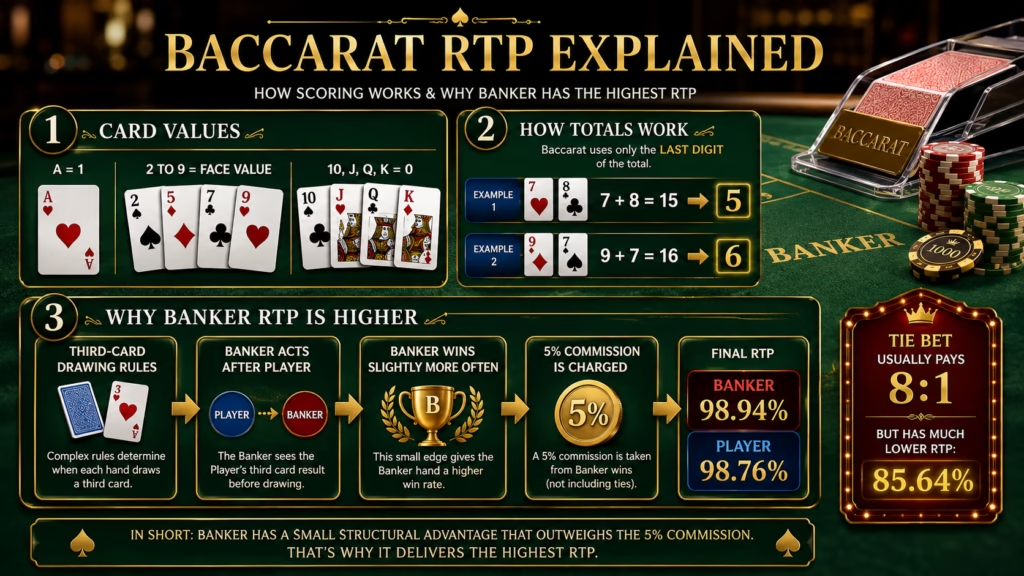
The Banker hand wins slightly more often because its drawing rules react to the Player hand’s third card. Players do not make these drawing decisions. The dealer or game software applies a fixed table of rules.
In a standard game, the possible Banker bet outcomes are:
- A Banker win normally pays 1:1 minus a 5% commission.
- A Player win loses the Banker wager.
- A Tie normally returns the original Banker wager without profit or loss.
The commission reduces a winning $100 Banker bet to a $95 profit rather than $100. Standard baccarat rules normally specify that winning Banker bets pay even money less a 5% house commission.
Why Banker Has the Highest RTP
The Banker bet has the highest standard baccarat RTP because the Banker hand wins about 45.86% of all rounds, while the Player hand wins about 44.62%. The remaining rounds are ties. The 5% commission reduces the value of Banker wins, but it does not completely remove the mathematical advantage created by the drawing rules.
The difference between Banker and Player is small. The house edge is approximately 0.18 percentage points lower on Banker. That difference becomes more noticeable as total wagering volume increases.
For example, over $10,000 in total wagers, the theoretical expected loss is approximately:
- $106 on Banker bets
- $124 on Player bets
- $1,436 on 8:1 Tie bets
These figures are mathematical expectations, not forecasts. An individual player could finish far above or below the expected result.
Player Bet RTP
The Player bet has an RTP of approximately 98.76% and a house edge of about 1.24% in a standard eight-deck game. A winning Player bet normally pays even money without commission.
The Player bet is straightforward:
- A Player win pays 1:1.
- A Banker win loses the wager.
- A Tie normally results in a push, so the original wager is returned.
Some players prefer the Player bet because its payout is easier to calculate. A $20 winning wager produces a $20 profit, while a standard Banker win produces $19 after the 5% commission.
The absence of commission does not make Player the mathematically stronger wager. The Player hand wins slightly less often, giving the casino a larger overall advantage despite the full even-money payout.
Is the Player Bet a Bad Choice?
The Player bet is not dramatically worse than Banker. Its house edge remains low compared with many casino side bets, and the difference between the two main baccarat bets is modest.
The Player bet may suit someone who values simple payouts and does not want to track commission. However, a player choosing only by mathematical return would normally select Banker in a standard commission game.
Tie Bet RTP
A standard Tie bet paying 8:1 has an RTP of approximately 85.64% and a house edge of about 14.36%. That makes the Tie wager considerably more expensive than either Banker or Player.
The high 8:1 payout can look attractive, but a Tie occurs in only about 9.52% of rounds in a typical eight-deck game. The payout is not high enough to fully compensate for how rarely the result occurs.
When a Tie bet wins at 8:1:
- A $10 wager produces an $80 profit.
- The original $10 stake is also returned.
- Banker and Player wagers are normally pushed.
The Tie bet can produce occasional larger payouts, but its lower RTP means that repeated Tie betting creates a much higher expected loss.
Does a 9:1 Tie Payout Improve RTP?
A Tie bet paying 9:1 has an approximate RTP of 95.16%, assuming the usual eight-deck outcome probabilities. This is much better than the 85.64% RTP of an 8:1 Tie bet, although it generally remains below the RTP of Banker and Player.
The difference between 8:1 and 9:1 is substantial because the underlying probability of a Tie remains the same while the winning payout increases.
Players should inspect the paytable carefully. A table labeled simply as baccarat may use an 8:1 Tie payout, a 9:1 payout or a different rule structure.
Why RTP Does Not Predict a Baccarat Session
Baccarat RTP does not tell a player what will happen during the next ten, fifty or one hundred rounds. RTP represents a theoretical average calculated across a very large number of outcomes.
A player could win several Banker bets in a row even though Banker has a house edge. Another player could lose immediately despite choosing the highest-RTP bet. Both results are compatible with the mathematics because short-term variance can be large.
The following statements are therefore incorrect:
- A 98.94% RTP guarantees that only 1.06% of a bankroll will be lost.
- Banker is due to win after several Player results.
- A scoreboard can predict the next hand.
- A betting system can remove the house edge.
- Increasing a wager after a loss changes the probability of the next outcome.
Past baccarat results do not force the next round to produce the opposite result. Scoreboards display history, but they do not change the fixed drawing rules or the probabilities of a freshly dealt hand.
Do Baccarat Betting Systems Improve RTP?
Betting systems do not change baccarat RTP. Martingale, Fibonacci, Paroli and pattern-based systems alter bet size or timing, but they do not change the probability of Banker, Player or Tie winning.
A progression system can create many small winning sessions followed by a much larger loss. Table limits, bankroll limits and long losing sequences prevent players from increasing bets indefinitely.
For example, a Martingale sequence starting at $10 becomes:
$10, $20, $40, $80, $160, $320 and $640
After six consecutive losses, the next wager must be $640, and the total amount already lost is $630. The underlying baccarat house edge remains unchanged throughout the sequence.
The only reliable way to reduce theoretical loss is to choose a lower-house-edge bet, reduce the amount wagered or stop playing. No staking pattern can convert a negative-expectation casino bet into guaranteed profit.
How Commission-Free Baccarat Changes the Calculation
Commission-free baccarat does not automatically offer a better Banker RTP. These variants usually replace the 5% commission with another rule, such as paying only 0.5:1 when Banker wins with a total of six.
The exact effect depends on the variant. Some no-commission formats have a Banker house edge close to the standard commission game, while others produce a noticeably different return.
Before playing commission-free baccarat, check:
- What happens when Banker wins with six.
- Whether any Banker result pushes instead of winning.
- The payout on Player and Tie.
- Whether special side bets are included.
- The number of decks used.
- Whether the displayed RTP applies to the base wager or a side bet.
A game should be judged by its full paytable, not by the words “commission-free.”
How to Choose Between Banker, Player and Tie
The Banker bet is normally the strongest choice when the goal is to minimize the mathematical house advantage in standard commission baccarat.
Choose Banker when:
- The game uses a normal 5% commission.
- You want the highest standard baccarat RTP.
- You are comfortable calculating commission.
- No unusual Banker payout rule is present.
Choose Player when:
- You prefer a simple even-money payout.
- You do not want to track Banker commission.
- You accept a slightly higher house edge.
Be cautious with Tie when:
- The payout is only 8:1.
- You plan to make the wager repeatedly.
- The large headline payout is influencing your decision.
- You have not checked the exact paytable.
The most important comparison is not the size of one possible win. It is the relationship between payout and probability over repeated wagers.
Common Baccarat RTP Mistakes
Confusing RTP With Win Probability
RTP includes both the probability of winning and the size of the payout. Banker has a higher win probability than Player, but its winning payout is reduced by commission. Tie has a much larger payout, but the result occurs much less frequently.
Ignoring Pushes
Banker and Player bets normally push when the two hands tie. A push returns the original wager and affects the overall expected return calculation.
Comparing Only Payouts
A high payout does not automatically mean good value. The 8:1 Tie payout is larger than the Banker and Player payouts, but its house edge is much higher.
Assuming Every Baccarat Table Is Identical
Different casinos and game providers may use alternative commission rules, Tie payouts, side bets and deck configurations. The RTP displayed in the game information should take priority over a general baccarat percentage.
Chasing Previous Losses
Increasing wagers to recover losses raises the amount of money at risk without improving baccarat RTP. A losing sequence can continue longer than a player’s bankroll or the table limit allows.
Practical Ways to Reduce Baccarat Risk
Choose Banker or Player instead of repeatedly betting on Tie or high-house-edge side bets. This does not create a winning strategy, but it reduces the theoretical cost of each wager.
Set a fixed money limit before starting. The limit should be an amount that can be lost without affecting rent, bills, savings or other essential expenses.
Set a time limit as well as a money limit. Faster online and live-dealer games can generate a high total wagering volume even when each individual bet is small.
Avoid increasing stakes because of frustration, excitement or a belief that a particular result is due. The next hand remains uncertain.
Responsible gambling guidance commonly recommends setting spending limits and using account controls when gambling begins to exceed the intended budget.
How This Information Was Reviewed
The comparison in this guide is based on standard baccarat payouts, common eight-deck outcome probabilities and the mathematical relationship between RTP and house edge.
Before playing, users should verify the following information in the game rules or paytable:
- Banker commission
- Banker six rules
- Player payout
- Tie payout
- Number of decks
- Side-bet payouts
- Published RTP
- Minimum and maximum wager
RTP and house edge describe long-term mathematical expectations. They do not guarantee a win, limit a possible loss or predict the outcome of a specific session.
Baccarat should be treated as paid entertainment rather than a source of income. Stop playing when a preset limit is reached, when gambling stops being enjoyable or when there is an urge to recover losses by increasing wagers.
FAQ
What is the highest baccarat RTP?
The Banker bet normally has the highest baccarat RTP at approximately 98.94% in standard eight-deck commission baccarat. The exact figure can change when a game uses different commission or payout rules.
What is the baccarat house edge on Banker?
The standard Banker bet has a house edge of approximately 1.06% after accounting for the usual 5% commission on winning Banker wagers.
What is the RTP of the Player bet?
The standard Player bet has an RTP of approximately 98.76%. Its corresponding house edge is about 1.24%, which is slightly higher than the Banker house edge.
Why does Banker charge commission?
Banker wins slightly more frequently because of the fixed drawing rules. The standard 5% commission reduces the payout and creates a house advantage while still leaving Banker with a marginally higher RTP than Player.
Is betting on Banker always better?
Banker is normally the mathematically strongest base bet in standard commission baccarat, but not every variant uses the same rules. Check the paytable for reduced payouts, Banker-six rules or other exceptions.
What is the RTP of an 8:1 Tie bet?
An 8:1 Tie bet has an approximate RTP of 85.64% in a standard eight-deck game. Its house edge is about 14.36%, making it much more expensive than Banker or Player over repeated wagers.
Is a 9:1 Tie bet worth considering?
A 9:1 Tie payout improves the theoretical RTP to approximately 95.16%, assuming standard eight-deck probabilities. It remains a volatile wager and usually offers a lower return than Banker or Player.
Can baccarat patterns predict the next winner?
Baccarat patterns cannot reliably predict the next winner. Scoreboards record previous results, but previous hands do not force Banker, Player or Tie to appear next.
Does Martingale improve baccarat RTP?
Martingale does not improve baccarat RTP. It changes the size of wagers after losses, but the probability and house edge of each bet remain the same.
Can a player make money from high-RTP baccarat?
A high RTP does not guarantee profit. Baccarat remains a negative-expectation casino game, and short-term outcomes can vary widely. Players should use strict limits and treat the game as entertainment.
Brief Conclusion
Standard commission baccarat offers approximately 98.94% RTP on Banker, 98.76% on Player and 85.64% on an 8:1 Tie bet. Banker is normally the most efficient base wager, while Tie carries a much larger house edge. These percentages describe long-term averages only and cannot predict or guarantee the result of an individual session.