
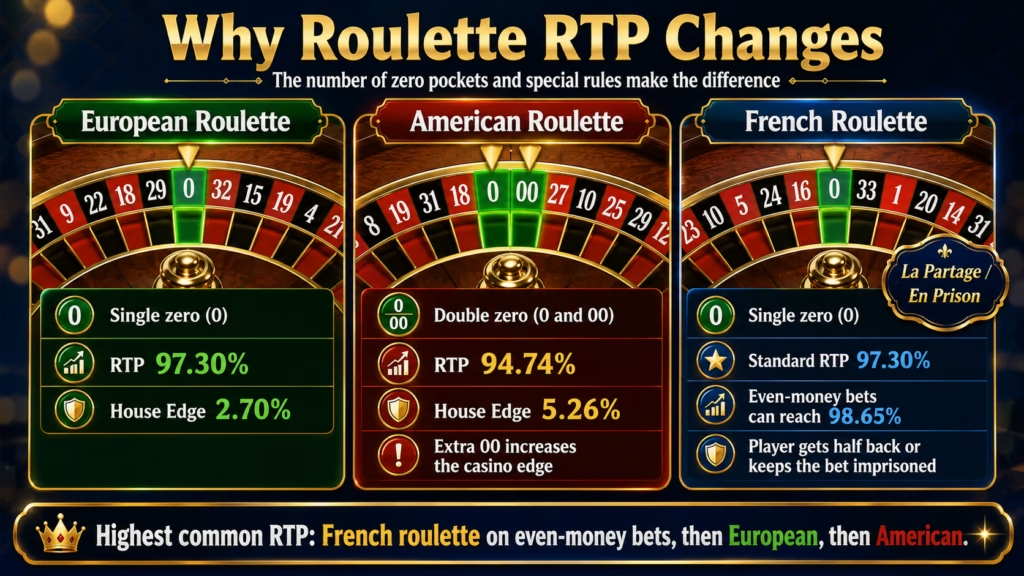
Roulette RTP depends mainly on the number of zero pockets and whether the table applies player-friendly rules such as La Partage or En Prison. European roulette normally has an RTP of 97.30%, American roulette has an RTP of 94.74% on most bets, and French roulette can reach 98.65% on even-money bets when La Partage or a comparable En Prison rule applies.
- European and French roulette use one zero, giving the casino a standard house edge of 2.70%.
- American roulette adds a double zero, increasing the standard house edge to 5.26%.
- La Partage can reduce the French roulette house edge to 1.35% on eligible even-money bets.
- Changing betting systems does not change the mathematical RTP of the roulette table.
- RTP describes theoretical long-term returns, not what will happen during one session.
European roulette is usually the strongest widely available option for players who want simple rules and a lower house edge. French roulette may offer better mathematical value, but only when its special rules apply. American roulette is generally less favorable because the additional double-zero pocket gives the casino a larger advantage.
What Is Roulette RTP?
Roulette RTP is the theoretical percentage of all money wagered that a roulette game returns to players over a very large number of spins. A roulette table with a 97.30% RTP is mathematically expected to retain approximately 2.70% of total wagers for the casino over the long term.
RTP does not mean that a player who wagers $100 will receive exactly $97.30 back. A short roulette session may end with a large win, a complete loss or a result close to the starting balance. The percentage becomes meaningful only across a very large sample of wagers.
The relationship between RTP and house edge is straightforward:
RTP = 100% minus the house edge
- 97.30% RTP equals a 2.70% house edge.
- 94.74% RTP equals a 5.26% house edge.
- 98.65% RTP equals a 1.35% house edge.
Roulette RTP is determined by the wheel layout, payout table and special rules. It is not improved by changing stake sizes, tracking previous numbers or switching between betting patterns.
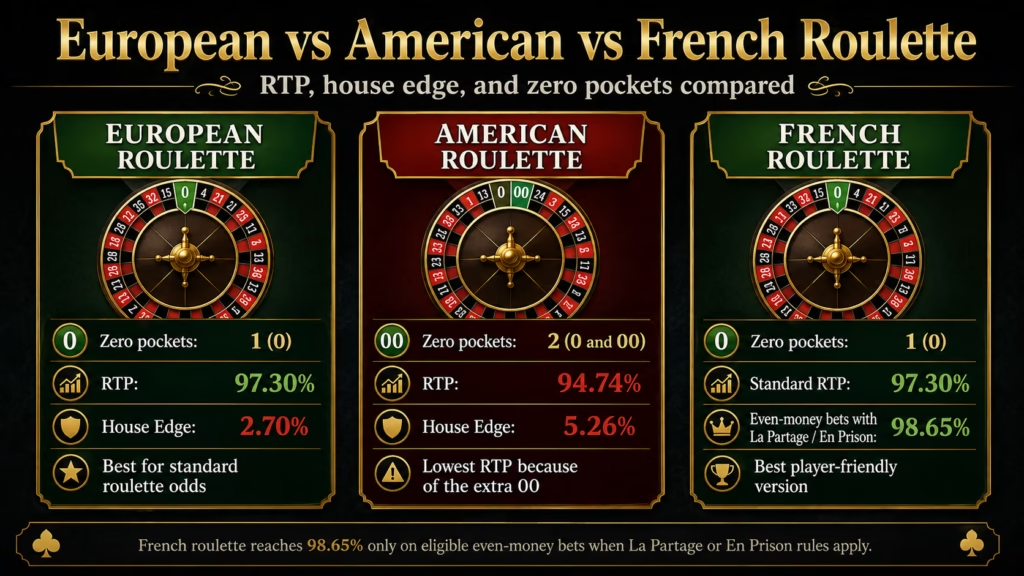
Roulette RTP Comparison
| Roulette version | Wheel pockets | Standard RTP | Standard house edge | Important exception |
| European roulette | 37 | 97.30% | 2.70% | Some tables may offer favorable zero rules |
| American roulette | 38 | 94.74% | 5.26% | The five-number bet has an even lower RTP |
| French roulette | 37 | 97.30% | 2.70% | Eligible even-money bets may reach 98.65% RTP with La Partage or En Prison |
The strongest standard option is European or French roulette because both use a single-zero wheel. French roulette becomes mathematically better for certain wagers when a favorable zero rule is available.
European Roulette RTP
European roulette has 37 pockets: numbers 1 to 36 and one green zero. Its standard RTP is 97.30%, which corresponds to a house edge of approximately 2.70%.
Consider a bet on red. The wheel contains 18 red numbers, 18 black numbers and one green zero. A red bet therefore wins on 18 of the 37 possible outcomes. Because the payout is 1:1, the zero creates the casino’s mathematical advantage.
The same 97.30% RTP generally applies to both inside and outside bets when the standard payout table is used. A straight-up bet on one number has a much lower chance of winning than a red or black bet, but its 35:1 payout compensates for most of that difference. The remaining disadvantage is still created by the zero.
European roulette may suit players who:
- Want a lower house edge than standard American roulette.
- Prefer a familiar wheel with straightforward betting options.
- Cannot find a French table with La Partage or En Prison.
- Want to compare different bets without changing the underlying RTP.
European roulette does not make individual spins more predictable. Every spin remains independent, and previous outcomes do not change the probability of the next result on a properly operating wheel or certified random number generator.
American Roulette RTP
American roulette has 38 pockets: numbers 1 to 36, a single zero and a double zero. Its standard RTP is approximately 94.74%, giving the casino a house edge of about 5.26% on most bets.
The additional double-zero pocket is the main reason American roulette offers a lower RTP. A red bet still covers 18 numbers, but it now loses when either zero or double zero appears. The probability of winning is therefore 18 out of 38 rather than 18 out of 37.
American roulette may look almost identical to European roulette, but the mathematical difference is significant. For every $1,000 wagered over the long term, the theoretical casino advantage is approximately:
- $27 on a standard European table.
- $52.60 on a standard American table.
These figures are theoretical averages, not guaranteed session losses. Actual short-term results can differ sharply because roulette has substantial variance.
The Five-Number Bet in American Roulette
The five-number bet covers 0, 00, 1, 2 and 3. It normally pays 6:1 and has a house edge of approximately 7.89%, which equals an RTP of about 92.11%.
This is less favorable than other standard American roulette bets. Players comparing roulette RTP should therefore pay particular attention to this wager rather than assuming every bet on the table has the same return percentage.
American roulette may still appeal to players who specifically enjoy the double-zero layout or play in locations where it is the main version available. From a purely mathematical perspective, however, European roulette is normally the better option when both games have otherwise equivalent rules.
French Roulette RTP
French roulette uses the same 37-pocket single-zero wheel as European roulette. Without special rules, French roulette therefore has the same standard RTP of 97.30% and a house edge of 2.70%.
The main difference is that French tables may offer La Partage or En Prison. These rules can reduce the casino advantage on eligible even-money bets.
Common even-money bets include:
- Red or black.
- Odd or even.
- Low numbers 1 to 18 or high numbers 19 to 36.
La Partage Rule
La Partage means that when the ball lands on zero, the player loses only half of an eligible even-money wager. The other half is returned.
This rule reduces the house edge on qualifying bets from approximately 2.70% to 1.35%. The corresponding roulette RTP becomes approximately 98.65%.
For example, suppose a player places $20 on red:
- If a red number wins, the bet pays normally.
- If a black number wins, the full $20 is lost.
- If zero wins, $10 is returned and $10 is lost under La Partage.
La Partage does not apply to every type of wager. Straight-up numbers, splits, streets and other inside bets generally continue to use the standard single-zero RTP.
En Prison Rule
En Prison usually allows an eligible even-money bet to remain on the table when zero appears. The wager is held for the next spin instead of being immediately lost.
If the following spin wins under the applicable table rules, the original stake may be returned without profit. If the following spin loses, the stake is lost. Exact procedures can differ, especially when zero appears again, so players should read the table rules before wagering.
Under common En Prison rules, the long-term house edge on eligible even-money bets can be reduced to approximately 1.35%. However, the exact treatment of repeated zeros and imprisoned wagers should always be checked with the operator.
European vs American vs French Roulette RTP
French roulette with La Partage is mathematically the strongest of the three common versions for even-money wagers. European roulette is the strongest straightforward alternative when favorable French rules are unavailable. American roulette provides the lowest standard RTP because of its double-zero pocket.
The practical ranking is:
1. French roulette with La Partage or favorable En Prison rules: approximately 98.65% RTP on qualifying even-money bets.
2. European roulette or standard French roulette: approximately 97.30% RTP.
3. American roulette: approximately 94.74% RTP on most bets.
4. American five-number bet: approximately 92.11% RTP.
This comparison assumes standard payouts. A nonstandard payout table can change the RTP, so the game rules should be reviewed before playing.
Do Different Roulette Bets Have Different RTPs?
Most bets on the same standard roulette table have the same RTP, even though their probabilities and payouts differ. A straight-up number is less likely to win than red or black, but it pays substantially more when successful.
For example, on a European wheel:
- A straight-up number wins on 1 of 37 outcomes and usually pays 35:1.
- A red bet wins on 18 of 37 outcomes and pays 1:1.
- A dozen bet wins on 12 of 37 outcomes and pays 2:1.
Each standard bet retains the same approximate house edge of 2.70%. The main exceptions are special rules, unusual side bets and wagers with nonstandard payouts.
Players should not confuse hit frequency with RTP. Outside bets win more frequently but pay smaller amounts. Inside bets win less frequently but offer larger payouts. The theoretical return can remain the same even when the playing experience feels very different.
Does a Roulette Strategy Change RTP?
No betting strategy can remove the built-in roulette house edge. Martingale, Fibonacci, D’Alembert and other progression systems change how much is wagered after wins or losses, but they do not change the probability of the ball landing on any number.
A progression system may create many small winning sessions followed by an occasional large loss. Table limits, bankroll limits and long losing sequences can prevent the player from continuing the progression.
Flat betting also does not increase RTP, but it makes spending easier to monitor because the stake remains consistent. Players who choose to play roulette should select a fixed entertainment budget rather than increasing bets to recover previous losses.
Common Roulette RTP Myths
“A number is due after not appearing”
A number that has not appeared recently is not more likely to win on the next independent spin. A properly operating roulette game does not compensate for previous outcomes.
“Outside bets have a higher RTP”
Outside bets usually have a higher hit frequency, not a higher standard RTP. Their lower payouts balance their greater probability of winning.
“American roulette offers larger payouts”
Standard American and European roulette bets normally use the same advertised payouts. American roulette simply has an extra losing pocket, which lowers its RTP.
“Online roulette has no house edge”
Online roulette still uses a defined payout model and house edge. Digital roulette may use a random number generator, while live roulette uses physical equipment, but neither format removes the mathematical advantage built into the rules.
“A high RTP predicts a winning session”
A higher RTP indicates a lower theoretical long-term casino advantage. It cannot predict whether a specific player will win or lose during a particular session.
How to Choose a Roulette Table
Choose a roulette table by checking the wheel, special rules, payout table and betting limits before placing a wager.
A practical checklist includes:
1. Count the zero pockets. Prefer one zero over zero and double zero.
2. Check for La Partage. This is particularly valuable for even-money bets.
3. Read the En Prison procedure. Confirm what happens after zero and repeated zero results.
4. Verify payouts. A straight-up number should normally pay 35:1.
5. Review minimum and maximum stakes. Avoid choosing a table that pressures you to exceed your budget.
6. Inspect side bets separately. Side bets may use a different RTP from the main roulette game.
7. Check the game information screen. Online operators should normally display rules, payouts and relevant technical information.
8. Set a loss and time limit. Stop when either limit is reached rather than trying to recover losses.
A French-style interface does not automatically guarantee a 98.65% RTP. The improved percentage applies only when a qualifying rule is active and the player uses an eligible even-money wager.
How This Information Was Reviewed
The comparison is based on standard roulette wheel layouts, conventional payouts and the mathematical effect of single zero, double zero, La Partage and En Prison rules.
Players should verify the exact wheel, payout table, side bets and zero rules inside the game before wagering. Operators may use different table configurations, and special rules may apply only to selected bets.
RTP represents a theoretical long-term average. It does not guarantee returns, reduce the randomness of individual spins or provide a reliable way to recover losses. Roulette should be treated as paid entertainment rather than a source of income. Players should use predetermined limits and stop if gambling becomes stressful, unaffordable or difficult to control.
FAQ
What is the highest roulette RTP?
French roulette with La Partage can offer an RTP of approximately 98.65% on eligible even-money bets. Inside bets generally retain the standard single-zero RTP of approximately 97.30%.
What is the RTP of European roulette?
European roulette normally has an RTP of approximately 97.30%. Its single-zero wheel gives the casino a standard house edge of about 2.70%.
What is the RTP of American roulette?
American roulette normally has an RTP of approximately 94.74% on most standard bets. The double-zero pocket increases the house edge to about 5.26%.
Why is American roulette RTP lower?
American roulette RTP is lower because the wheel contains both zero and double zero. These two green pockets create more losing outcomes without increasing the standard payouts.
Does French roulette always have a 98.65% RTP?
No. French roulette reaches approximately 98.65% RTP only on qualifying even-money bets when La Partage or an equivalent favorable En Prison rule applies. Other wagers generally remain at approximately 97.30%.
Is European roulette better than American roulette?
European roulette is mathematically more favorable because its house edge is approximately 2.70%, compared with about 5.26% on most American roulette bets. This does not guarantee a winning session.
Which roulette bet has the best RTP?
Most standard bets on the same roulette table have an identical RTP. On a French table with La Partage, eligible even-money bets can have a higher RTP than inside bets.
Do red and black have a 50% chance of winning?
No. On a European wheel, red and black each cover 18 of 37 pockets because zero is neither red nor black. On an American wheel, each covers 18 of 38 pockets because both zero and double zero are green.
Can the Martingale strategy improve roulette RTP?
No. Martingale changes the stake after a loss but does not change the probability of winning or the table’s RTP. Long losing sequences and table limits can cause large losses.
Is online roulette RTP different from casino roulette RTP?
The RTP can be the same when the online and land-based games use identical wheels, payouts and special rules. Players should check the specific game information because online variants, side bets and operator settings may differ.
Conclusion
European roulette normally returns 97.30% theoretically, while American roulette returns 94.74% on most bets. French roulette offers the strongest potential RTP at 98.65%, but only for eligible even-money bets under La Partage or favorable En Prison rules. Choosing a single-zero table reduces the casino’s mathematical advantage, but no roulette version or betting system can guarantee a win.