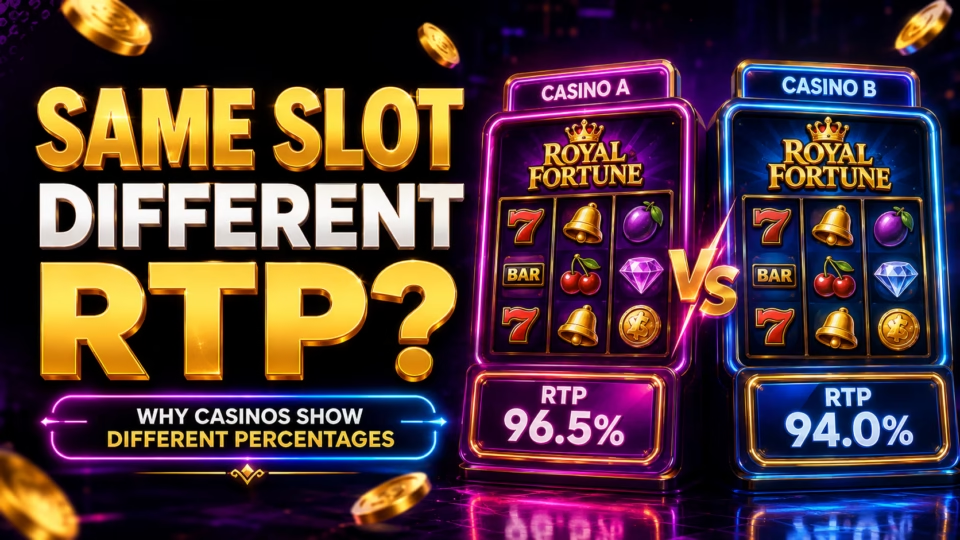
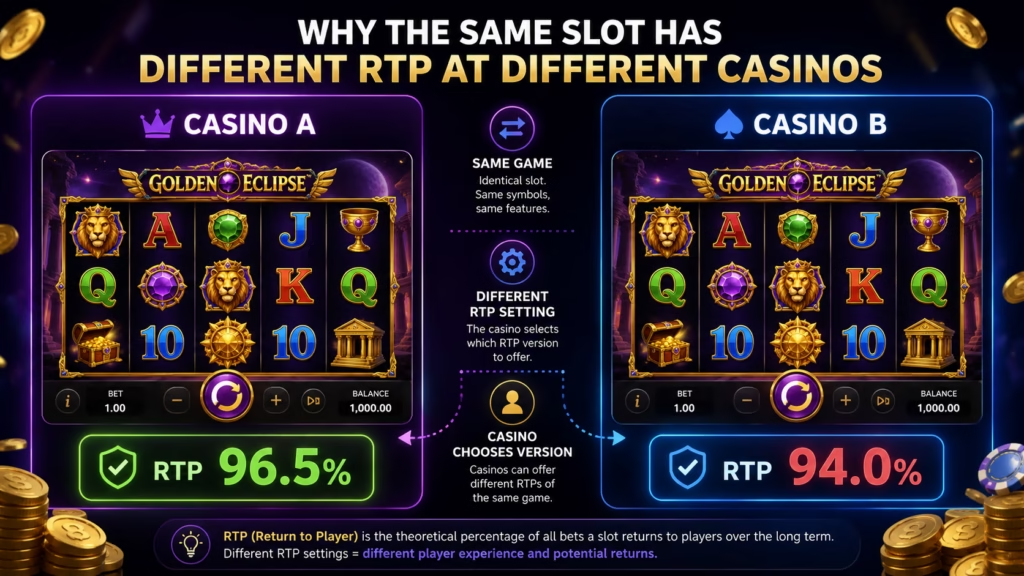
The same slot can have a different RTP at different casinos because some game providers create several approved mathematical versions of one title. The artwork, name, reels and bonus features may look identical, but the casino can receive a version with a different theoretical return.
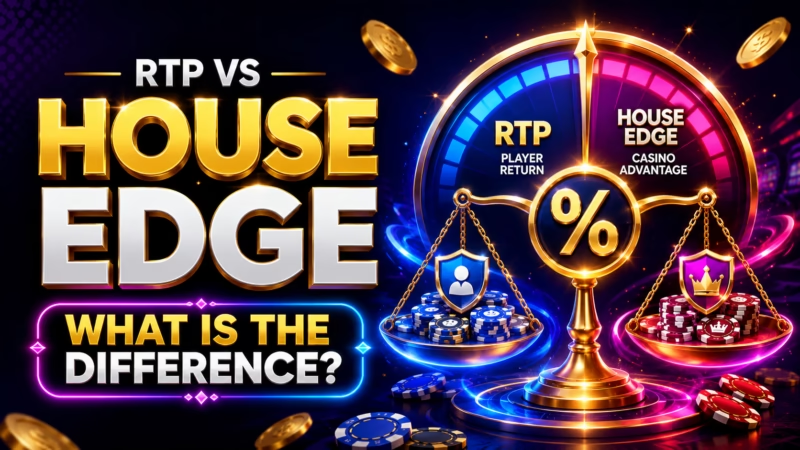
RTP, or Return to Player, represents the percentage of total wagers that a game is mathematically expected to return over a very large number of spins. It does not predict what one player will win or lose during a short session.
The main points are:
- A slot title does not always have one universal RTP.
- The provider, not the casino, normally develops the available mathematical configurations.
- The operator or platform may select an approved version for a particular casino or market.
- The active RTP should be checked inside the game rules, help screen or paytable.
- A higher RTP is mathematically more favorable, but it does not guarantee better results in a particular session.
This issue matters most to players comparing the same popular slot across several casinos. It is also useful for players who read reviews, because the RTP quoted in a review may describe the provider’s default version rather than the exact version available at a specific operator.
What Does “Same Slot, Different RTP” Mean?
A same slot different RTP situation means that two casinos offer the same game title but run different approved mathematical configurations.
For example, one casino might provide a version with a theoretical RTP of 96%, while another offers a 94% configuration. Both versions may use the same graphics, sounds, paylines and feature names. The difference is in the game mathematics that determine the expected long-term return.
Multiple RTP levels are not only theoretical. Some major providers certify or publish several RTP options for the same title, and certain game pages list more than one possible RTP value.
Not every slot has multiple operator-selectable versions. Some titles have one fixed RTP, while others have several configurations or different returns for separate betting modes.
How Multiple RTP Versions Are Created
A game provider can build several mathematical models for the same slot. Each model is designed to produce a particular theoretical return over a sufficiently large number of completed game rounds.
The provider may change one or more mathematical components, including:
- symbol probabilities;
- payout values;
- bonus trigger frequency;
- average bonus value;
- jackpot contribution;
- the probability of particular feature outcomes;
- the return assigned to an optional extra-bet or bonus-buy mode.
The exact adjustment depends on the provider and game. A lower-RTP version does not necessarily reduce every prize or make every bonus harder to trigger. The provider may change only selected probabilities or values while preserving the visible structure of the slot.
Independent testing laboratories can evaluate the paytable, possible combinations, bonus contributions, jackpots, volatility and expected return of the submitted model. Theoretical RTP may be calculated by evaluating possible outcomes or running large simulations based on game data supplied by the developer.
After approval, the different configurations can be distributed for use in permitted markets. A regulated operator should deploy an approved configuration rather than inventing its own unpublished payout model.
Why Do Casinos Choose Different RTP Versions?
Casinos usually choose between available RTP versions as part of their product and margin strategy.
A 96% slot has a theoretical house edge of 4%. A 94% version has a theoretical house edge of 6%. The lower version therefore gives the operator a larger expected margin across a large volume of wagering.
An operator may choose a lower configuration for several reasons:
Commercial Margin
A lower RTP increases the game’s theoretical contribution to casino revenue. This does not mean the casino will earn the predicted amount every day, because short-term results can vary significantly, but the mathematical difference becomes more relevant over a large number of rounds.
Market Conditions
Casino costs can differ by country. Licensing fees, gaming taxes, supplier charges and promotional expenses may affect the versions that an operator is willing to offer.
This does not mean that every high-tax market automatically receives lower RTP games. It means that market economics can influence operator decisions where several approved configurations are available.
Casino Positioning
Some operators compete through large game libraries, bonuses or loyalty programs. Others emphasize transparent game information and higher-RTP versions.
A casino offering more promotional value may still use lower game configurations. Conversely, a casino with modest bonuses may provide better mathematical versions of certain slots. Players should evaluate the game RTP and promotional terms separately.
Regional Rules
The same slot may not work identically in every jurisdiction. Bonus buys, jackpots, autoplay and other features may be restricted or unavailable in certain markets.
A regional version may therefore have a different feature set, certification or RTP calculation.
What Changes When a Slot Has a Lower RTP?
A lower RTP increases the casino’s theoretical advantage, but the difference may not be obvious from a few spins.
Consider two versions of the same game:
- Version A: 96% RTP and 4% theoretical house edge
- Version B: 94% RTP and 6% theoretical house edge
Across $1,000 in total wagering, the mathematical expected loss would be $40 in Version A and $60 in Version B. The difference is $20 per $1,000 wagered.
This is only a long-term statistical illustration. One player could finish ahead after using the 94% version, while another could lose heavily on the 96% version. RTP describes aggregated mathematical expectations, not a scheduled refund to an individual player.
The financial difference becomes more meaningful as total wagering increases. A player placing repeated $1 bets may cycle the same bankroll through hundreds or thousands of wagers, so total wagering can become much higher than the original deposit.
Does a Different RTP Mean the Slot Is Rigged?
A different RTP does not automatically mean that a slot is rigged. Multiple configurations can be legitimate when they were created by the provider, appropriately tested, permitted in the relevant jurisdiction and accurately disclosed.
However, legitimate does not mean equally valuable. A certified 92% version is still mathematically less favorable than a certified 96% version of the same game.
The important questions are:
1. Is the casino permitted to operate in the player’s jurisdiction?
2. Is the active RTP available in the game information?
3. Does the displayed figure apply to the selected betting mode?
4. Are optional jackpots, bonus buys or extra bets included in that figure?
5. Does the casino provide clear game rules before a real-money wager?
An operator that hides required information or displays a value that does not match the active game should be treated differently from a casino openly offering a lower but approved version.
RTP Does Not Predict a Short Slot Session
RTP should not be used to predict when a slot will pay or whether the next session will be profitable.
RTP is calculated over a long period and across game sessions played by many players. A short session may return more or less than the stated percentage. Slot outcomes are generated independently, so previous spins do not determine the result of the next spin.
A slot with 96% RTP does not return exactly $96 from every $100 deposited. The amount deposited is also not the same as total wagering. A player can reuse winnings, creating much more than $100 in total bets from a $100 starting balance.
RTP also should not be confused with volatility:
- RTP describes expected long-term return.
- Volatility describes the general distribution of wins.
- Hit frequency describes how often a winning result may occur.
- Maximum win describes the largest possible payout under the game rules.
Two slots can have the same RTP but feel completely different. One may produce frequent small wins, while another concentrates more of its return in rare bonuses or large prizes.
How to Check the Exact RTP at a Casino
The most reliable RTP is the figure shown inside the exact game version loaded by the casino.
Use this process before playing:
1. Open the slot without placing a real-money wager.
2. Select the information, help, rules or paytable button.
3. Search for “RTP,” “Return to Player,” “theoretical return” or “payout percentage.”
4. Check whether several betting modes have separate values.
5. Confirm whether a jackpot contribution, extra bet or bonus buy changes the return.
6. Repeat the check at every casino where you intend to play the title.
Do not rely only on the casino lobby, a search snippet or an old slot review. A provider may publish the highest or standard configuration, while an individual operator may use another available version.
Screenshots can be useful when comparing casinos because game configurations and displayed information may be updated. Record the casino, game title, displayed RTP, date and selected mode.
Common RTP Mistakes
The most common mistake is assuming that a familiar slot name guarantees familiar mathematics. Identical lobby artwork does not prove that two casinos offer the same configuration.
Another mistake is choosing a casino based on a provider-level RTP list. The provider’s website can identify possible or standard values, but the active in-game rules remain more relevant to the specific installation.
Players also sometimes assume that a lower RTP means fewer winning spins. That is not necessarily true. A provider could preserve hit frequency while reducing average payout value, or it could make another mathematical adjustment. The exact effect cannot be determined from the RTP percentage alone.
A welcome bonus also does not increase the slot’s built-in RTP. Bonus funds, free spins and wagering requirements are separate casino terms. They may change the overall value of an offer, but they do not normally rewrite the underlying mathematical model of the game.
How to Compare the Same Slot Across Casinos
Compare casinos in the following order:
1. Active in-game RTP
2. Applicable game mode
3. Casino licensing and market availability
4. Deposit and withdrawal conditions
5. Bonus wagering requirements
6. Bet limits and currency settings
7. Responsible gambling tools
A higher RTP is a meaningful advantage when the game, bet mode and other conditions are genuinely comparable. It should not be the only selection criterion, because withdrawal reliability, account rules and player-protection controls are more important than a small percentage difference.
Players who decide to gamble should set spending and time limits before starting. Slot outcomes remain random, and even a high-RTP game can produce a complete loss of the available balance. Slots should be treated as paid entertainment rather than a source of income.

How This Information Was Reviewed
This explanation is based on the mathematical definition of RTP, standard game-testing methodology, provider practices concerning multiple RTP configurations, published game specifications and regulatory disclosure principles.
The exact RTP of a particular casino installation must still be checked in its current game rules. RTP, volatility, bonus frequency and maximum win do not guarantee any individual result. Stop playing when gambling is no longer affordable or entertaining, and do not chase previous losses.
FAQ
Can the same slot really have different RTP at two casinos?
Yes. Some providers create several approved mathematical versions of one slot, and different operators may deploy different versions. The title and graphics can remain the same while the theoretical return changes. Check the RTP inside the game at each casino rather than assuming the provider’s headline figure applies everywhere.
Why do slots have different RTP at different casinos?
Slots have different RTP at different casinos mainly because providers may supply several certified configurations. Operators can select an available version based on market conditions, operating costs, commercial strategy and local requirements. Not every provider or game offers this choice.
Can a casino change a slot RTP whenever it wants?
A regulated casino should use an approved game configuration and follow applicable testing, change-control and disclosure requirements. Players should not assume that the RTP is being adjusted personally or after every spin. The active value should be treated as a defined version of the game, although operators may update their catalog or configuration over time.
Where can I find the real RTP of a slot?
Open the game’s information, help, rules or paytable menu. Look for Return to Player, RTP, theoretical return or payout percentage. Check the value before placing a wager and confirm whether optional modes have separate returns.
Is 96% RTP always better than 94% RTP?
A 96% RTP is mathematically more favorable than 94% when comparing the same game under equivalent conditions. Its theoretical house edge is 4% rather than 6%. It still cannot guarantee better results during a particular session.
Does demo mode have the same RTP as real-money mode?
Demo mode is often designed to represent the real game, but players should not assume that every casino demo uses the same configuration as its real-money version. Check both information screens where possible. Demo results also cannot predict future real-money outcomes.
Does a bonus buy change the RTP?
It may. Some games publish different RTP values for base play, extra-bet options, bonus buys or specific bonus modes. Other games use the same overall return. The correct answer must be checked in the rules of the exact version being played.
Does higher RTP mean more frequent wins?
No. Higher RTP does not necessarily mean a higher hit frequency. RTP measures the expected value returned over the long term, while hit frequency measures how often winning results occur. Prize size, volatility and feature distribution also affect how the game feels.
Can a high-RTP slot still take my entire balance?
Yes. RTP is not a loss limit or guaranteed refund. Random short-term variation can be substantial, particularly in high-volatility games. A player can lose the entire available balance even when playing a slot with a comparatively high theoretical return.
Brief Conclusion
The same slot can have a different RTP at different casinos because providers may produce several approved mathematical configurations of one title. The casino-specific in-game rules are more reliable than a general review or provider headline. Compare the active RTP before playing, but remember that no percentage can predict an individual session or guarantee a return.